55+ CommunitiesDel WebbSaint Johns FLNew ConstructionActive Adult Living

Cleared for Landing: Del Webb at The Landings Is Saint Johns County's Most Exciting 55+ Community — And the Perks Are Sky-High

Everything you need to know about the hottest new active adult community in Northeast Florida, including how to get up to $1,500 back when you buy.

GD
Gail DeMarco
Your Over-55 REALTOR® | eXp Realty | St. Johns County Specialist 904-640-8000


If you have ever dreamed of trading winter coats for sunshine, trading traffic for pickleball, and trading the old chapter for the best one yet — your runway is ready. Del Webb at The Landings in Saint Johns, Florida is officially open, and it is turning heads, dropping jaws, and filling up fast.

I am Gail DeMarco, your dedicated Over-55 REALTOR® in St. Johns County, and I have toured this community with buyers from across the country. Let me tell you this one is different. This one has that feeling. Read on to find out why Del Webb at The Landings might just be your final destination.


A Storied Legacy Lands in Saint Johns County

Del Webb is not just a builder it is a legacy. Founded in 1960 by Arthur Minshall and named after Del E. Webb, the company pioneered the concept of age-restricted active adult living in the United States with the original Sun City community in Arizona. Del Webb did not just build homes it invented an entirely new way to live in retirement, one that centered on community, activity, friendship, and purpose.

More than six decades later, Del Webb, now a flagship brand under PulteGroup — one of the nation's largest homebuilders continues to raise the bar for 55+ communities. And in 2024, PulteGroup made a bold move: it acquired 963 acres in northern St. Johns County to create The Landings at Saint Johns, a master-planned community that would become home to both The Landings by Pulte Homes and the crown jewel  Del Webb Saint Johns.

Ground broke in the summer of 2024 south of Greenbriar Road and west of Longleaf Pine Parkway, and sales launched in 2025. The response from buyers? Exactly what you would expect when Del Webb enters one of the fastest-growing counties in the entire country.

"St. Johns County is the most sought-after destination for relocating retirees from the Northeast and Midwest and Del Webb at The Landings is the community they have been waiting for." Gail DeMarco, Over-55 REALTOR® 904-640-8000

✈️ Why "The Landings"? This Community Has Aviation in Its DNA


From the moment you turn into the community, you notice it. The street names are not ordinary they are intentional. Contrail Court. Skipping Stone Court. These names are a nod to the golden age of aviation, evoking freedom, lift-off, and the thrill of a destination reached.

The community name itself The Landings is a love letter to everyone who has spent decades in the climb and is now ready to touch down somewhere truly spectacular. You have worked hard, raised families, built careers, navigated turbulence. Now it is time to land somewhere that actually deserves you.

This aviation theme runs through the spirit of the entire development: a sense of adventure, of arrival, of beginning something magnificent. And when you see the amenity center for the first time, the metaphor becomes very literal because it looks like it belongs on a cruise ship, not a subdivision. More on that in a moment.


Del Webb at The Landings: What You Need to Know

Del Webb Saint Johns is a gated, 55+ active adult community featuring up to 761 single-family homes on generous 50-foot and 65-foot homesites. Many lots offer stunning water and preserve views. Homes range from approximately 1,600 to 3,800 square feet, with 15 thoughtfully designed floor plans across three collections Classics, Estate, and Distinctive to suit a variety of lifestyles and budgets.

Pricing starts in the low $400,000s and reaches the upper $800,000s for larger estate homes with premium finishes. Every home is built with Del Webb's signature open-concept design philosophy, gourmet kitchens, indoor-outdoor living spaces, and energy-efficient construction.

Community Quick Facts

  • Up to 761 single-family homesites (55+ age-restricted)
  • 50' and 65' lot options, many with water or preserve views
  • 15 floor plans from 1,600 to 3,800+ sq ft
  • Pricing from the low $400,000s to the upper $800,000s
  • Located south of Greenbriar Road, west of Longleaf Pine Pkwy, NW St. Johns County
  • Zoned for A-rated St. Johns County Schools (great for visiting grandkids!)
  • New Publix grocery store less than 2 miles away
  • 15 minutes to Durbin Pavilion shopping, dining, and movies
  • 35 minutes to Historic Downtown St. Augustine
  • Minutes from the St. Johns River for boating, fishing, and watersports
  • Close proximity to stunning St. Johns County beaches and TPC Sawgrass

🚢 The Amenity Center That Looks Like a Cruise ShipThe flagship Del Webb Saint Johns amenity center a resort experience you never have to check out of.

Let me paint you a picture. You wake up in your beautiful new Del Webb home. You walk across the street to an amenity center that looks like it belongs anchored in the Caribbean. And then you realize  you never have to leave. This is your life now.

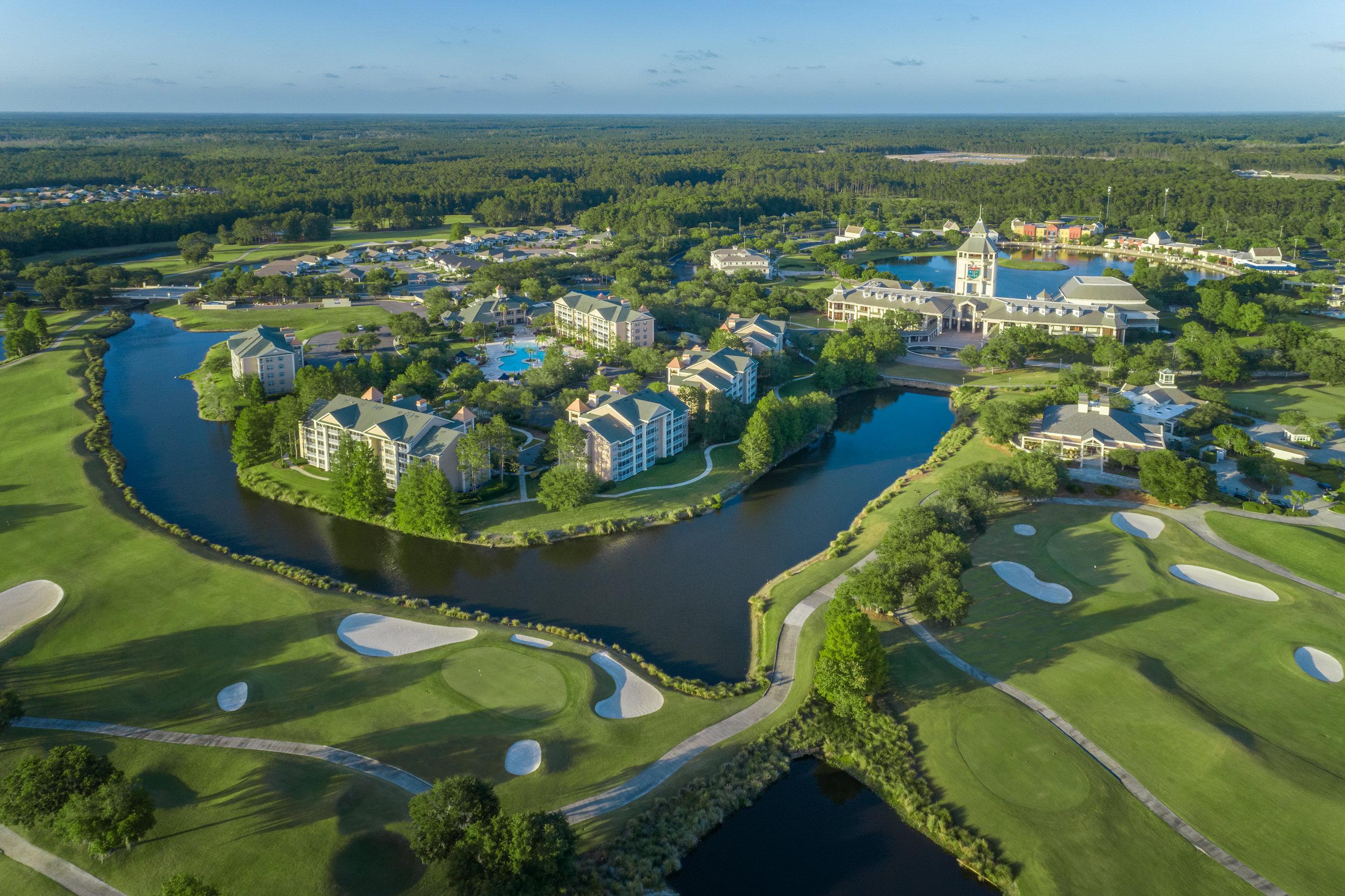
The Del Webb Saint Johns amenity center sits on a sprawling 11-acre private campus and features a flagship clubhouse of approximately 19,000 square feet a space so grand and so beautifully designed that residents consistently describe it as something you would find on a luxury cruise ship. This is not your grandmother's recreation room. This is resort living, full stop.

Amenity Center Highlights

  • 19,000 sq ft flagship clubhouse (cruise-ship level design)
  • Resort-style pool with zero-entry access and outdoor spa
  • Innovative state-of-the-art fitness center
  • On-site Tavern and Grill (your new favorite neighborhood spot)
  • Pickleball courts and multi-sport courts
  • Grand ballroom for events, dances, and celebrations
  • Community garden
  • Full-time Del Webb Lifestyle Director to organize clubs and activities
  • RV and boat storage parking available for a fee
  • Walking trails and outdoor recreation spaces

The RV and boat storage is a detail that gets buyers from Florida's coastal communities and snowbirds from the Midwest genuinely excited. You no longer have to choose between the community you love and the adventures you live for. Bring the RV. Bring the boat. Park them right here.


The HOA Fee That Actually Makes Sense

HOA fees get a bad reputation but not all HOA fees are created equal. When you look at what is included at Del Webb at The Landings, the math becomes very clear very fast.

$298
Per Month HOA Fee
High-Speed Internet Included
🚤
RV & Boat Parking Available (fee)
🎉
Full Resort Amenity Access

At $298 per month, residents receive access to all community amenities plus high-speed internet service included in the HOA. When you factor in what you would pay separately for internet, club memberships, gym access, and recreational facilities in a typical retirement scenario, this number is a genuine bargain for the lifestyle on offer.

And for those with RVs, boats, or watercraft  additional parking is available within the community for a separate fee, giving you the security and convenience of keeping your adventure equipment close to home.


🔥 Builder Promotions Change Every Single Month

Del Webb at The Landings runs some of the most aggressive and exciting new construction incentive packages in Northeast Florida — and they are updated monthly. These promotions can include closing cost contributions, design upgrade allowances, interest rate buydowns, and more. The best deals are time-sensitive and go fast.

The only way to know what is available right now is to call someone who is tracking it daily.

As your Over-55 specialist, I monitor Del Webb's promotions, pricing adjustments, and inventory in real time. I will make sure you never leave money on the table and never miss a window. These incentives are not advertised loudly they reward buyers who are working with the right agent at the right time.


Why Saint Johns County? Let Me Count the Ways.

St. Johns County is consistently ranked among the best places to live in Florida and in the entire United States. It holds the distinction of having some of Florida's highest-rated public schools, some of the lowest crime rates in the state, and a quality of life that attracts buyers from New York, New Jersey, California, Illinois, and beyond. For retirees relocating to Northeast Florida, Saint Johns is almost always the answer.

Here is what makes the location of Del Webb at The Landings particularly powerful:

Location Highlights

  • Minutes from the St. Johns River for boating, fishing, and kayaking
  • 30 to 40 minutes from world-class St. Johns County beaches
  • 35 minutes to Historic Downtown St. Augustine, the oldest city in America
  • 25 minutes to St. Johns Town Center and St. Augustine Premium Outlets
  • Near TPC Sawgrass, home of The Players Championship
  • Jacksonville International Airport approximately 30 minutes north
  • World-class healthcare systems including Mayo Clinic Jacksonville nearby
  • No Florida state income tax
  • Homestead exemption available for Florida primary residents

Frequently Asked Questions About Del Webb at The Landings

Is Del Webb at The Landings age-restricted?

Yes. Del Webb Saint Johns is a 55+ age-restricted community. At least one resident per household must be 55 or older, and no permanent residents under the age of 18 are permitted.

What is the HOA fee and what does it include?

The HOA fee is $298 per month when the amenity center is open and now it is $150 a month and includes high-speed internet service plus access to all community amenities. RV and boat parking storage is available for an additional fee.

Are homes still available?

Del Webb at The Landings is actively selling, with inventory moving quickly. Available homesites, floor plans, and move-in timelines vary by phase. Call me directly for current inventory status.

What are the current builder promotions?

Del Webb's incentive packages change every month and can be substantial covering closing costs, design upgrades, or rate buydowns. Call Gail for the most current promotions before they change.

Can I visit and tour the community?

Absolutely. Model homes are open daily. I can coordinate your tour and give you an independent, expert perspective on every floor plan and homesite at no cost to you.

Do I need a buyer's agent to purchase a Del Webb home?

You are not required to have one, but you absolutely should. The builder's on-site sales team represents the builder not you. Having your own Over-55 specialist in your corner protects your interests, ensures you get the best available promotion, and costs you nothing extra.


Ready to Land? Call Your Over-55 REALTOR® Today

Hi, I am Gail DeMarco — Team Lead of the Coast to Coast Team at eXp Realty, licensed in Florida and California, and the dedicated Over-55 specialist for St. Johns County. I have helped hundreds of active adults find their perfect community in Northeast Florida, and Del Webb at The Landings is one I am genuinely excited about.

I tour these communities. I track the promotions. I know the homesites. And I work for you — not the builder.

✈️ EXCLUSIVE BUYER PERK: When you purchase your Del Webb home through me, you can receive UP TO $1,500 BACK toward your travel expenses to tour the community. Your next chapter should not cost you to discover.

Promotions change monthly. Inventory moves fast.

Let's talk today. 904-640-8000


📞 Call Gail Now 💬 Send a Message

Gail DeMarco | eXp Realty | FL DBPR #SL3527532 | CA DRE #01933515
Coast to Coast Team | MoveToStJohnsFl.com

The Bottom Line on Del Webb at The Landings

Del Webb at The Landings in Saint Johns, Florida is not just another 55+ community. It is a masterfully designed active adult destination built by the nation's most trusted brand in retirement living, in one of the most desirable counties in all of Florida. With a flagship amenity center that rivals any luxury resort, a $298/month HOA that includes internet, RV and boat storage options, monthly builder promotions that genuinely move the needle, and a location that connects you to beaches, history, rivers, and world-class dining this is the whole package.

And if you work with me, you get up to $1,500 back on travel expenses just for making the trip to see it in person.

The runway is clear. The weather is perfect. It is time to land.

Call or text Gail DeMarco at eXp Realty your Over-55 REALTOR® for St. Johns County and let's get you into Del Webb at The Landings before the best homesites are gone. Visit MoveToStJohnsFl.com to learn more.
July 3, 2026

Palencia vs. Ponte Vedra Beach: Same Zip Code Energy, Very Different Price Tags

If you're relocating to St. Johns County, chances are you've come across both Palencia and Ponte Vedra Beach. On the surface, they seem similar—great schools, beautiful homes, golf, and an exceptional quality of life.

But there's one major difference:

Ponte Vedra Beach offers a prestigious coastal address. Palencia delivers a similar lifestyle at a significantly lower price point.

Here's a simplified comparison to help you decide which community best fits your goals and budget.


Quick Overview

Ponte Vedra Beach (ZIP 32082)

Ponte Vedra Beach is one of Northeast Florida's most desirable coastal communities. It's home to renowned destinations like the TPC Sawgrass, THE PLAYERS Championship, Ponte Vedra Inn & Club, and Marsh Landing Country Club.

You'll find:

  • Oceanfront and golf course homes
  • Established neighborhoods with mature landscaping
  • Direct beach access
  • Some of the county's most sought-after schools

Palencia (ZIP 32095)

Located just north of St. Augustine, Palencia is a master-planned community built around golf, recreation, and walkability.

Highlights include:

  • Private golf club
  • Resort-style amenities
  • Miles of trails
  • Kayak launch access
  • An on-site elementary school
  • Strong schools throughout the community

Location Comparison

Destination Ponte Vedra Beach Palencia
Jacksonville Airport 30–35 min 35–40 min
Downtown Jacksonville 25–30 min 30–35 min
Beach Access 5–10 min 25–30 min
Historic St. Augustine 30–35 min 10–15 min
TPC Sawgrass 5 min 20–25 min
I-95 Access 20 min 5–8 min

Best Fit:

  • Choose Ponte Vedra Beach if being close to the ocean is a top priority.
  • Choose Palencia if convenience, St. Augustine access, and easy commuting matter more.

Home Prices: The Biggest Difference

Ponte Vedra Beach

Home Type Typical Price
Entry-Level Homes $620,000–$800,000
Mid-Range Homes $800,000–$1.2M
Golf/Waterfront Homes $1.2M–$2.5M+
Oceanfront Estates $3M–$10M+

Average Home Value: Approximately $850,000–$950,000

Palencia

Home Type Typical Price
Townhomes / Entry-Level $380,000–$520,000
Mid-Range Homes $520,000–$750,000
Golf & Premium Lots $750,000–$1.1M
Estate Homes $1.1M–$2M

Average Home Value: Approximately $580,000–$650,000

Bottom Line

A buyer with a $650,000 budget can often purchase a well-appointed 3–4 bedroom home in Palencia.

In Ponte Vedra Beach, that same budget typically buys an older entry-level home and may require updates.


Amenities

Ponte Vedra Beach

The Ponte Vedra lifestyle revolves around private clubs and beach access.

Popular options include:

  • TPC Sawgrass
  • Ponte Vedra Inn & Club
  • Marsh Landing Country Club
  • Public beach access points

Many of these amenities require separate memberships and initiation fees.

Best For:

Buyers seeking a luxury coastal lifestyle and world-class golf access.


Palencia

Palencia includes many amenities directly within the community:

  • Resort-style pool
  • Lap pool
  • Fitness center
  • Tennis and pickleball courts
  • Walking and biking trails
  • Kayak launch
  • Community events
  • Private golf club (optional membership)

HOA fees generally range from $165–$225 per month.

Best For:

Buyers who want a complete lifestyle package without additional club costs.


Schools

Both communities are located within the highly rated St. Johns County School District, ranked among the best in Florida.

Ponte Vedra Beach Schools

  • Ponte Vedra Palm Valley Elementary
  • Alice B. Landrum Middle School
  • Ponte Vedra High School

Ponte Vedra High is consistently recognized as one of Florida's top public high schools.

Palencia Schools

  • Palencia Elementary (located within the community)
  • Pacetti Bay Middle School
  • Allen D. Nease High School

Nease High School offers:

  • International Baccalaureate (IB) Program
  • Dual enrollment opportunities
  • Strong college placement rates

School Advantage

Ponte Vedra Beach has a slight edge in school prestige.

However, many families love Palencia because children can walk or bike to Palencia Elementary, a rare convenience in Florida.


Golf Comparison

Ponte Vedra Beach

Golf here is legendary.

Options include:

  • TPC Sawgrass
  • Dye's Valley Course
  • Ponte Vedra Inn & Club
  • Marsh Landing

The experience is world-class—but often comes with premium pricing.

Palencia

The Palencia Club features an Arthur Hills-designed championship course winding through marsh and preserve views.

Membership costs are generally much lower than Ponte Vedra's elite private clubs, making it one of Northeast Florida's best golf values.


Community Personality

Ponte Vedra Beach

Ponte Vedra feels established, prestigious, and coastal.

People move here for:

  • Beach access
  • Top-ranked schools
  • Luxury clubs
  • The prestige of the address itself

Palencia

Palencia feels intentional, active, and family-oriented.

People move here for:

  • Strong value
  • Community amenities
  • Golf and recreation
  • Walkability
  • Excellent schools

Many buyers are surprised to discover Palencia becomes their favorite community after touring it.


Side-by-Side Snapshot

Category Ponte Vedra Beach Palencia
Average Home Value $850K–$950K $580K–$650K
Entry-Level Price $620K+ $380K+
Property Taxes Higher Lower
Beach Access Excellent Moderate
Golf Prestige Elite Strong Value
On-Site Elementary School No Yes
St. Augustine Access 30–35 min 10–15 min
Best For Beach, prestige, top schools Value, amenities, lifestyle

Which Community Should You Choose?

Ponte Vedra Beach May Be Right for You If:

✔ Beach access is non-negotiable
✔ You want a prestigious coastal address
✔ Top-ranked schools are a priority
✔ Your budget comfortably exceeds $800,000

Palencia May Be Right for You If:

✔ You want more home for your money
✔ You prefer a master-planned community lifestyle
✔ An on-site elementary school appeals to your family
✔ You want strong schools, golf, and amenities without Ponte Vedra pricing


The Bottom Line

Ponte Vedra Beach is one of the most desirable addresses in Florida — and it is priced accordingly. For buyers for whom prestige, beach proximity, and the PVH school zone are the priorities, the premium is justified.

But for buyers who are making a rational, value-driven decision about where to live well in St. Johns County — Palencia consistently delivers more lifestyle per dollar than almost any other community in the county. The schools are excellent. The golf is accessible. The community design is thoughtful. And the savings relative to Ponte Vedra Beach are real and significant.

I've helped buyers make this decision many times. Sometimes Ponte Vedra Beach is the right answer. Often Palencia surprises people — and they don't look back.

Call or text Gail DeMarco: 904-640-8000 St. Johns County Relocation Specialist Serving Palencia, Ponte Vedra Beach, Nocatee, RiverTown, St. Augustine, and all of St. Johns County, FL


All home values, fees, and tax figures are approximate 2026 estimates based on local market data and public records. Individual results vary. Always verify current pricing with your agent and the St. Johns County Property Appraiser. School zone assignments subject to change — verify directly with St. Johns County School District.

Posted in Market Updates
July 1, 2026

Nocatee vs. RiverTown: Which St. Johns County Master-Planned Community Is Right for Your Family in 2026?

If you've been researching a move to St. Johns County, you've almost certainly landed on these two names: Nocatee and RiverTown.

Both are master-planned communities in St. Johns County. Both have excellent schools, resort-style amenities, and the kind of lifestyle that makes relocating families from New Jersey and New York stop mid-tour and ask, "Wait — people actually live like this?"

But they are not the same — and the right choice depends entirely on who you are and how you want to live.

Here's the honest comparison.


What Each Community Actually Is

Nocatee (ZIP 32081 · Ponte Vedra) One of the top-selling master-planned communities in the entire United States. It spans ~15,000 acres with dozens of villages, its own Town Center retail district, restaurants, medical offices, and an amenity footprint that has to be seen in person. Nocatee is essentially a city within a community.

RiverTown (ZIP 32259 · St. Johns) A nature-first waterfront community built along the western bank of the St. Johns River. Smaller and more intimate — approximately 4,000 homes at buildout. Its entire identity is shaped by the river. RiverTown is not trying to be Nocatee. That's the point.


Location & Commute

Destination Nocatee RiverTown
Jacksonville Airport ~35–40 min ~45–55 min
Downtown Jacksonville ~25–30 min ~35–40 min
Ponte Vedra Beach ~10–15 min ~25–30 min
St. Augustine ~25–30 min ~20–25 min
I-95 access ~15 min ~10 min

Bottom line: Nocatee wins for Jacksonville commuters and frequent flyers. RiverTown works well for remote workers and those oriented toward St. Augustine and I-95.


Amenities

Nocatee

  • Full Splash Water Park with slides, lazy river, and resort pools
  • Nocatee Town Center — walkable shops, dining, medical, accessible by golf cart
  • 15+ miles of trails connecting the entire community
  • Multiple fitness centers, dog parks, sports courts, and event pavilions
  • Full-time lifestyle programming team
  • Golf cart culture is genuinely part of daily life here

RiverTown

  • The RiverClub — resort pool and fitness center directly on the St. Johns River
  • The RiverHouse — second amenity center with pool and social spaces
  • Kayak and paddleboard launches, fishing docks, riverside trails
  • Miles of nature trails through preserved land
  • Quieter, nature-immersed atmosphere throughout

Bottom line: Nocatee is bigger, busier, and more resort-like. RiverTown is quieter, more peaceful, and has something Nocatee genuinely cannot offer — a river.


Home Prices & Fees (2026)

Nocatee

Home Type Price Range
Townhomes / entry-level $380,000–$520,000
Mid-range single-family $520,000–$750,000
Larger / estate homes $750,000–$1,200,000+
Sweetwater Del Webb (55+) $450,000–$720,000

HOA: ~$200–$285/month · CDD: ~$1,500–$2,800/year Builders: Toll Brothers, Pulte, David Weekley, Dream Finders, ICI Homes Inventory: Largely resale in core sections — motivated sellers in 2026's balanced market

RiverTown

Home Type Price Range
Townhomes / entry-level $340,000–$480,000
Mid-range single-family $480,000–$700,000
Larger / estate homes $700,000–$1,000,000+
WaterSong at RiverTown (55+) $360,000–$560,000

HOA: ~$195–$250/month · CDD: ~$1,500–$3,200/year Builder: Dream Finders Homes (primary) Inventory: Still actively building — more new construction available

Bottom line: RiverTown offers more accessible entry pricing and new construction opportunity. Nocatee offers broader builder choice and a wider price range across more neighborhoods.


Schools

Both communities feed into St. Johns County School District — ranked #1 in Florida — but assignments differ.

Nocatee Schools

Level School Rating
Elementary / Middle Patriot Oaks Academy K–8 GreatSchools 9/10 · A-rated
Elementary / Middle Valley Ridge Academy K–8 GreatSchools 9/10 · A-rated
High School Allen D. Nease HS GreatSchools 9/10 · 96%+ grad rate · IB program

RiverTown Schools

Level School Rating
Elementary / Middle Liberty Pines Academy K–8 GreatSchools 8/10 · A-rated
High School Creekside High School GreatSchools 8/10 · 95%+ grad rate

Bottom line: Nease carries a slight edge in overall ranking and program depth. Creekside is newer with modern facilities and a strong upward trajectory. Both are exceptional by any national standard.


The 55+ Option in Each Community

Feature Sweetwater (Nocatee) WaterSong (RiverTown)
Builder Pulte / Del Webb Dream Finders
Price range $450K–$720K $360K–$560K
HOA ~$210–$280/mo ~$200–$250/mo
Amenity access Private club + all Nocatee Private club + RiverTown
Best feature Golf cart to Town Center St. Johns River access
Inventory Mostly resale New construction available

Bottom line: Sweetwater for buyers who want social energy and golf-cart convenience. WaterSong for buyers drawn to waterfront living and a quieter pace.


The Feel of Each Community

This is the part you can't fully capture in a table — and the reason I always tell buyers to visit both on a weekday morning before deciding.

Nocatee feels alive. Golf carts everywhere. Town Center humming. Trails busy. Kids on bikes, people heading to the fitness center. If you want energy, activity, and a community that never feels empty — Nocatee delivers that every day.

RiverTown feels peaceful. Trails wind through natural preserves. The RiverClub sits at the water's edge with a view that genuinely stops people. The pace is slower and more intentional. For buyers who have spent decades in the relentless pace of Northeast suburban life, RiverTown can feel like a genuine exhale.

Neither is better. They reflect different personalities.


Quick Decision Guide

Choose Nocatee if you:

  • Want the most active community with the most social programming
  • Plan to use a golf cart for daily errands
  • Need the strongest school assignments in the county
  • Work in or near Jacksonville
  • Want multiple builders and the widest price range

Choose RiverTown if you:

  • Are drawn to waterfront living and natural scenery
  • Want a quieter, more intimate community feel
  • Prefer new construction over resale
  • Like the K–8 school structure for your children
  • Want strong value at a slightly more accessible price

Still Undecided?

That's actually a good sign — it means both communities genuinely fit your criteria. In that case, my advice is always the same: show up at each one on a Tuesday morning. Walk the trails. Have coffee. Watch how people move through the space. Two hours in person tells you more than any blog post can.

I've helped buyers navigate this decision dozens of times. I know which specific lots, phases, and streets offer the best value and livability in both communities right now — and I can help you think through which one truly fits your life.


Call or text Gail DeMarco: 904-640-8000 St. Johns County Relocation Specialist Serving Nocatee, RiverTown, WaterSong, Sweetwater, Ponte Vedra, Palencia, St. Augustine, and all of St. Johns County, FL


Prices, HOA fees, and CDD fees are approximate 2026 estimates subject to change. Always verify with the builder, HOA management, and your agent. School zones are subject to redistricting — verify directly with St. Johns County School District.

Posted in Guides
June 29, 2026

How Much Do You Actually Need to Retire Comfortably in St. Johns County? A Realistic 2026 Number

It’s a question almost every future retiree asks:

“Do I have enough to retire comfortably?”

If you’re considering a move to St. Johns County, Florida, the answer may be more encouraging than you think—especially if you're relocating from high-cost states like New Jersey, New York, Connecticut, or Massachusetts.

Between Florida’s tax advantages, lower property taxes, and strong quality of life, many retirees find their money stretches significantly further here than it does back home.

To help put things into perspective, here’s a look at three realistic retirement lifestyles in St. Johns County and what they may cost.


Why St. Johns County Makes Retirement More Affordable

St. Johns County consistently attracts retirees because it combines:

✅ No Florida state income tax
✅ Lower property taxes than many Northeast states
✅ Access to top healthcare providers, including Mayo Clinic Jacksonville and Baptist Health
✅ Year-round outdoor activities such as golf, boating, beaches, walking trails, and pickleball
✅ One of Florida’s safest counties
✅ Excellent schools for those wanting to stay close to grandchildren

For many retirees, the biggest financial benefit is simple:

Florida does not tax Social Security benefits, pensions, IRA withdrawals, or investment income.

That alone can save thousands of dollars each year.


Retirement Lifestyle #1: Modest but Comfortable

"We live comfortably and stay within our budget."

This lifestyle is ideal for retirees who:

  • Own their home outright or have a small mortgage
  • Cook most meals at home
  • Enjoy occasional golf and local outings
  • Travel once or twice per year
  • Want a comfortable lifestyle without financial stress

Estimated Monthly Budget

Expense Monthly Cost
Housing $1,400–$1,800
Utilities $380–$480
Groceries $550–$700
Dining Out $600–$800
Healthcare $700–$900
Transportation $750–$950
Personal Expenses $300–$400
Entertainment $300–$450
Travel $200–$350
Miscellaneous $300–$400

Total Cost:

$5,480–$7,230 per month
$65,760–$86,760 per year

Typical Retirement Savings Needed

Assuming Social Security covers part of your expenses:

Approximately $600,000–$800,000 in retirement savings


Retirement Lifestyle #2: Comfortable and Active

"We travel, golf, dine out, and enjoy life."

This lifestyle is common among many retirees relocating from the Northeast.

You may:

  • Dine out several times per week
  • Play golf regularly
  • Belong to a club
  • Travel two to three times per year
  • Enjoy a larger home and active social life

Estimated Monthly Budget

Expense Monthly Cost
Housing $1,800–$2,400
Utilities $400–$520
Groceries $700–$900
Dining Out $1,200–$1,600
Healthcare $900–$1,200
Transportation $950–$1,200
Golf/Club Membership $400–$700
Personal Expenses $450–$600
Entertainment $450–$650
Travel $600–$900
Miscellaneous $400–$600

Total Cost:

$7,850–$11,270 per month
$94,200–$135,240 per year

Typical Retirement Savings Needed

Approximately $900,000–$1.5 million in retirement savings, often less if you also receive a pension.

This is the retirement lifestyle many St. Johns County transplants enjoy.


Retirement Lifestyle #3: Luxury Retirement

"We've worked hard and want to enjoy the rewards."

This lifestyle may include:

  • A newer custom home
  • Private club memberships
  • Luxury vehicles
  • Frequent dining and entertainment
  • Multiple premium vacations each year

Estimated Monthly Budget

$14,300–$22,000 per month

Annual Cost

$171,600–$264,000 per year

Typical Retirement Savings Needed

$2 million–$3.5 million+ in retirement assets

Many retirees in this category use significant equity from the sale of a Northeast home to help fund their lifestyle.


The Hidden Advantage: Florida's Tax Savings

One of the biggest surprises for retirees moving from New Jersey or New York is how much they save annually.

Example

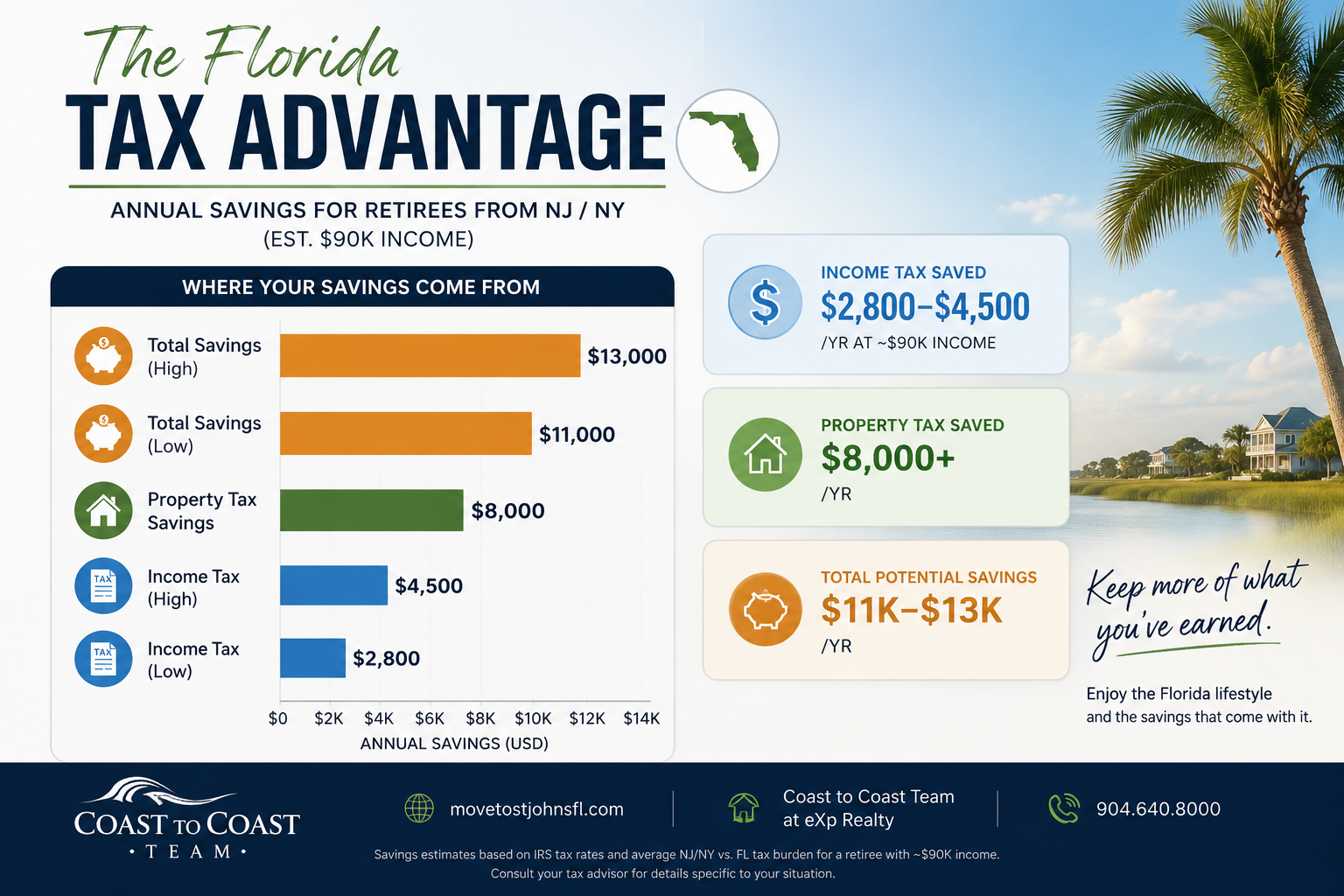
A retiree earning approximately $90,000 per year may save:

  • $2,800–$4,500 annually in state income taxes

  • $8,000+ annually in property taxes

Potential Total Savings

$11,000–$13,000 per year

Over time, that can have a significant impact on retirement finances.


Healthcare Costs May Be Lower Too

Healthcare is one of retirement's largest expenses.

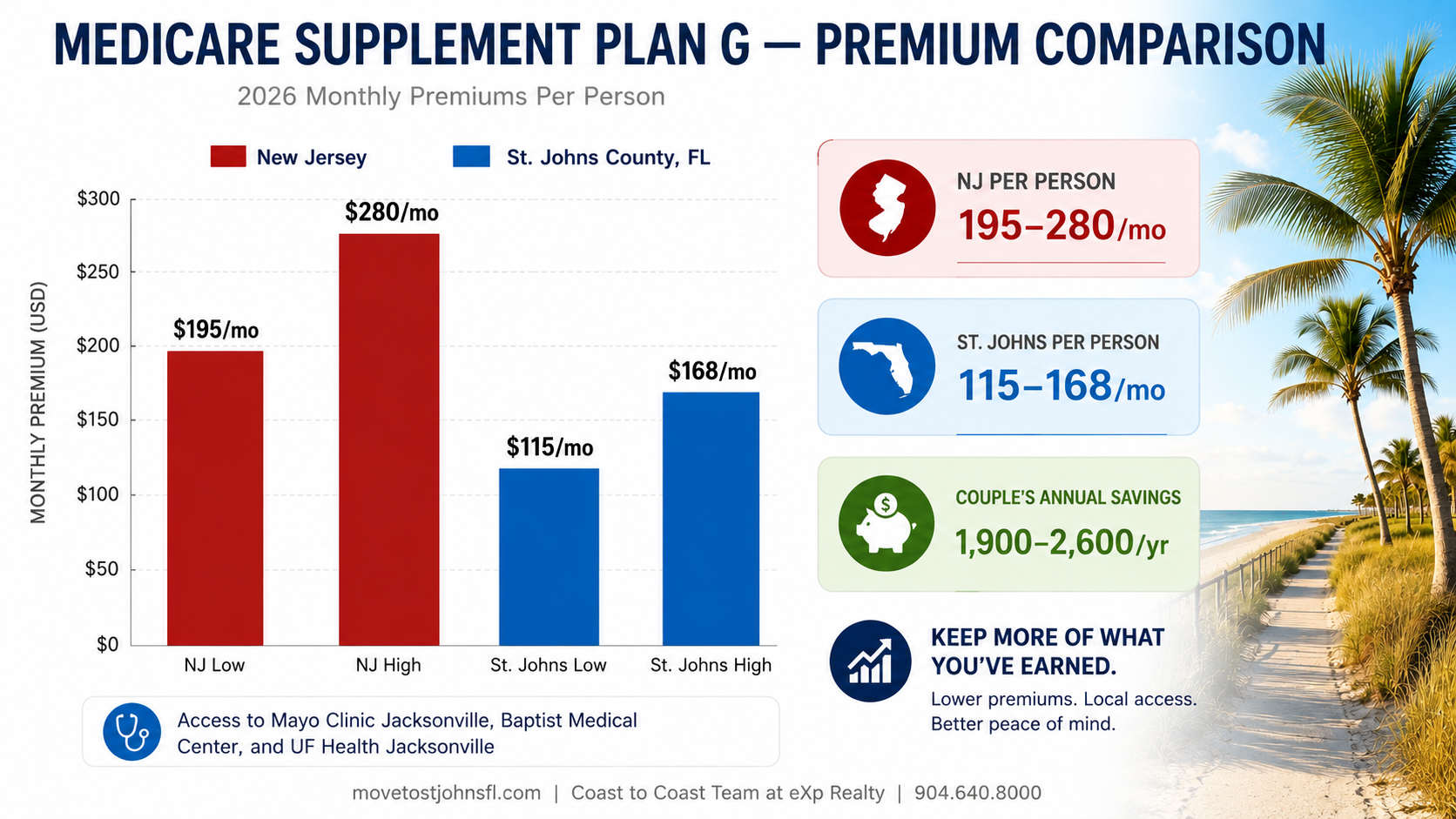
For Medicare Supplement Plan G coverage:

Typical Monthly Premiums (2026)

New Jersey: $195–$280 per person
St. Johns County: $115–$168 per person

For many couples, that can translate to annual savings of approximately:

$1,900–$2,600 per year

Plus, residents have convenient access to:

  • Mayo Clinic Jacksonville
  • Baptist Medical Center
  • UF Health Jacksonville


Your Home Equity Could Change Everything

For many Northeast homeowners, the biggest retirement boost comes from unlocking home equity.

Example Scenario

  • Sell a New Jersey home for $750,000
  • Net approximately $700,000+ after expenses
  • Purchase a St. Johns County home for $550,000
  • Invest the remaining equity

This approach can:

✔ Lower housing expenses
✔ Reduce property taxes
✔ Create additional retirement income from invested proceeds

For many retirees, this is what makes retirement feel financially comfortable sooner than expected.


The Bottom Line

Every retirement situation is unique, but many buyers relocating to St. Johns County discover they need less than they originally thought.

General Guidelines

Modest but Comfortable Retirement

  • $600,000–$800,000 in savings plus Social Security

Comfortable and Active Retirement

  • $900,000–$1.5 million in savings plus Social Security and/or pension income

Luxury Retirement Lifestyle

  • $2 million–$3.5 million+ in retirement assets

The common theme?

Your retirement dollars often go much further in St. Johns County than they do in many Northeast states.


Thinking About Retiring in St. Johns County?

Every retirement plan is different. Your ideal budget depends on your income sources, home equity, lifestyle goals, and healthcare needs.

If you're considering a move from New Jersey, New York, Connecticut, or Massachusetts, Gail DeMarco can help you understand what life—and retirement—could look like in Northeast Florida.

Gail DeMarco
📞 904-640-8000
St. Johns County Relocation Specialist

Serving Nocatee, Ponte Vedra, Del Webb Saint Johns, RiverTown, WaterSong, Palencia, St. Augustine, and surrounding communities.


All figures are estimates based on 2025–2026 data from the Bureau of Labor Statistics, Social Security Administration, Medicare.gov, MIT Living Wage Calculator, local market data, and published financial planning benchmarks. Individual retirement needs vary significantly based on health, lifestyle, debt, family obligations, and income sources. This article is for informational purposes only and does not constitute financial, tax, or investment advice. Always consult a qualified financial planner and CPA.

June 26, 2026

DeSantis Pushes to Eliminate Property Taxes in Florida — Here's What It Means for You

If you've been following Florida politics recently, something significant is happening in Tallahassee — and it has nothing to do with the weather.

Governor Ron DeSantis is actively pushing to place a constitutional amendment on the November 2026 ballot that would eliminate or dramatically reduce property taxes on homesteaded primary residences in Florida. For anyone who already owns a home here — or is seriously considering a move from a high-tax state like New Jersey, New York, Connecticut, or California — this changes the financial picture in a major way.

Here's what's actually happening, what it could mean for your wallet, and why Florida keeps pulling ahead as the top destination for relocators and retirees.


What Is Actually Happening Right Now

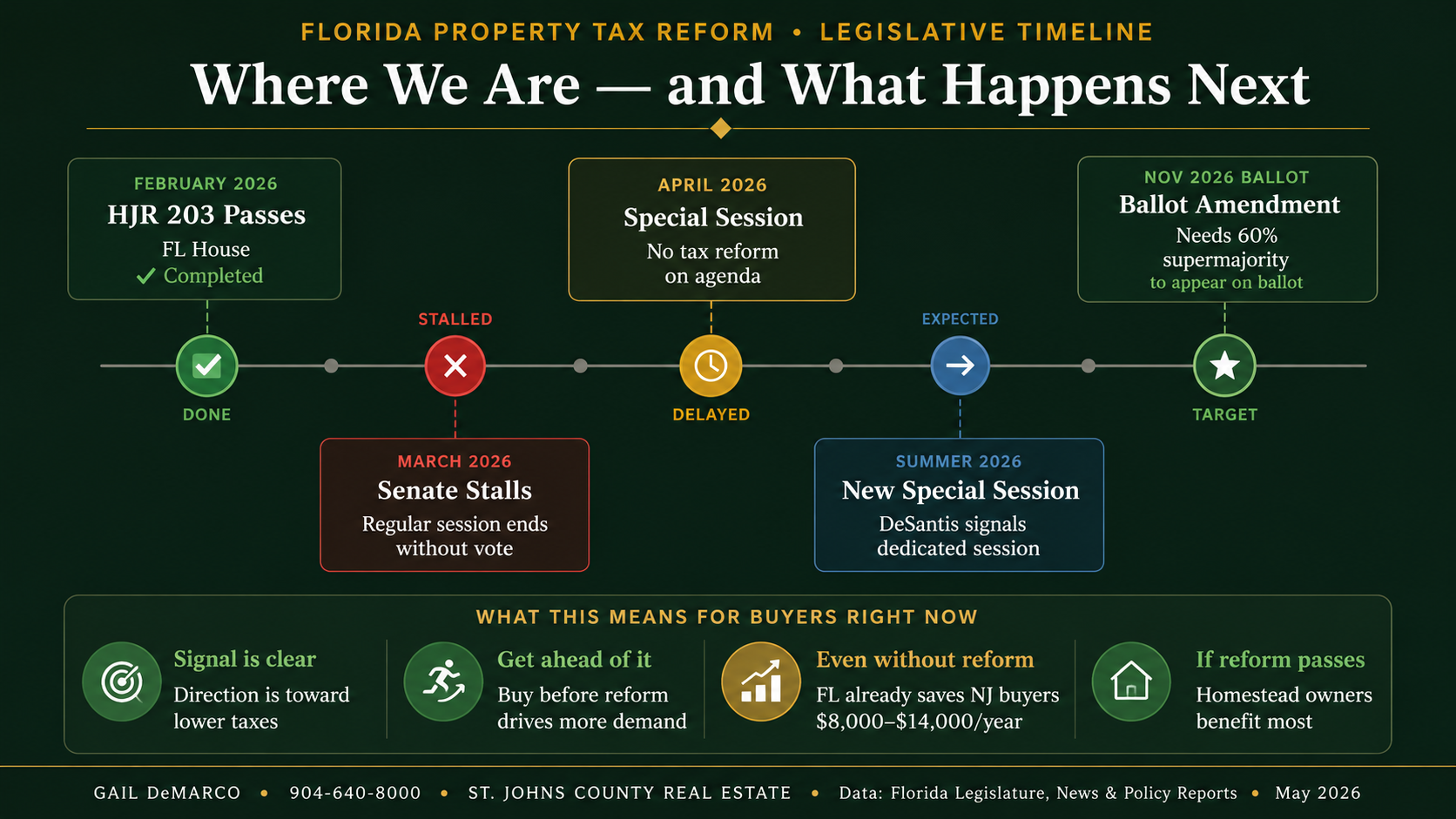
The Florida House passed HJR 203 in February 2026 — a measure that would set the stage for a constitutional amendment to eliminate homestead property taxes. The bill stalled in the Senate during the regular session, and a special session in April did not include it on the agenda.

But this is not dead. Governor DeSantis has signaled his intention to call a dedicated special session — likely in the summer of 2026 — specifically to push property tax reform across the finish line. A constitutional amendment requires a 60% supermajority in both chambers to reach the November ballot, so there is real negotiating ahead. But DeSantis has made this a top priority, and the political momentum is real.

The key facts right now:

  • HJR 203 passed the Florida House in February 2026 but stalled in the Senate
  • A summer 2026 special session is expected to revive the debate
  • A 60% supermajority is required for the amendment to reach the ballot
  • Even if passed, implementation would be phased in gradually — not an overnight change

What This Means If You Already Own in Florida

For current Florida homeowners, this is straightforward good news. Property taxes are one of the most persistent recurring costs of ownership — and they compound every year as home values rise.

In St. Johns County, homeowners currently pay anywhere from $3,000 to $7,000+ annually in property taxes depending on assessed value. A meaningful reduction — even short of full elimination — puts real money back into homeowners' pockets every single year. That's money redirected toward travel, healthcare, home improvements, or retirement savings.

The political direction is unmistakable. Florida has been trending toward a lower property tax burden for years. The conversation has shifted from whether to reduce them to how. That trajectory alone tells you where this state is headed — and why getting in now makes sense.


Why Buyers from NJ, NY, CT, and California Need to Pay Attention

If you're relocating from a high-tax state, you already know what punishing property taxes feel like. Here's the comparison as it stands today — before any further reform:

  • New Jersey average effective property tax rate: 2.23% — highest in the US
  • Connecticut average effective rate: approximately 1.73%     
  • New York — school, county, and municipal levies stacked: easily 2.5%+ in many areas
  • California — base rate near 1%, but new purchase reassessments push real costs significantly higher

St. Johns County's current effective property tax rate sits at approximately 0.76%–0.99%. Now imagine what happens if that drops further — or disappears entirely for homesteaded properties.

You're not just looking at a better deal on one line item. You're looking at a fundamentally different financial life.

The complete financial picture for a relocating buyer:

  • No Florida state income tax — already in place. Pensions, retirement distributions, Social Security, and investment income all untaxed at the state level.     
  • Property taxes already far below Northeast rates — and potentially headed toward elimination.     
  • No Florida estate or inheritance tax — assets pass to heirs without state-level death taxation.     
  • New construction builder incentives — rate buydowns, closing cost credits, and upgrades are actively available right now in communities across St. Johns County.

Stack all of these together and the financial argument for relocating to Florida moves from compelling to nearly impossible to argue against.


This Is a Gradual Shift — Which Is Actually Good News for Buyers

Even if the constitutional amendment passes in November 2026, eliminating property taxes on homesteaded residences would be phased in over time. Counties and school districts will need transition plans and replacement revenue strategies. A multi-year implementation timeline is expected.

Here's why that's actually good news for anyone considering a move: the signal is clear, but the timeline gives you room to plan deliberately rather than reactively. You don't need to make a rushed decision this month. But you also don't want to wait until everyone else catches on and competition for homes in the most desirable communities tightens further.

The smartest position is to get ahead of the curve. Start exploring communities now. Get familiar with areas like RiverTown, WaterSong, Del Webb at Nocatee, and Del Webb at The Landings. Understand your budget and timeline. When the moment is right, you'll move with confidence rather than scrambling with the crowd.


Florida Just Keeps Getting More Attractive

Take a step back and look at the full picture. Florida already offers:

  • No state income tax on any income type
  • No state estate or inheritance tax
  • Property taxes already well below the national average for comparable home values
  • A business-friendly regulatory environment
  • Year-round outdoor living and a genuinely exceptional quality of life
  • Some of the most thoughtfully designed 55+ and master-planned communities in the country

Now add the very real possibility of homestead property tax elimination on top of all of that — and you're looking at a state that is actively, deliberately removing every remaining financial barrier to living here.

The people I've helped relocate from New Jersey, New York, and Connecticut consistently say the same thing after settling into St. Johns County: "I wish I had done this sooner." The ones who came before property values ran up and before community waitlists formed have the most to show for their timing. The window for that kind of positioning is still open — but it won't stay open forever.


What This Means for St. Johns County Specifically

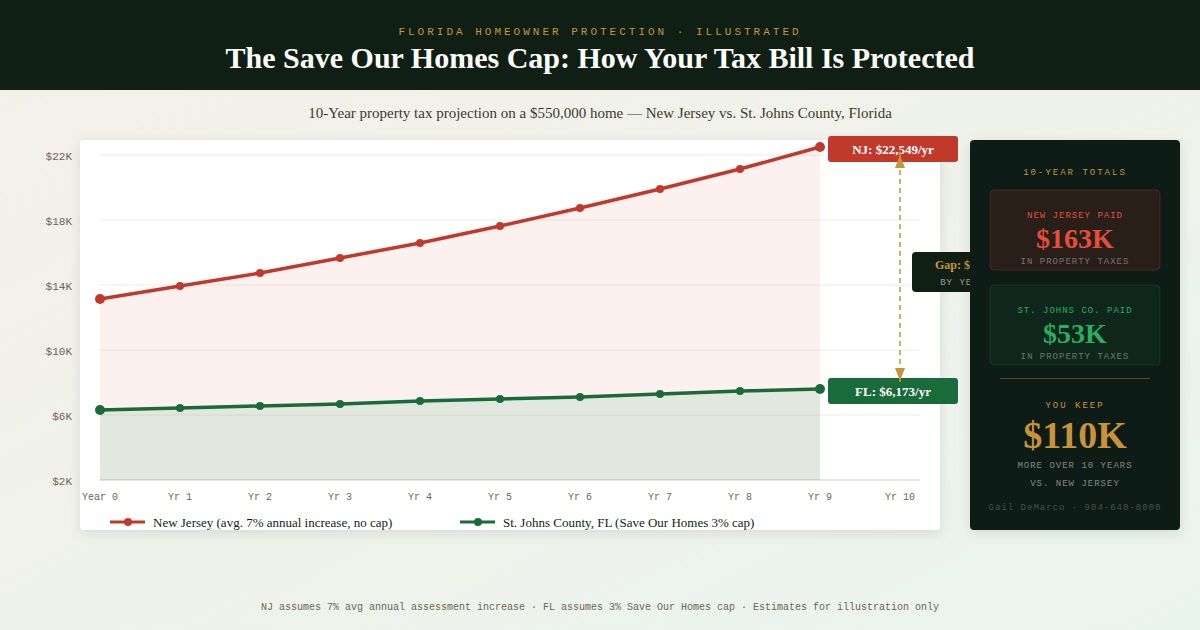
St. Johns County is already one of the most financially advantageous places to own a home in Florida. The county's current effective property tax rate is among the lowest in Northeast Florida. The Homestead Exemption reduces your assessed value by up to $50,000. The Save Our Homes cap limits annual assessment increases to 3% or inflation — whichever is lower. Senior exemptions are available for qualifying homeowners 65 and older.

If property tax reform advances and homestead taxes are phased down or eliminated, St. Johns County homeowners — who already benefit from some of the best protections in the state — stand to gain the most. And buyers who purchase here before that reform takes full effect will lock in their homestead status early, maximizing every protection the program offers.

This is not speculative. The legislative intent is on the record. The political will is visible. The only open question is the timeline — and prudent buyers plan around direction, not delay.


Ready to Explore Your Options?

Whether you're just starting to think about a Florida move or you're ready to walk through communities and run the real numbers for your situation, I'm here to help — with honest guidance and zero pressure.

I know which St. Johns County communities offer the best combination of location, lifestyle, and long-term value. I know the builders who are offering the strongest incentives right now. And I know how to help you think through the full financial picture — not just the purchase price, but the true annual cost of ownership compared to what you're paying today.

The landscape is shifting in Florida's favor. The smart move is to be ahead of it.

Call or text Gail DeMarco: 904-640-8000 St. Johns County Relocation Specialist · Coast to Coast Team Serving RiverTown, WaterSong, Del Webb at Nocatee, Del Webb at The Landings, Ponte Vedra, Palencia, St. Augustine, and all of St. Johns County, FL

You can also find me on YouTube at @LivinginStJohnsStJohnsCountyFL — neighborhood tours, community spotlights, and everything you need to know about life in St. Johns County.


This article reflects legislative developments as of May 2026. Property tax reform proposals are subject to change based on legislative outcomes. Always consult a qualified CPA or financial advisor regarding the tax implications of a real estate purchase or relocation decision.

Posted in Guides
June 24, 2026

The Best Golf Courses in St. Johns County & Ponte Vedra Beach

For golfers considering a move to Northeast Florida, St. Johns County and Ponte Vedra Beach offer something genuinely rare: world-class golf woven directly into the fabric of daily life.

    This isn't a region where the good courses are tucked behind gates an hour from your front door. Here, the fairways are part of the community — and whether you're a competitive golfer or someone who enjoys a relaxed Saturday morning round, the options are extraordinary at every price point.

As a relocation specialist working with buyers moving to St. Johns County from across the country, golf access is one of the most common lifestyle questions I receive. Here's the honest guide — what's available, what it costs, and how to find a home that puts you close to the courses you want to play.


TPC Sawgrass — The Crown Jewel

There's no better place to start. TPC Sawgrass in Ponte Vedra Beach is one of the most recognized golf venues on the planet — and for St. Johns County residents, it's practically a backyard amenity.

The facility runs two courses, each with a completely different personality.

The Stadium Course

Designed by Pete Dye and opened in 1980, the Stadium Course is where THE PLAYERS Championship is held every March. It's open to the public year-round — and yes, you can play that island green at the par-3 17th.

Green fees run on dynamic pricing: approximately $550 during slower summer months, rising to $750–$840 during peak season (September through May). Resort guests at the Sawgrass Marriott often see preferred rates. Weekend morning tee times — especially in spring and fall — fill quickly, so book ahead.

Dye's Valley Course

Often considered the more player-friendly of the two, Dye's Valley is a demanding but fair layout that hosted the Web.com Tour Championship for years. Many locals actually prefer it for everyday play.

Green fees are more accessible: typically $250–$450 depending on the season.

For relocating buyers, TPC Sawgrass carries weight beyond the scorecard. Living within range of one of golf's most iconic venues is a lifestyle statement — and the residential communities surrounding it are among the most desirable in the county.


Ponte Vedra Inn & Club — The Refined Classic

If TPC Sawgrass is the bold headline, Ponte Vedra Inn & Club is the understated classic. This historic oceanfront resort — established in 1928 — features two beautifully maintained courses in a members-and-guests setting.

The Ocean Course

A par-72 layout at 6,574 yards. The front nine plays through maritime forest; the back nine opens toward the Atlantic. It's a traditional Florida experience with meaningful bunkering and water throughout.

The Lagoon Course

This course plays shorter at 6,022 yards (par 70), but water comes into play on nearly half the holes. Accuracy matters more than distance here — a favorite among members who appreciate shot-making over power.

Green fees for both courses run approximately $175–$300 depending on season, available to resort guests and members. Combination day packages are available for those who want to play both.

Membership at a glance:

Initiation fees: approximately $15,000–$25,000 depending on tier     Annual dues: starting near $7,500 per year. Social and sports memberships are also available for buyers who want beach, dining, tennis, and fitness access without a full golf commitment.

For buyers moving to Ponte Vedra Beach, the Inn & Club is more than a golf destination — it's a social hub. The clubhouse, beach access, and dining make it a genuine gathering place for the community year-round.


Marsh Landing Country Club — Premier Private Golf

Marsh Landing is one of the most prestigious private clubs in Ponte Vedra Beach. Designed by Bobby Weed, the course winds through tidal marshes, beneath mature oaks, and alongside strategic water hazards.

It's a serious golfer's club — but equally serious about its social scene. Regular tournaments, member events, and a strong dining program make it a genuine lifestyle anchor for many Ponte Vedra families.

Membership at a glance:

Initiation fees: reported in the range of $25,000–$100,000+ depending on category and availability     Annual dues: vary by tier, with full golf at the top and social or limited-golf options at more accessible price points

For many buyers relocating to Ponte Vedra, a Marsh Landing membership becomes the centerpiece of their social life — and the fastest way to build deep roots in the community.


St. Johns Golf and Country Club — Best Everyday Value

Not every round needs to come with a four-figure price tag. St. Johns Golf and Country Club consistently surprises first-time visitors with its conditions, challenge, and accessibility — at a fraction of the private club cost.

Daily green fees: typically $59–$119 depending on day and season, with twilight rates offering additional savings. Annual passes: available for St. Johns County residents, offering unlimited play well below the per-round rate.

This is also the ideal starting point for relocation buyers still exploring communities. No membership commitment. Welcoming to newcomers. And you'll meet golfers who know the area well — which makes building your local network easier than you'd expect.


World Golf Village — Slammer & Squire and The King & Bear

Located just west of I-95 near St. Augustine, World Golf Village is home to two semi-private courses with serious pedigree — and the World Golf Hall of Fame sits at the center of it all.

The Slammer & Squire

Designed by Bobby Weed and named for legends Sam Snead and Gene Sarazen — plays 6,927 yards with water in play on 10 holes. It rewards smart course management over power.

The King & Bear

The only course ever co-designed by Arnold Palmer and Jack Nicklaus. At 7,277 yards, it's the longer and more dramatic of the two, with a spectacular closing stretch along the water.

Both courses operate on a semi-private model with daily-fee tee times available. Green fees generally fall in the $100–$200 range depending on season — making WGV one of the best semi-private values in the region.

For buyers considering communities in the World Golf Village area, this is a major lifestyle asset. The surrounding master-planned neighborhoods offer housing from townhomes to custom estates, with the Hall of Fame and both courses minutes from your front door.


More Worth Knowing

The marquee names don't tell the whole story. St. Johns County has a strong supporting cast of courses worth knowing:

  • Palm Valley Golf Club (Ponte Vedra Beach) — two 18-hole semi-private courses with a loyal local following and reasonable green fees.
  • Cimarrone Golf Club (St. Augustine) — a 27-hole public facility by Harry Bowers. Well-maintained, affordably priced, and a consistent local favorite.
  • South Hampton Golf Club (St. Augustine) — a links-inspired public layout, ideal for a relaxed round without the drive to Ponte Vedra.
  • Stillwater Golf & Country Club (St. Augustine) — a newer private club gaining traction among buyers who want a fresh experience outside the Ponte Vedra corridor.
  • St. Johns County Golf Club — municipally operated, with annual resident passes and budget-friendly green fees. Reliable and easy on the wallet.

Golf and the St. Johns County Lifestyle

Here's what makes this area genuinely different from other golf retirement destinations: the courses aren't isolated from daily life — they're embedded in it.

RiverTown residents are minutes from TPC Sawgrass. Del Webb at Nocatee and Del Webb at The Landings sit close to World Golf Village and the St. Augustine courses. Communities throughout the Durbin Park corridor put residents within 20 minutes of multiple options. In Ponte Vedra Beach, the private club scene is practically a neighborhood amenity.

For buyers relocating from markets where a decent round requires a long commute and a $200+ green fee, the combination of convenience, variety, and value here genuinely changes the picture.

Golf is also one of the fastest ways to build a social life in a new community. Men's and women's leagues, weekend groups, and club events create friendships faster than almost anything else — and I've watched many relocating buyers form their closest relationships on the back nine before they'd even fully unpacked.


Finding a Home Near the Fairways

If golf is a priority in your move, the community you choose matters as much as the course you want to play.

I know which neighborhoods offer course views, which communities give you the best access without the private club price tag, and where the right balance of location and value sits in 2026's St. Johns County market.

Let's find your home near the fairways.

Call or text Gail DeMarco: 904-640-8000 St. Johns County Relocation Specialist Serving Nocatee, Ponte Vedra, RiverTown, World Golf Village, Palencia, St. Augustine, and all of St. Johns County, FL


Green fees and membership figures are approximate and subject to change. Always verify current pricing directly with the course or club before making decisions. This article is for informational purposes only.

Posted in Ponte Vedra
June 22, 2026

One of Florida’s Biggest Family Benefits? Up to $7,500 Per Child for School Choice

When families relocating from New Jersey, New York, Connecticut, or Massachusetts start running the numbers on a move to Florida, they focus on the obvious: lower taxes, better weather, more space.

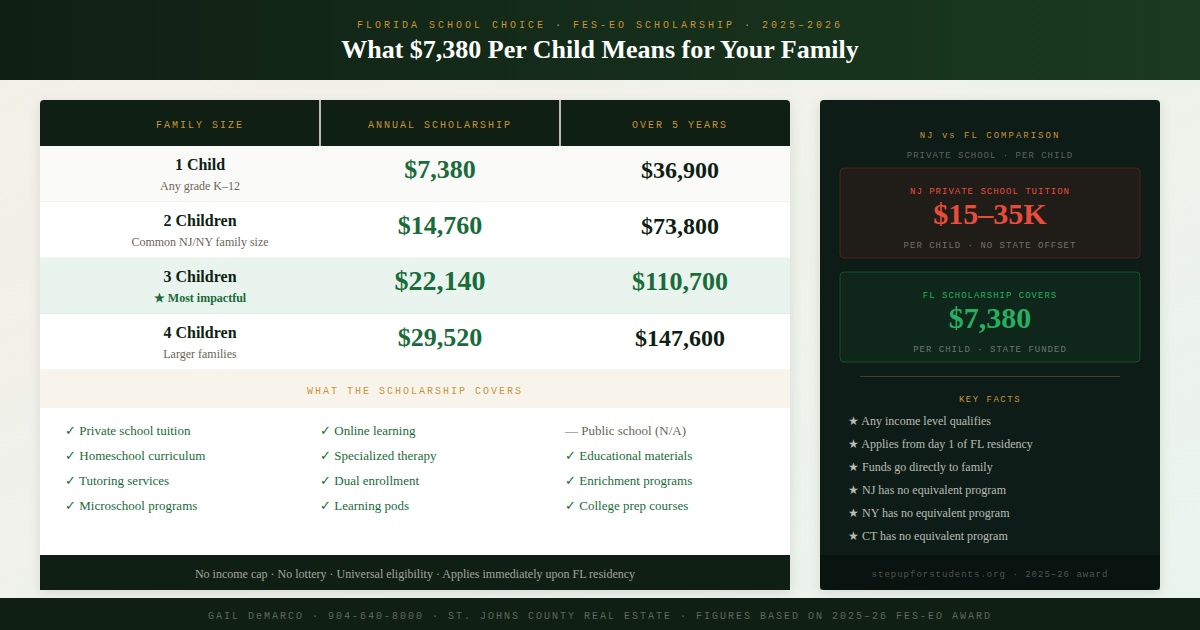
But there's one benefit most Northeast families completely miss — and for households with school-age children, it can be worth $7,500 per child, per year.

Florida's school choice program is one of the most expansive in the United States. And in 2026, nearly every family in the state qualifies for it.

Here's what it is, how it works, and why it matters for families considering a move to St. Johns County.


What Is Florida's School Choice Program?

In 2023, Florida expanded its school choice legislation under the Family Empowerment Scholarship for Educational Options (FES-EO) program — making Florida one of the first states in the country to offer universal school choice regardless of household income.

That means this is not a program just for low-income families. It is not means-tested. Any Florida K–12 student is eligible — including families relocating from out of state the moment their child enrolls in Florida.

The program is administered by Step Up For Students, Florida's largest nonprofit scholarship funding organization.


How Much Is the Scholarship Worth?

For the 2025–2026 school year, the FES-EO scholarship is valued at approximately $7,380 per student — often rounded up to $7,500 in most planning conversations.

This funding follows the child — not the school district — meaning families can direct it toward:

  • Private school tuition at a participating accredited school
  • Homeschooling expenses including curriculum, tutoring, and materials
  • Microschool or learning pod programs
  • Therapeutic or specialized educational services for students with learning differences
  • Dual enrollment college courses for eligible high school students
  • Online learning programs approved under the scholarship

The scholarship is deposited into a Scholarship Funding Account (SFA) — essentially an education savings account that families manage directly through the Step Up For Students portal.


Who Qualifies?

As of 2025–2026, eligibility is broad:

Any Florida K–12 student who is not currently enrolled in a Florida public school — or who is transferring out of a public school — qualifies. New residents enrolling their children for the first time in Florida qualify immediately upon establishing residency.

There is no income cap. There is no academic performance requirement. There is no application lottery for most students.

The main requirement: your child must be a Florida resident and must not be simultaneously enrolled in a Florida public school receiving per-pupil funding.


What This Means for a Family of Three Kids

Run the math on a family relocating from New Jersey with three school-age children:

$7,380 × 3 children = $22,140 per year in education scholarship funding

That is money that can cover:

  • Full or partial private school tuition at a quality participating school
  • A fully customized homeschool curriculum with tutoring and enrichment
  • A combination of private schooling and supplemental programs

For families who were already paying private school tuition in New Jersey — where private K–12 tuition commonly runs $15,000–$35,000 per child per year — this scholarship significantly changes the cost equation.

For families whose children attended public school in NJ and plan to continue in Florida's public system, the scholarship provides an optional alternative worth knowing about if their assigned school isn't the right fit.


But Wait — St. Johns County's Public Schools Are Already Exceptional

Here's what makes St. Johns County's school choice picture uniquely strong: families aren't choosing between a great school choice program and a great public school district. They have both.

St. Johns County School District is ranked #1 in Florida by the Florida Department of Education — a streak it has maintained for multiple consecutive years. Approximately 95% of schools hold an A or B rating. Graduation rates exceed 94%. Top high schools like Ponte Vedra High School and Allen D. Nease High School regularly send graduates to Ivy League and top-tier universities.

This means St. Johns County families have a genuinely rare combination:

Option A: Enroll in one of the best public school districts in the entire state of Florida — at no additional cost — in a district that rivals top-performing schools in NJ, NY, CT, and MA.

Option B: Use the FES-EO scholarship to attend a participating private school, microschool, or homeschool program — funded at up to $7,380 per child per year by the state.

Most families in St. Johns County choose Option A and are extremely satisfied. But the existence of Option B — funded, accessible, and universal — gives families a flexibility that no Northeast state currently offers at this scale.


How Does This Compare to New Jersey and New York?

Let's be direct.

New Jersey has no universal school choice program. NJ does have a limited Opportunity Scholarship Act that has faced ongoing legislative battles and remains far more restricted than Florida's program. New Jersey families who want private school pay full tuition — with no state scholarship offset — while also paying some of the highest property taxes in the country to fund a public school system they may or may not use.

New York similarly has no universal school choice program. New York City has a tax credit program for low-income families, but nothing approaching Florida's universal, per-pupil scholarship model.

Connecticut and Massachusetts have no equivalent universal school choice programs.

The contrast is stark: in Florida, the state sends education funding directly to families and lets them decide how to use it. In most Northeast states, education funding is locked inside the public system — and if the assigned school isn't the right fit, families pay again out of pocket for an alternative.


Participating Private Schools in the St. Johns County Area

St. Johns County and the surrounding Jacksonville metro area have a strong network of private schools participating in the FES-EO scholarship program. A partial list of participating school types in the area includes:

  • Faith-based schools (Catholic, Christian, Jewish day school options)
  • Classical and liberal arts academies
  • Montessori programs
  • College preparatory independents
  • Specialized learning difference schools
  • STEM-focused private academies

A full, searchable directory of participating schools is available at stepupforstudents.org — filterable by location, grade level, and school type.


How to Apply: The Short Version

The application process is straightforward:

  • Step 1: Visit stepupforstudents.org and create a family account.
  • Step 2: Complete the FES-EO application for your child. You will need proof of Florida residency — a utility bill, lease, or closing statement works.
  • Step 3: Once approved, select a participating school or approved education provider.
  • Step 4: Scholarship funds are deposited into your child's Scholarship Funding Account and disbursed directly to the approved provider.

Applications are accepted on a rolling basis. There is no single deadline, but applying early in the school year — or before you move — is recommended to ensure placement before the academic year begins.

For families buying a home in St. Johns County and planning a summer move, applying for the scholarship in the spring before your closing date is entirely feasible.


The Bigger Picture for Relocating Families

Florida's school choice program is not a replacement for a strong public school system. In St. Johns County, it doesn't need to be — the public schools are genuinely excellent.

What it is, instead, is one more layer of family financial benefit that doesn't exist in New Jersey, New York, Connecticut, or Massachusetts.

Add it to the full picture:

No state income tax — saving a $150K household $7,500–$11,000/year Property taxes 50–60% lower than NJ — saving $6,000–$9,000/year No inheritance or estate tax — protecting family wealth at death Lower healthcare premiums — saving a retired couple $2,000–$3,000/year And now: up to $7,380 per child per year in education scholarship funding for families who choose to use it

For a family with two school-age children earning $150,000 per year and owning a $600,000 home, the combined annual financial advantage of Florida versus New Jersey can reach $35,000–$40,000 per year — before touching the school choice benefit.

Add two scholarship-eligible children and that number climbs by another $14,760 per year.

That is a number worth taking seriously.


Questions About Schools, Scholarships, and St. Johns County Communities?

School zoning, scholarship eligibility, and the right community for your family's needs are all part of the relocation conversation I have with buyers every week. I know which St. Johns County communities put children in the strongest school zones — and how the school choice landscape intersects with your housing decision.

Call or text Gail DeMarco: 904-640-8000 St. Johns County Relocation and Family Specialist Serving Nocatee, Ponte Vedra, RiverTown, Palencia, St. Augustine, and all of St. Johns County, FL


Scholarship amounts are based on 2025–2026 FES-EO award levels as administered by Step Up For Students. Eligibility requirements and award amounts are subject to annual legislative review and may change. Always verify current program details at stepupforstudents.org before making enrollment decisions. This article is for informational purposes only.

Posted in Guides
June 18, 2026

The Hidden Costs of Staying in New Jersey: What NJ Homeowners Are Paying That Florida Residents Simply Don't

Most New Jersey homeowners know they pay a lot.

High property taxes. High income taxes. High cost of everything.

But here's what most NJ homeowners don't fully realize until they sit down and add it all up:

It's not just the taxes. It's an entire ecosystem of costs that Florida residents simply don't pay.

Exit taxes. Inheritance taxes. Mandatory vehicle inspections. Balloon heating bills. Snow removal. Flood surcharges. Estate taxes on assets you spent a lifetime building.

Each line item feels manageable on its own. Together, they add up to a number that shocks most people when they finally see it clearly.

This post puts every hidden cost on the table — honestly, with real numbers — so you can decide for yourself whether staying in New Jersey is still worth it.


Let's Start With What Everyone Already Knows

Before we get to the hidden costs, the visible ones deserve a quick recap because the baseline is staggering.

New Jersey state income tax: NJ taxes income at rates up to 10.75% — the second highest state income tax rate in the country. A household earning $150,000 pays approximately $6,500–$8,200 in NJ state income taxes annually.

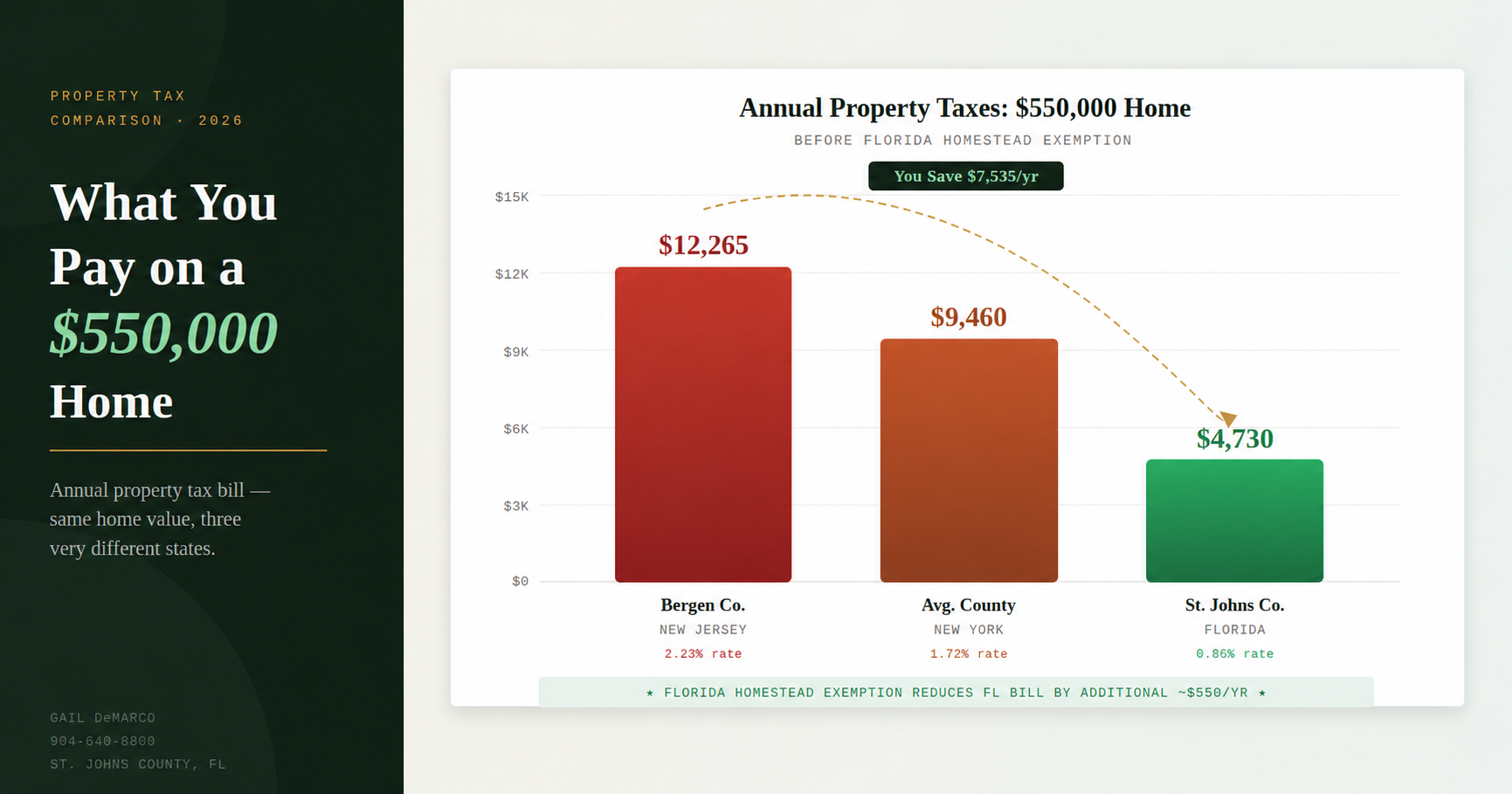
New Jersey property taxes: New Jersey has the #1 highest average property tax rate in the United States at 2.23%. On a $600,000 home, that's $13,380 per year — $1,115 every single month — just in property taxes.

Florida comparison: 0.86% effective rate on the same $600,000 home = $5,160/year after Homestead Exemption. Annual savings: $8,220.

These numbers are well known. What follows is what most people miss.


HIDDEN COST #1: The NJ Exit Tax

Planning to sell your New Jersey home and move to Florida?

New Jersey will collect money from you on the way out.

New Jersey imposes a mandatory withholding at closing on home sales — commonly called the "exit tax" — equal to 2% of the total sale price or 8.97% of the estimated gain, whichever is higher.

On a $650,000 home sale, that withholding is $13,000 at minimum — held by the state at closing and applied to your final NJ tax return. If you no longer have NJ income after the sale, you can file for a refund — but you don't receive it immediately. The state holds your money for months while you wait.

Florida has no exit tax. No real estate transfer tax at the state level. Zero.

Your equity moves with you, immediately, on closing day.

For most NJ homeowners selling to fund their Florida purchase, this is $10,000–$15,000 they didn't account for.


HIDDEN COST #2: New Jersey's Inheritance Tax

New Jersey abolished its estate tax in 2018 — but it kept something most people overlook:

New Jersey still has a state inheritance tax — and it applies to assets left to siblings, nieces, nephews, friends, and non-immediate family members.

The rates range from 11% to 16% depending on the relationship and the size of the inheritance. Direct descendants (children, grandchildren) and spouses are exempt. Everyone else is not.

If you plan to leave assets to a sibling, a close friend, a business partner, or an extended family member — New Jersey will tax that transfer at rates up to 16%.

Florida has no state inheritance tax. No state estate tax. None.

Assets pass to your beneficiaries — whoever they are — with zero Florida state-level death taxation. For families with meaningful accumulated wealth, establishing Florida domicile before death can preserve tens of thousands to hundreds of thousands of dollars for the next generation.


HIDDEN COST #3: NJ Mandatory Vehicle Inspection and Higher Registration Fees

This one feels small. It isn't, when you add it up over time — and the hassle factor is real.

New Jersey requires mandatory vehicle emissions and safety inspections every two years. The inspection itself is free, but the time cost is real — and if your vehicle fails, repair costs to pass re-inspection can run $200–$1,500 depending on the issue.

New Jersey vehicle registration fees are also notably higher than Florida's. NJ bases registration fees partly on vehicle age and weight. A typical NJ household with two newer vehicles pays $300–$600/year in registration fees.

Florida vehicle registration for the same two vehicles: approximately $150–$300/year. No mandatory emissions testing in most Florida counties. No biennial inspection requirement.

Annual savings on registration and inspection-related costs: $150–$400/year. Small on its own — but it's one more line item that simply doesn't exist in Florida.


HIDDEN COST #4: Winter Heating Bills

New Jersey winters are cold. The average NJ household heats with natural gas, oil, or electric — and the bills from November through March are a real and substantial annual cost.

Average NJ household annual heating costs: Natural gas heat: $1,400–$2,200/year Oil heat (still common in older NJ homes): $2,000–$3,500/year Electric heat: $1,800–$2,800/year

These costs fluctuate with energy prices — and NJ winters in recent years have produced heating bills that caught many homeowners off guard.

Florida has no meaningful heating season. St. Johns County averages highs in the low-to-mid 60s from December through February. Electric heat strips or heat pumps run occasionally during cold snaps. Annual heating-equivalent costs in a St. Johns County home: $200–$500/year at most.

Annual savings on heating costs: $1,200–$3,000 depending on your current NJ heating system and usage.

Yes, Florida summer cooling bills are higher than NJ summer cooling costs. But when you net the full year — no heating season versus a real heating season — Florida households consistently come out $600–$1,800 ahead annually on total energy costs.


HIDDEN COST #5: Snow Removal

Nobody puts this in a cost-of-living comparison. But anyone who has owned a home in New Jersey for more than a few years knows exactly what it costs.

Snow removal for NJ homeowners:

Professional driveway plowing service (seasonal contract): $350–$700/season Snow blower purchase and maintenance: $400–$800 amortized over 5 years = $80–$160/year Roof raking (necessary in heavy snow years to prevent ice dams): $200–$500/event Ice melt product, shovels, equipment: $50–$150/year Emergency plowing after major storms (above contract): $75–$200/event

A realistic annual snow removal budget for an NJ homeowner: $500–$1,200/year in a typical winter. In a heavy snow year, more.

In St. Johns County, Florida: $0. There is no snow season. There is no snow removal budget. There is no ice dam. There is no roof rake.

Over 10 years of Florida living, this is $5,000–$12,000 you simply never spend.


HIDDEN COST #6: Higher Home Maintenance Costs on Older Stock

New Jersey's housing stock is old. The median age of a home in New Jersey is approximately 50 years — meaning the average NJ homeowner is maintaining a house built in the mid-1970s.

Older homes carry higher maintenance costs. Full stop.

Typical annual maintenance costs on a 1970s–1980s NJ home: Roof (replacement every 20–25 years, amortized): $700–$1,200/year HVAC service and eventual replacement (amortized): $400–$800/year Plumbing repairs (older galvanized or cast-iron pipes): $300–$700/year Electrical updates (many older NJ homes have aging panels): $200–$500/year General repairs, weatherproofing, chimney maintenance: $400–$800/year

Total annual maintenance budget for a typical older NJ home: $2,000–$4,000/year as a conservative estimate. Many NJ homeowners spend significantly more in any given year when a major system fails.

In a new-construction St. Johns County home built in 2018–2026: Major systems are under builder warranty. HVAC is modern and efficient. Roof is new. Plumbing is current. A realistic first-decade annual maintenance budget: $500–$1,200/year.

Annual maintenance savings by moving to new construction in St. Johns County: $1,500–$3,000/year in the first decade.


HIDDEN COST #7: NJ's Mandatory Flood Insurance Surcharges

New Jersey's proximity to the Atlantic coast and its river systems means a significant portion of the state's homeowners carry mandatory flood insurance — a requirement of FEMA when a property sits in a designated flood zone.

Post-Hurricane Sandy FEMA flood insurance rates in New Jersey have risen dramatically. Many NJ homeowners in flood-prone areas now pay $2,000–$5,000+ per year in flood insurance premiums alone — on top of their standard homeowner's insurance.

In St. Johns County's master-planned communities — Nocatee, RiverTown, Del Webb Saint Johns, Palencia, Shearwater — most homes are located in FEMA Flood Zone X, meaning low to minimal flood risk. Flood insurance is generally not required and not necessary for most properties.

Always verify the flood zone of any specific property before purchasing — in Florida or New Jersey. But for most buyers in St. Johns County's inland master-planned communities, mandatory flood insurance is not a cost they carry.


HIDDEN COST #8: New Jersey's High Auto Insurance Rates

New Jersey consistently ranks among the most expensive states for car insurance in the country — driven by high population density, a no-fault insurance system, and one of the highest rates of uninsured drivers in the Northeast.

Average annual car insurance cost in New Jersey (two cars, clean record): $2,800–$3,800/year

Florida's car insurance rates are also high — and this is one area where Florida does not win the comparison outright.

Average annual car insurance in St. Johns County, FL (two cars, clean record): $3,000–$4,400/year

Florida car insurance can run $200–$600 more per year than New Jersey for some households. This is worth budgeting for — and worth shopping aggressively when you arrive. Carriers like USAA, Amica, and regional Florida insurers often offer meaningfully better rates than national chains.

This is the one line item where New Jersey has a cost advantage. We're including it because an honest comparison includes the costs that cut both ways.


HIDDEN COST #9: Retirement Income Taxation

For retirees or near-retirees, this is the cost that quietly drains the most wealth over time — because it repeats every single year for the rest of your life.

New Jersey taxes retirement income: Social Security: partially taxed for higher-income households Pension income: fully taxed as ordinary income at NJ state rates IRA and 401(k) distributions: fully taxed as ordinary income Investment dividends and capital gains: taxed at NJ income tax rates

On $90,000 in combined retirement income in New Jersey, a retired couple pays approximately $2,800–$4,500 in NJ state income taxes annually depending on income composition and deductions.

Florida taxes retirement income: $0. Social Security: exempt. Pension: exempt. IRA distributions: exempt. Investment income: exempt.

Annual retirement income tax savings: $2,800–$4,500/year Over a 20-year retirement: $56,000–$90,000

And this doesn't include the compounding effect of investing those annual savings rather than sending them to Trenton.


The Complete Hidden Cost Summary

Here is every cost we've covered, annualized for a typical NJ homeowner:

Hidden Cost Annual NJ Cost Annual FL Cost Annual Savings
State income tax ($150K household) $7,500 $0 $7,500
Property taxes ($600K home) $13,380 $5,160 $8,220
NJ exit tax (one-time, amortized) $1,300* $0 $1,300
Inheritance tax exposure (est.) $800* $0 $800
Vehicle registration & inspection $500 $225 $275
Winter heating costs $1,800 $350 $1,450
Snow removal $750 $0 $750
Home maintenance (older vs. new) $3,000 $850 $2,150
Flood insurance (if applicable) $2,500 $0 $2,500
Retirement income tax (retired) $3,600 $0 $3,600
Car insurance $3,300 $3,700 -$400
Total $38,430 $10,285 $28,145

Exit tax amortized over 10 years. Inheritance tax exposure estimated conservatively.

Net annual savings moving from New Jersey to St. Johns County: approximately $28,000/year

Over 10 years: $280,000 Over 20 years: $560,000

These are not best-case projections. These are conservative estimates based on average costs for a typical NJ household. Many households will save significantly more.


The Question Worth Asking

Every year you stay in New Jersey, you pay this bill.

Not just the property taxes. Not just the income taxes. The whole stack — the exit tax you'll eventually pay anyway, the heating bills, the snow removal, the old-home maintenance, the retirement income taxation that will drain your savings every year you collect a pension or draw from an IRA.

Most NJ homeowners have never seen this number written down in one place. Now you have.

The move to St. Johns County isn't just about better weather or more space — though both are real. It's about stopping the bleeding on a cost structure that New Jersey has built around its residents over decades.

Florida didn't eliminate all costs. Car insurance is higher. Home insurance on a new Florida home may run more than you paid in NJ. Those are real trade-offs.

But the net number — $28,000 per year — is not a rounding error. It is a second income. A retirement account contribution. A college fund. A legacy.

It is money that belongs to your family. And right now it belongs to New Jersey.


Want to See What Your Specific Numbers Look Like?

Every household is different. Your income, your home value, your retirement timeline, and your insurance profile all affect the real savings figure for your situation. I work with NJ relocating buyers every week and can connect you with a local CPA and estate attorney to run your actual numbers — no pressure, no pitch.

Call or text Gail DeMarco: 904-640-8000 St. Johns County Relocation Specialist Serving Nocatee, Ponte Vedra, St. Johns, St. Augustine, RiverTown, and all of St. Johns County, FL


All figures based on 2025–2026 data from the New Jersey Division of Taxation, Tax Foundation, FEMA, Florida Department of Revenue, Zillow, and publicly available insurance rate data. Individual results vary. This article is for informational purposes only and does not constitute financial, tax, or legal advice. Consult a qualified CPA and estate attorney for guidance specific to your situation.
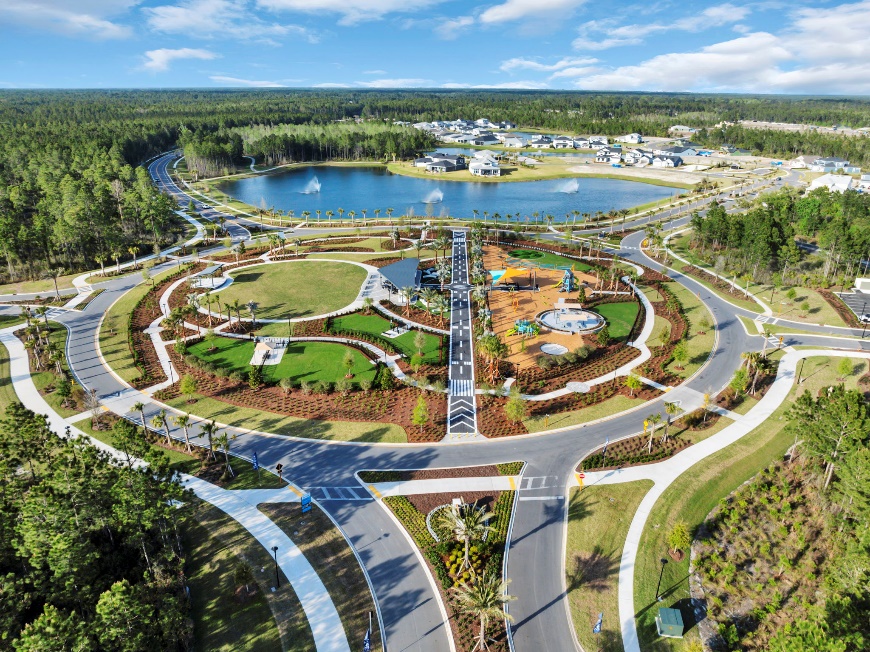
Posted in Guides
June 15, 2026

What Does $700,000 Actually Buy You in St. Johns County vs. Westchester County, New York?

Westchester County is one of the most desirable addresses in the New York metro area. Great schools. Proximity to the city. Beautiful older homes. A reputation that precedes itself.

It's also one of the most expensive places to own a home in the United States — and for a growing number of Westchester families and retirees, the math has finally stopped making sense.

If you're sitting on $700,000 in purchasing power — whether from equity, savings, or both — and you're wondering what that budget actually gets you somewhere else, this post is for you.

We're doing a direct, honest, line-by-line comparison: $700,000 in Westchester County, New York versus $700,000 in St. Johns County, Florida.

Same budget. Very different lives.


First, the Westchester Reality in 2026

Westchester County's median home price in 2026 sits between $680,000 and $760,000 depending on the municipality — meaning $700,000 is essentially the entry point for a decent single-family home in most towns.

What that $700,000 typically buys you in Westchester:

A 3-bedroom, 2-bath colonial or cape built between the 1950s and 1980s. Approximately 1,600–2,100 square feet. A modest lot — often under a quarter acre. An older kitchen and bathrooms unless recently renovated. A one-car garage if you're lucky. Oil or gas heat with aging systems. And a property tax bill that will make your eyes water.

The home itself may be charming. The community may be excellent. But the cost of ownership beyond the mortgage is where Westchester starts to hurt.


The Property Tax Problem

Westchester County has one of the highest property tax burdens of any county in the United States. It is not a close contest.

Annual property taxes on a $700,000 home:

Westchester County, NY average effective rate: 1.62% Annual tax bill: approximately $11,340 per year — or $945 every month

That $945 per month goes to your property tax escrow before you've paid a single dollar toward your mortgage principal, put food on the table, or turned the heat on.

St. Johns County, FL average effective rate: 0.86% Annual tax bill on a $700,000 home: approximately $6,020 per year After Florida Homestead Exemption: approximately $5,470 per year — or $456 per month

Annual property tax savings: $5,870 Monthly savings: $489 — every single month, forever

And unlike Westchester — where reassessments and municipal budget increases can spike your bill without warning — Florida's Save Our Homes cap limits your annual assessment increase to 3% or inflation, whichever is lower. Your tax bill is structurally protected from the runaway increases that are a routine part of Westchester homeownership.


What $700,000 Actually Buys:

Let's get specific. Here is what you are actually purchasing for $700,000 in each market as of 2026.

$700,000 in Westchester County, NY

Location options at this price: Yonkers, Mount Vernon, New Rochelle, parts of White Plains, or a small home in a more desirable town like Scarsdale or Bronxville at the very bottom of the market.

What you get:

  • 3 bedrooms, 1.5–2 bathrooms
  • 1,600–2,100 sq ft
  • Built 1950s–1980s
  • Likely needs kitchen or bathroom updates
  • Small to modest lot — under 0.25 acres typical
  • One-car garage or none
  • Oil or gas heat — budget for fuel costs
  • No community amenities — you pay separately for gym, clubs, pool access
  • Property taxes: $11,000–$14,000/year depending on exact municipality
  • New York State income tax: up to 6.85% on your income
  • No HOA in most cases — but also no amenities

$700,000 in St. Johns County, FL

Location options: Nocatee, Ponte Vedra, RiverTown, Palencia, Shearwater, or St. Augustine — all within minutes of each other.

What you get:

  • 4 bedrooms, 3 bathrooms
  • 2,600–3,400 sq ft — often with a bonus room or flex space
  • Built 2015–2026 — new or near-new construction
  • Modern open floor plan, granite or quartz countertops, stainless appliances
  • Screened lanai — Florida's version of a backyard living room
  • Pool-ready backyard or existing pool on many homes at this price
  • Two-car garage standard
  • Located in a master-planned community with resort pool, fitness center, pickleball courts, walking and biking trails, and a full events calendar
  • Property taxes: approximately $5,470/year after Homestead Exemption
  • Florida state income tax: $0
  • HOA: $150–$350/month — covers landscaping, common areas, and amenity access

The bottom line in one sentence: For $700,000 in St. Johns County, you get roughly 800–1,300 more square feet, a home that is 30–70 years newer, a two-car garage, a screened lanai, resort amenities included, and a property tax bill that is $5,870 less per year than its Westchester equivalent.


New York State Income Tax vs. Florida: The Other Big Number

Property taxes are the visible number. Income taxes are the one that quietly compounds every year.

New York State income tax on a $180,000 household income: NY State rate on this income: approximately 6.85% Annual NY State income tax: approximately $10,800–$12,300

Add Westchester's local tax implications, and the picture gets worse.

Florida state income tax on a $180,000 household income: $0.

Annual income tax savings: $10,800–$12,300

Combined with property tax savings, a Westchester household earning $180,000 and owning a $700,000 home saves approximately $16,000–$18,000 per year by relocating to St. Johns County — before accounting for lower cost of living, lower healthcare premiums, and lower daily expenses.

Over 10 years: $160,000–$180,000 in cumulative savings. Before investment growth.


The Schools Question — Because Westchester Families Always Ask

Westchester County is famous for its public school districts. Scarsdale, Bronxville, Ardsley, Pelham — these are among the most celebrated public schools in New York State, and families have paid the Westchester premium specifically to access them.

So the school question is fair: does St. Johns County hold up?

Here's the honest answer: yes, at the district level — and in some ways, better.

St. Johns County School District is ranked #1 in Florida by the Florida Department of Education. Approximately 95% of schools hold an A or B rating. Graduation rates exceed 94% — within two percentage points of the top Westchester districts. Average SAT scores consistently outpace the Florida state average and match national benchmarks.

The specific high schools serving the communities where a $700,000 budget lands:

Allen D. Nease High School (serves Nocatee) — GreatSchools 9/10, Florida DOE A-rated, 96%+ graduation rate. IB program. Dual enrollment. Competitive athletics and AP catalog that rivals what you'd find at top-tier Westchester public schools.

Ponte Vedra High School (serves Ponte Vedra Beach) — GreatSchools 9/10, Florida DOE A-rated, 97%+ graduation rate. Recent graduates accepted to Yale, Princeton, Duke, Georgetown. One of the top public high schools in the state of Florida.

Families who have made the move from Westchester consistently report that their children did not experience a step down — academically or socially. The facilities are newer. The programs are strong. And the family is $16,000 richer every year.


Everyday Cost Comparison: The Expenses That Add Up

Beyond the big-ticket items, the daily cost difference is real and consistent.

Expense Westchester Co., NY St. Johns Co., FL
Monthly groceries (family of 4) $1,100–$1,500 $650–$900
Dinner for two, mid-range restaurant $110–$175 $60–$95
Gas per gallon $3.60–$4.40 $3.00–$3.40
Monthly utilities (4BR home) $280–$430 $170–$260
Medicare Supplement Plan G /mo (per person) $195–$280 $115–$168
Car insurance (2 cars, clean record) $2,800–$3,800/yr $3,000–$4,400/yr

Car insurance costs more in Florida — that's true and worth budgeting for. Everything else on this list runs measurably lower in St. Johns County.

Monthly grocery and daily expense savings for a family of four: approximately $400–$600/month — or $4,800–$7,200 per year.


The Commute Trade-Off: An Honest Look

Westchester's value proposition has always included proximity to New York City. If your career requires daily or frequent in-person presence in Manhattan, that matters — and Florida doesn't solve it.

But the commuter landscape has shifted meaningfully since 2020. Remote and hybrid work is now the permanent baseline for a large percentage of professional households. If you're working remotely full-time, or commuting to Manhattan two or three days a week at most, the Westchester proximity premium is worth much less than it used to be.

For buyers who need occasional NYC access: Jacksonville International Airport offers direct flights to New York (JFK, LGA, EWR) with multiple daily options. A planned trip to New York from St. Johns County is a manageable reality — not a logistical burden.

For buyers who have retired or will retire within 24 months: the commute question disappears entirely, and what remains is a pure quality-of-life and financial comparison that St. Johns County wins decisively.


The Full Annual Savings Summary

For a family or couple owning a $700,000 home and earning $180,000 per year, moving from Westchester County to St. Johns County:

Category Annual Savings
NY State income tax +$11,500
Property taxes +$5,870
Groceries & daily expenses +$6,000
Healthcare premiums (retired couple) +$2,400
Car insurance -$800
Home insurance -$1,500
Net Annual Savings $23,470

Over 10 years: approximately $234,700 Over 20 years: approximately $469,400

And that $700,000 budget? In St. Johns County it buys you more house, better amenities, lower taxes, and a lifestyle that most Westchester residents only experience on vacation.


What Westchester Buyers Say After They Move

I work with relocating families and retirees from the New York metro area every week. Here is what Westchester buyers consistently tell me after settling into St. Johns County:

The space surprised them. They knew the homes were bigger, but walking into a 3,000 square foot home with a screened lanai and a resort pool two minutes away is different from reading about it.

The tax bill surprised them — in the best way. The first property tax notice after homesteading feels almost unreal compared to what they were paying in Westchester.

The schools held up. Families with children in Nease or Ponte Vedra High consistently report strong academics, engaged teachers, and a healthier social environment than they left behind.

The weather won. October through April in St. Johns County is the kind of weather that changes people. After the first winter without a single snow shovel, most families stop asking if they made the right decision.


Ready to See What $700,000 Gets You Here?

The market in St. Johns County in 2026 is buyer-friendly. Inventory is up. Days on market have stretched. Sellers are negotiating. Your $700,000 has more leverage right now than it has had in years.

I can show you exactly what that budget buys — in Nocatee, Ponte Vedra, RiverTown, Palencia, or wherever the right fit is for your family — and walk you through what your total cost of ownership looks like compared to what you're paying in Westchester today.

No pressure. Just clarity.

Call or text Gail DeMarco: 904-640-8000 St. Johns County Relocation SpecialistServing Nocatee, Ponte Vedra, St. Augustine, RiverTown, Palencia, and all of St. Johns County, FL


All figures based on 2025–2026 data from the New York State Department of Taxation, Florida Department of Revenue, Zillow, GreatSchools, Medicare.gov, and local market sources. Individual results vary. This article is for informational purposes only and does not constitute financial, tax, or legal advice.

Posted in Guides
June 11, 2026

Your Connecticut or Massachusetts Dollar Goes Further Here: The St. Johns County Cost Comparison No One Has Done Yet

Everyone talks about New Jersey and New York buyers moving to Florida.

But here's what the relocation data is quietly showing: Connecticut and Massachusetts residents are leaving at some of the highest rates in the Northeast — and a growing number of them are landing in St. Johns County, Florida.

Fairfield County, CT. The Boston suburbs. The North Shore. MetroWest. These are high-earning, highly educated households who have spent decades building wealth — and are now asking a very simple question:

Why am I paying this much to live here?

This post answers that question with real numbers. Not estimates pulled from a generic cost-of-living website. Actual line-by-line comparisons that show what your Connecticut or Massachusetts dollar buys in St. Johns County — and what it's been costing you to stay.


The Big Picture First

According to 2025–2026 data from the Council for Community and Economic Research and the MIT Living Wage Calculator:

  • Fairfield County, CT cost of living index: 148 (48% above national average)
  • Greater Boston / Middlesex County, MA: 162 (62% above national average)
  • St. Johns County, FL: 103 (just 3% above national average)

A household spending $130,000 per year in Fairfield County can maintain the same standard of living in St. Johns County for approximately $90,000. That's $40,000 back in your household every single year — before we even touch state income taxes.

In Boston's suburbs, that same gap is even wider.


STATE INCOME TAX: Where It Starts

Connecticut: CT has a state income tax with rates ranging from 3% to 6.99% on income over $500,000. For a household earning $150,000, expect to pay approximately $7,200–$8,800 in Connecticut state income taxes annually.

Massachusetts: MA has a flat income tax rate of 5% across all income — plus a new 4% surtax on income above $1 million (the "Millionaires Tax" passed in 2022). For a $150,000 household, annual MA state income tax: approximately $7,500.

Florida / St. Johns County: State income tax: $0. Always. On wages, salaries, bonuses, investment income, pension distributions, and Social Security.

Annual income tax savings for a $150K household: Moving from CT: $7,200–$8,800/year Moving from MA: $7,500/year

Over 10 years — before any investment growth — that's $72,000–$88,000 that stays in your family instead of going to Hartford or Boston.


PROPERTY TAXES: The Line Item That Changes Everything

This is the comparison that stops Connecticut and Massachusetts buyers cold — because both states carry some of the heaviest property tax burdens in the country.

On a $650,000 home:

Location Effective Tax Rate Annual Property Tax
Fairfield County, CT 1.83% $11,895
Middlesex County, MA (Boston suburbs) 1.12% $7,280
Hartford County, CT 2.20% $14,300
St. Johns County, FL 0.86% $5,590
St. Johns County + Homestead Exemption ~$5,040

Moving from Fairfield County to St. Johns County on a comparable home saves you $6,855 per year in property taxes alone.

Moving from Hartford County — one of the highest-taxed areas in the entire Northeast — the savings jump to over $9,000 per year.

And unlike Connecticut and Massachusetts, Florida's Save Our Homes cap limits your annual assessment increase to 3% or the rate of inflation — whichever is lower. Your tax bill cannot spiral the way it does in CT and MA when municipalities raise rates or reassessments come through.


WHAT DOES $650,000 BUY YOU?

This is the question that makes the comparison visceral.

$650,000 in Fairfield County, CT: A 3–4 bedroom colonial or cape, typically 1,800–2,400 sq ft, built in the 1970s–1990s. Older systems. Modest lot. Annual property taxes of $11,000–$14,000. Brutal winters. Likely a commuter-town location with highway dependence.

$650,000 in the Boston suburbs (Middlesex or Norfolk County, MA): A 3-bedroom ranch or split-level, approximately 1,600–2,200 sq ft. Tight lots. Aging infrastructure. Annual property taxes of $7,000–$9,000. Snow removal. High utility costs. Congested commutes.

$650,000 in St. Johns County, FL (Nocatee, Ponte Vedra, or St. Augustine area): A brand-new or near-new 4-bedroom, 3-bath single-family home. 2,400–3,200 sq ft. Open floor plan. Modern kitchen. Screened lanai or pool-ready backyard. Two-car garage. Located in a master-planned community with resort pools, fitness centers, pickleball courts, and miles of walking trails. Annual property taxes of $5,000–$5,800. HOA covering landscaping: $150–$350/month.

Same budget. Roughly 800–1,000 more square feet. A newer home. Lower taxes. A community designed around living well.


GROCERIES & EVERYDAY EXPENSES

The gap in daily spending is real and consistent.

Item Fairfield Co., CT Greater Boston, MA St. Johns Co., FL
Gallon of milk $4.80–$6.20 $4.60–$5.80 $3.20–$3.80
Dozen eggs $5.20–$7.00 $5.00–$6.80 $3.50–$4.50
Dinner for two, mid-range $110–$170 $100–$160 $55–$90
Monthly groceries (couple) $950–$1,350 $900–$1,250 $550–$760
Gas per gallon $3.60–$4.30 $3.50–$4.20 $3.00–$3.40
Monthly utilities (3BR home) $280–$420 $260–$400 $160–$250

Monthly grocery and daily expense savings for a couple relocating from CT or MA to St. Johns County: approximately $350–$600/month — or $4,200–$7,200 per year.


HEALTHCARE COSTS

For retirees or near-retirees, this one matters enormously.

Medicare Supplement Plan G (monthly premium, per person):

  • Connecticut: $195–$275
  • Massachusetts: $210–$295 (MA has unique insurance regulations that often push premiums higher)
  • St. Johns County, FL: $115–$168

Annual healthcare premium savings for a retired couple: Moving from CT: $1,920–$2,568/year Moving from MA: $2,280–$3,048/year

Same Plan G coverage. Same benefits. Simply a different state's insurance market — and Florida's competitive market drives premiums significantly lower.


CAR INSURANCE AND HOME INSURANCE: The Honest Numbers

Florida does cost more in these two categories — and any honest comparison has to say so.

Car insurance (two cars, clean record, couple): Connecticut: $2,400–$3,200/year Massachusetts: $2,600–$3,400/year St. Johns County, FL: $3,000–$4,400/year

Florida's car insurance runs $400–$1,200 more per year than CT or MA. Budget for it.

Home insurance: Connecticut ($650K older home): $1,800–$2,800/year Massachusetts ($650K older home): $2,000–$3,000/year St. Johns County ($650K new construction, non-coastal): $3,200–$5,200/year

Florida home insurance is higher — no sugarcoating it. New construction in a non-coastal St. Johns County community insures better than older coastal or flood-zone properties. An independent insurance broker who shops multiple Florida carriers is essential. Budget approximately $1,500–$2,500 more per year than what you paid in CT or MA.


THE COMPLETE ANNUAL SAVINGS PICTURE

For a household earning $150,000 moving from Fairfield County, CT to St. Johns County:

Category Annual Savings
State income tax +$8,000
Property taxes +$6,855
Groceries & daily expenses +$5,400
Healthcare premiums (retired couple) +$2,200
Car insurance -$800
Home insurance -$2,000
Net Annual Savings $19,655

For a household earning $150,000 moving from Greater Boston, MA to St. Johns County:

Category Annual Savings
State income tax +$7,500
Property taxes +$2,240
Groceries & daily expenses +$5,000
Healthcare premiums (retired couple) +$2,664
Car insurance -$700
Home insurance -$1,800
Net Annual Savings $14,904

Over 10 years: CT household saves approximately $196,000 MA household saves approximately $149,000

These are conservative estimates. They do not include investment growth on what you didn't spend, the equity typically freed up by right-sizing from a Northeast home to a Florida home, or the estate and inheritance tax advantages of Florida domicile.


THE CONNECTICUT EXIT TAX: One More Number

Connecticut homeowners planning to sell and leave should be aware of one additional cost: Connecticut imposes a real estate conveyance tax at the state and municipal level. On a $650,000 home sale, expect to pay approximately $8,000–$12,000 in Connecticut conveyance taxes at closing — before you even leave the state.

Florida has no equivalent exit tax. No real estate transfer tax at the state level. Your sale proceeds move with you.


WHY ST. JOHNS COUNTY SPECIFICALLY?

Connecticut and Massachusetts buyers tend to arrive with high standards — for schools, community quality, safety, and infrastructure. St. Johns County meets every one of them:

  • Schools: #1 ranked school district in Florida by the Florida Department of Education. 95% of schools rated A or B. Graduation rates above 94%. For families with children, the academic quality is genuinely comparable to top CT and MA public school districts — at a fraction of the property tax cost.
  • Safety: St. Johns County ranks consistently in the top 10 safest counties in Florida. The county's communities are well-maintained, well-lit, and actively managed.
  • Infrastructure: Master-planned communities like Nocatee, RiverTown, Palencia, and the Del Webb communities were built in the last 10–20 years. The roads are new. The amenities are new. The utilities are new. You're not inheriting aging infrastructure the way you often do in established CT and MA towns.
  • Proximity: Jacksonville International Airport offers direct flights to Boston, New York, Chicago, and Washington D.C. Staying connected to family and colleagues in the Northeast is genuinely manageable from St. Johns County.
  • The lifestyle: Beaches, golf, boating, nature preserves, world-class dining, and a calendar of outdoor activities that functions year-round. From October through April, St. Johns County weather is something Connecticut and Massachusetts residents simply don't have a comparison for.

The Bottom Line

Connecticut and Massachusetts residents are among the most financially sophisticated households in the country. They run the numbers carefully before making major decisions.

So here are the numbers, plainly:

A $150,000 household moving from Fairfield County saves approximately $19,600 per year in St. Johns County. A Boston suburb household saves approximately $14,900 per year. Both savings persist and compound every year — for as long as you live here.

The weather gets better. The space gets bigger. The schools stay excellent. And the tax bill gets dramatically smaller.

The only question is how many more years you're willing to pay the Northeast premium before making the move.


Want to See What Your Specific Numbers Look Like?

Every household is different — your income sources, your home value, your retirement timeline all affect the real savings figure for your situation. I work with CT and MA relocating buyers regularly and can connect you with a local CPA to run your actual numbers.

No pressure. No pitch. Just the math.

Call or text Gail DeMarco: 904-640-8000 St. Johns County Relocation Specialist Serving Nocatee, Ponte Vedra, St. Augustine, RiverTown, Palencia, and all of St. Johns County, FL


All figures based on 2025–2026 data from the Tax Foundation, Council for Community and Economic Research, MIT Living Wage Calculator, Medicare.gov, Zillow, and local market data. Individual results vary. This article is for informational purposes only and does not constitute financial, tax, or legal advice. Consult a qualified CPA for guidance specific to your situation.
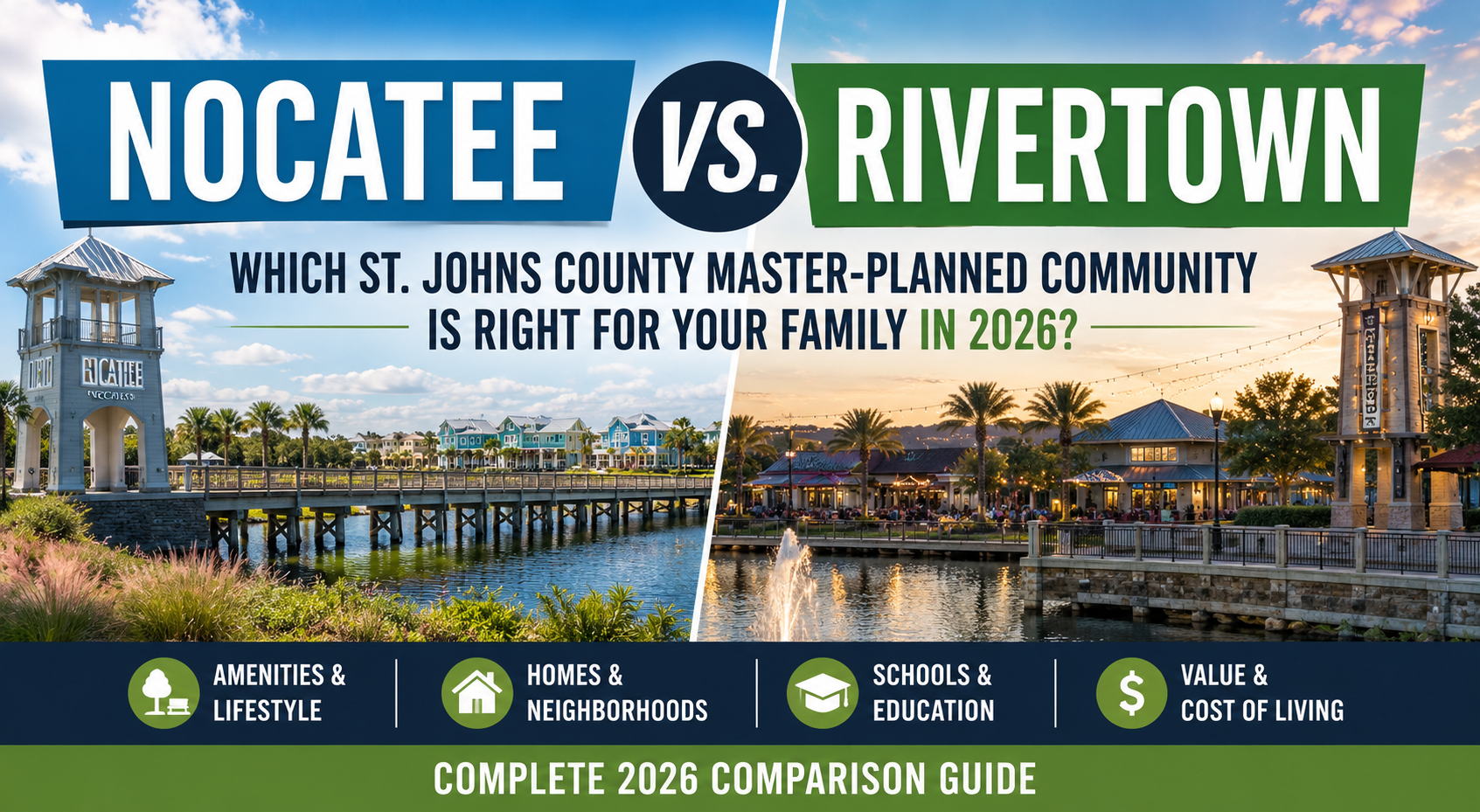
Posted in Guides
June 8, 2026

The Real Tax Savings of Moving to St. Johns County, FL


Nobody likes talking about taxes. But when a single relocation decision can put $8,000 to $12,000 — or more — back in your pocket every single year, it becomes one of the most important financial conversations you can have.

If you live in New Jersey or New York and you've been thinking about moving to St. Johns County, Florida, this post is your wake-up call. Not a vague promise about "Florida's tax advantages." Real numbers. Real line items. A real calculation you can run against your own situation tonight.

Let's get into it.


The Foundation: Florida Has No State Income Tax

This is the headline — and it deserves to be stated plainly before anything else.

Florida is one of only nine states in the country with no state income tax. Zero. None. Your wages, your salary, your freelance income, your consulting fees — none of it is taxed at the state level in Florida.

New Jersey's state income tax rate goes up to 10.75% — the second highest in the United States.

New York's state income tax rate goes up to 10.9%. Add New York City's local income tax of up to 3.876% if you live in the five boroughs, and city residents can face a combined state and local income tax rate approaching 14.776%.

That is not a typo. Nearly 15 cents of every dollar earned goes to New York State and New York City before federal taxes even enter the picture.

The moment you establish Florida residency — and domicile your life in St. Johns County — that state and local income tax burden drops to zero. Permanently.


The Simple Calculator: A $120,000 Household

Let's make this concrete. Meet a household earning $120,000 per year — a dual-income couple, a mid-career professional, or a retiree drawing from a pension and investment accounts. Here's what their tax picture looks like in each state versus St. Johns County, Florida.

State Income Tax

  • New Jersey ($120K income): New Jersey taxes this income across graduated brackets. A household earning $120,000 in NJ pays approximately $5,200–$6,800 in state income tax annually depending on filing status and deductions.
  • New York ($120K income): New York State income tax on $120,000: approximately $6,100–$7,400. Add NYC local tax if applicable: approximately $3,200–$4,000 more. Total state plus local for NYC residents: $9,300–$11,400 per year.
  • St. Johns County, FL ($120K income): State income tax: $0. Local income tax: $0. Annual income tax savings versus NJ: $5,200–$6,800. Annual income tax savings versus NYC: $9,300–$11,400.

Property Taxes

  • New Jersey (on a $550,000 home): At New Jersey's average effective property tax rate of 2.23%, annual property taxes: approximately $12,265.
  • New York (on a $550,000 home outside NYC): At New York's average effective property tax rate of 1.72%, annual property taxes: approximately $9,460.
  • St. Johns County, FL (on a $550,000 home): At Florida's average effective property tax rate of 0.86%, annual property taxes before exemptions: approximately $4,730. After the Florida Homestead Exemption ($50,000 off assessed value): approximately $4,300.

Annual property tax savings versus NJ: $7,965. Annual property tax savings versus NY: $5,160.

The $120K Household Running Total

NJ resident moving to St. Johns County: Income tax savings: $6,000 Property tax savings: $7,965 Total annual savings: approximately $13,965

NY/NYC resident moving to St. Johns County: Income tax savings: $10,350 Property tax savings: $5,160 Total annual savings: approximately $15,510

NY State resident (outside NYC) moving to St. Johns County: Income tax savings: $6,750 Property tax savings: $5,160 Total annual savings: approximately $11,910

Every one of these scenarios lands solidly in the $8,000–$15,000 annual savings range — and we haven't touched retirement income, investment income, or estate planning yet.


Florida's Homestead Exemption: What It Is and How It Works

Once you purchase a primary residence in Florida and establish it as your homestead, you qualify for the Florida Homestead Exemption — one of the most valuable property tax benefits in the country.

Here's exactly what it does:

The first $25,000 of your home's assessed value is completely exempt from all property taxes. The next $25,000 (assessed value from $25,001 to $50,000) is exempt from all taxes except school district taxes. In practice, this reduces your taxable assessed value by up to $50,000 — saving the average St. Johns County homeowner approximately $500–$700 per year on their tax bill compared to a non-homesteaded property.

To qualify, the property must be your permanent primary residence as of January 1st of the tax year. You must apply through the St. Johns County Property Appraiser's office by March 1st of the year you're claiming the exemption.

This is not automatic. It requires an application. One of the first calls I tell every buyer to make after closing is to the Property Appraiser's office to file their homestead exemption.


The Save Our Homes Cap: Your Protection Against Future Tax Spikes

This is the benefit that New Jersey and New York homeowners understand most viscerally — because they've lived without it.

In NJ and NY, your property tax bill can increase dramatically year over year as municipal budgets grow, assessments are updated, and local governments raise rates. There is no meaningful limit on how fast your property tax bill can climb. Many long-term NJ homeowners have watched their annual property tax bill increase by $1,000–$3,000 in a single reassessment cycle.

Florida has the Save Our Homes cap — and it changes everything.

Once you file a Homestead Exemption on your Florida primary residence, the Save Our Homes cap limits the annual increase in your property's assessed value to 3% or the rate of inflation — whichever is lower. Every year. Permanently, as long as you maintain homestead status.

This means that even if the real estate market surges and your home's market value increases by 15% in a year, your taxable assessed value can only go up by 3% maximum. Your property tax bill is structurally protected from the kind of runaway increases that have driven so many New Jersey and New York homeowners out of their homes.

Over a 10-year homeownership period in a rising market, the Save Our Homes cap can easily save a St. Johns County homeowner $15,000–$40,000 in cumulative property taxes compared to what they would have paid without the cap. That is money that stays in your family — not in a municipal budget.

Portability: Florida also allows you to take your accumulated Save Our Homes savings — called "portability" — with you when you move to another Florida home. If you've built up significant protected value in your first Florida home and decide to upsize or downsize within the state, you don't start from zero. You carry up to $500,000 of that protected assessment difference to your new home. This is a powerful long-term benefit that compounds over time.


Taxes on Retirement Income: Where Florida Wins Completely

For retirees or near-retirees moving from New Jersey or New York, the income tax picture gets even more favorable — because Florida doesn't just spare your wages. It spares everything.

  • Social Security income: New Jersey: partially taxed for higher-income households. New York: partially taxed at the state level. Florida: completely exempt. $0 in state tax on Social Security. Ever.
  • Pension income: New Jersey: fully taxed as ordinary income at state rates. New York: partially taxed (some government pensions exempt, private pensions taxed). Florida: completely exempt. $0 in state tax on pension income.
  • IRA and 401(k) distributions: New Jersey: taxed as ordinary income. New York: taxed as ordinary income (some pension exclusions apply). Florida: $0 in state tax on retirement account distributions.
  • Investment income (dividends, capital gains): New Jersey: taxed at state income tax rates. New York: taxed as ordinary income at state rates. Florida: $0 in state tax on investment income.

For a retired couple drawing $95,000 per year from a combination of Social Security, pension, and IRA distributions — which is a typical picture for a retiring NJ or NY professional — the annual state income tax savings in Florida range from $3,500 to $8,500 depending on their prior state and income composition.

Over a 20-year retirement, that differential compounds to $70,000–$170,000. Before investment growth. Before the property tax savings. Before the Homestead Exemption and Save Our Homes cap.

The cumulative lifetime tax advantage of retiring in Florida versus New Jersey or New York is, for most households, a six-figure number. Often well into the six figures.


Estate and Inheritance Tax: The Benefit Nobody Talks About Until It's Too Late

This is the category that catches the most people off guard — because estate and inheritance taxes aren't something most families think about until they're deep into retirement planning or dealing with a loss.

  • New Jersey: NJ abolished its state estate tax in 2018, but it still imposes a state inheritance tax on assets left to certain beneficiaries. Siblings, nieces, nephews, and non-family members can face NJ inheritance tax rates up to 16%. If you have a complex family situation or plan to leave assets to anyone other than a spouse or direct descendants, New Jersey's inheritance tax is a real planning concern.
  • New York: New York imposes a state estate tax with an exemption of approximately $7.16 million (2026). Estates above that threshold are taxed at rates up to 16%. New York also has a notorious "cliff effect" — if your estate exceeds the exemption by even a small amount, the entire estate above zero becomes taxable, not just the excess. For high-net-worth households, this is a significant planning issue.
  • Florida: No state estate tax. No state inheritance tax. None. Assets pass to your heirs without any Florida state-level death tax, regardless of the size of your estate or who your beneficiaries are.

For families with meaningful accumulated wealth — a combination of real estate equity, retirement accounts, investment portfolios, and business interests — establishing Florida domicile before death can preserve hundreds of thousands of dollars in state-level death taxes for the next generation.

This is not a fringe benefit. For households with estates above $1–2 million, it is one of the most significant financial advantages of Florida residency.


Domicile Matters: How to Make the Tax Benefits Stick

Here's something most articles skip — and it's important.

Simply buying a home in Florida does not automatically make you a Florida resident for tax purposes. New Jersey and New York are aggressive about auditing former residents who claim to have moved but maintain significant ties to the original state. NJ and NY have been known to pursue tax claims against former residents for years after a stated relocation — and they win those cases when the former resident hasn't properly established Florida domicile.

To properly establish Florida domicile and protect your tax benefits, you need to take deliberate steps including:

Obtain a Florida driver's license and surrender your NJ or NY license. Register your vehicles in Florida. Register to vote in Florida. File a Florida Declaration of Domicile with your county clerk. Update your estate planning documents — will, trust, power of attorney — to reflect Florida domicile. Spend the majority of your time (183+ days per year) in Florida. Update your address on bank accounts, brokerage accounts, insurance policies, and with the IRS. Resign from any NJ or NY professional or civic organizations where membership implies primary residence.

This is not complicated, but it is deliberate. I always recommend working with a Florida-based estate attorney and CPA in the year of your move to make sure your domicile change is properly documented and bulletproof.


The Full Annual Savings Picture: $120K Household Summary

Let's bring it all together for a household earning $120,000 moving from New Jersey to St. Johns County, Florida:

State income tax savings: $6,000/year Property tax savings (NJ vs. FL on comparable homes): $7,965/year Homestead Exemption additional savings: $600/year Save Our Homes cap (estimated value in year 3+): $800–$2,000/year Retirement income tax savings (if applicable): $3,500–$6,000/year

Conservative annual total for a working household: $14,565/year Annual total for a retired household drawing $95K: $18,000–$22,000/year

Over 10 years for a working household: $145,650 in cumulative tax savings Over 20 years for a retired couple: $360,000–$440,000 in cumulative tax savings

These are not projections built on best-case assumptions. These are conservative estimates based on actual current tax rates, actual current property tax data, and actual Florida exemption values.

The money is real. The savings are real. And for most households, the only variable is how soon they decide to act on them.


One More Number to Leave You With

New Jersey has the highest property tax burden of any state in America. New York City residents pay a combined state and local income tax rate that is among the highest of any jurisdiction in the developed world.

Florida has no income tax, no estate tax, no inheritance tax, a capped property tax assessment system, and one of the most generous homestead exemption programs in the country.

You have been subsidizing one of the most expensive tax environments in America. St. Johns County is offering you a way out — with world-class schools, resort-style communities, and a lifestyle that most people only get to experience on vacation.

The math has never been more obvious. The only question is what you're waiting for.


Want a Personalized Tax Savings Estimate for Your Situation?

Every household is different. Your income sources, your home value, your retirement timeline, and your estate planning picture all affect what the move actually saves you. I work with relocating families and retirees from New Jersey and New York every week — and I can connect you with the right local CPA and estate attorney to run the real numbers for your household.

No pressure. No sales pitch. Just clarity — and a clear path forward.

Call or text Gail DeMarco: 904-640-8000

St. Johns County Relocation and Tax Savings Specialist Serving Nocatee, Ponte Vedra, St. Johns, St. Augustine, and all of St. Johns County, FL


Disclaimer: Tax figures cited are estimates based on 2025–2026 federal and state tax data. Individual tax situations vary based on income sources, filing status, deductions, and other factors. This article is for informational purposes only and does not constitute legal, financial, or tax advice. Always consult a qualified CPA and estate attorney for guidance specific to your household.


Posted in Guides