55+ CommunitiesDel WebbSaint Johns FLNew ConstructionActive Adult Living
Cleared for Landing: Del Webb at The Landings Is Saint Johns County's Most Exciting 55+ Community — And the Perks Are Sky-High
Everything you need to know about the hottest new active adult community in Northeast Florida, including how to get up to $1,500 back when you buy.
GD
Gail DeMarco
Your Over-55 REALTOR® | eXp Realty | St. Johns County Specialist 904-640-8000
If you have ever dreamed of trading winter coats for sunshine, trading traffic for pickleball, and trading the old chapter for the best one yet — your runway is ready. Del Webb at The Landings in Saint Johns, Florida is officially open, and it is turning heads, dropping jaws, and filling up fast.
I am Gail DeMarco, your dedicated Over-55 REALTOR® in St. Johns County, and I have toured this community with buyers from across the country. Let me tell you this one is different. This one has that feeling. Read on to find out why Del Webb at The Landings might just be your final destination.
A Storied Legacy Lands in Saint Johns County
Del Webb is not just a builder it is a legacy. Founded in 1960 by Arthur Minshall and named after Del E. Webb, the company pioneered the concept of age-restricted active adult living in the United States with the original Sun City community in Arizona. Del Webb did not just build homes it invented an entirely new way to live in retirement, one that centered on community, activity, friendship, and purpose.
More than six decades later, Del Webb, now a flagship brand under PulteGroup — one of the nation's largest homebuilders continues to raise the bar for 55+ communities. And in 2024, PulteGroup made a bold move: it acquired 963 acres in northern St. Johns County to create The Landings at Saint Johns, a master-planned community that would become home to both The Landings by Pulte Homes and the crown jewel Del Webb Saint Johns.
Ground broke in the summer of 2024 south of Greenbriar Road and west of Longleaf Pine Parkway, and sales launched in 2025. The response from buyers? Exactly what you would expect when Del Webb enters one of the fastest-growing counties in the entire country.
"St. Johns County is the most sought-after destination for relocating retirees from the Northeast and Midwest and Del Webb at The Landings is the community they have been waiting for." Gail DeMarco, Over-55 REALTOR® 904-640-8000
✈️ Why "The Landings"? This Community Has Aviation in Its DNA
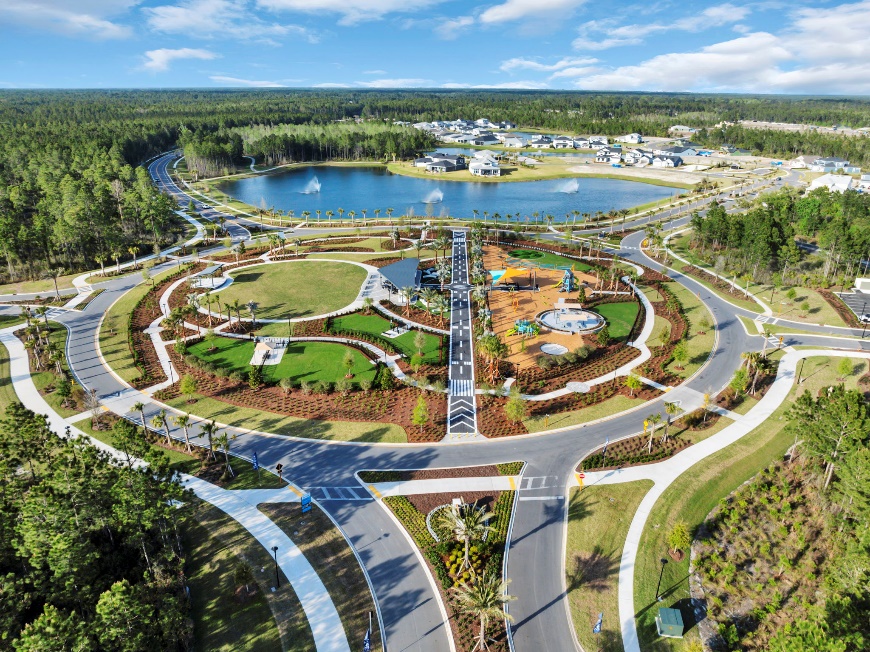
From the moment you turn into the community, you notice it. The street names are not ordinary they are intentional. Contrail Court. Skipping Stone Court. These names are a nod to the golden age of aviation, evoking freedom, lift-off, and the thrill of a destination reached.
The community name itself The Landings is a love letter to everyone who has spent decades in the climb and is now ready to touch down somewhere truly spectacular. You have worked hard, raised families, built careers, navigated turbulence. Now it is time to land somewhere that actually deserves you.
This aviation theme runs through the spirit of the entire development: a sense of adventure, of arrival, of beginning something magnificent. And when you see the amenity center for the first time, the metaphor becomes very literal because it looks like it belongs on a cruise ship, not a subdivision. More on that in a moment.
Del Webb at The Landings: What You Need to Know
Del Webb Saint Johns is a gated, 55+ active adult community featuring up to 761 single-family homes on generous 50-foot and 65-foot homesites. Many lots offer stunning water and preserve views. Homes range from approximately 1,600 to 3,800 square feet, with 15 thoughtfully designed floor plans across three collections Classics, Estate, and Distinctive to suit a variety of lifestyles and budgets.
Pricing starts in the low $400,000s and reaches the upper $800,000s for larger estate homes with premium finishes. Every home is built with Del Webb's signature open-concept design philosophy, gourmet kitchens, indoor-outdoor living spaces, and energy-efficient construction.
Community Quick Facts
- Up to 761 single-family homesites (55+ age-restricted)
- 50' and 65' lot options, many with water or preserve views
- 15 floor plans from 1,600 to 3,800+ sq ft
- Pricing from the low $400,000s to the upper $800,000s
- Located south of Greenbriar Road, west of Longleaf Pine Pkwy, NW St. Johns County
- Zoned for A-rated St. Johns County Schools (great for visiting grandkids!)
- New Publix grocery store less than 2 miles away
- 15 minutes to Durbin Pavilion shopping, dining, and movies
- 35 minutes to Historic Downtown St. Augustine
- Minutes from the St. Johns River for boating, fishing, and watersports
- Close proximity to stunning St. Johns County beaches and TPC Sawgrass
🚢 The Amenity Center That Looks Like a Cruise ShipThe flagship Del Webb Saint Johns amenity center a resort experience you never have to check out of.
Let me paint you a picture. You wake up in your beautiful new Del Webb home. You walk across the street to an amenity center that looks like it belongs anchored in the Caribbean. And then you realize you never have to leave. This is your life now.
The Del Webb Saint Johns amenity center sits on a sprawling 11-acre private campus and features a flagship clubhouse of approximately 19,000 square feet a space so grand and so beautifully designed that residents consistently describe it as something you would find on a luxury cruise ship. This is not your grandmother's recreation room. This is resort living, full stop.
Amenity Center Highlights
- 19,000 sq ft flagship clubhouse (cruise-ship level design)
- Resort-style pool with zero-entry access and outdoor spa
- Innovative state-of-the-art fitness center
- On-site Tavern and Grill (your new favorite neighborhood spot)
- Pickleball courts and multi-sport courts
- Grand ballroom for events, dances, and celebrations
- Community garden
- Full-time Del Webb Lifestyle Director to organize clubs and activities
- RV and boat storage parking available for a fee
- Walking trails and outdoor recreation spaces
The RV and boat storage is a detail that gets buyers from Florida's coastal communities and snowbirds from the Midwest genuinely excited. You no longer have to choose between the community you love and the adventures you live for. Bring the RV. Bring the boat. Park them right here.
The HOA Fee That Actually Makes Sense
HOA fees get a bad reputation but not all HOA fees are created equal. When you look at what is included at Del Webb at The Landings, the math becomes very clear very fast.
✅
High-Speed Internet Included
🚤
RV & Boat Parking Available (fee)
🎉
Full Resort Amenity Access
At $298 per month, residents receive access to all community amenities plus high-speed internet service included in the HOA. When you factor in what you would pay separately for internet, club memberships, gym access, and recreational facilities in a typical retirement scenario, this number is a genuine bargain for the lifestyle on offer.
And for those with RVs, boats, or watercraft additional parking is available within the community for a separate fee, giving you the security and convenience of keeping your adventure equipment close to home.
As your Over-55 specialist, I monitor Del Webb's promotions, pricing adjustments, and inventory in real time. I will make sure you never leave money on the table and never miss a window. These incentives are not advertised loudly they reward buyers who are working with the right agent at the right time.
Why Saint Johns County? Let Me Count the Ways.
St. Johns County is consistently ranked among the best places to live in Florida and in the entire United States. It holds the distinction of having some of Florida's highest-rated public schools, some of the lowest crime rates in the state, and a quality of life that attracts buyers from New York, New Jersey, California, Illinois, and beyond. For retirees relocating to Northeast Florida, Saint Johns is almost always the answer.
Here is what makes the location of Del Webb at The Landings particularly powerful:
Location Highlights
- Minutes from the St. Johns River for boating, fishing, and kayaking
- 30 to 40 minutes from world-class St. Johns County beaches
- 35 minutes to Historic Downtown St. Augustine, the oldest city in America
- 25 minutes to St. Johns Town Center and St. Augustine Premium Outlets
- Near TPC Sawgrass, home of The Players Championship
- Jacksonville International Airport approximately 30 minutes north
- World-class healthcare systems including Mayo Clinic Jacksonville nearby
- No Florida state income tax
- Homestead exemption available for Florida primary residents
Frequently Asked Questions About Del Webb at The Landings
Is Del Webb at The Landings age-restricted?
Yes. Del Webb Saint Johns is a 55+ age-restricted community. At least one resident per household must be 55 or older, and no permanent residents under the age of 18 are permitted.
What is the HOA fee and what does it include?
The HOA fee is $298 per month when the amenity center is open and now it is $150 a month and includes high-speed internet service plus access to all community amenities. RV and boat parking storage is available for an additional fee.
Are homes still available?
Del Webb at The Landings is actively selling, with inventory moving quickly. Available homesites, floor plans, and move-in timelines vary by phase. Call me directly for current inventory status.
What are the current builder promotions?
Del Webb's incentive packages change every month and can be substantial covering closing costs, design upgrades, or rate buydowns. Call Gail for the most current promotions before they change.
Can I visit and tour the community?
Absolutely. Model homes are open daily. I can coordinate your tour and give you an independent, expert perspective on every floor plan and homesite at no cost to you.
Do I need a buyer's agent to purchase a Del Webb home?
You are not required to have one, but you absolutely should. The builder's on-site sales team represents the builder not you. Having your own Over-55 specialist in your corner protects your interests, ensures you get the best available promotion, and costs you nothing extra.
Ready to Land? Call Your Over-55 REALTOR® Today
Hi, I am Gail DeMarco — Team Lead of the Coast to Coast Team at eXp Realty, licensed in Florida and California, and the dedicated Over-55 specialist for St. Johns County. I have helped hundreds of active adults find their perfect community in Northeast Florida, and Del Webb at The Landings is one I am genuinely excited about.
I tour these communities. I track the promotions. I know the homesites. And I work for you — not the builder.
✈️ EXCLUSIVE BUYER PERK: When you purchase your Del Webb home through me, you can receive UP TO $1,500 BACK toward your travel expenses to tour the community. Your next chapter should not cost you to discover.
Promotions change monthly. Inventory moves fast.
Let's talk today. 904-640-8000
📞 Call Gail Now 💬 Send a Message
Gail DeMarco | eXp Realty | FL DBPR #SL3527532 | CA DRE #01933515
Coast to Coast Team | MoveToStJohnsFl.com
The Bottom Line on Del Webb at The Landings
Del Webb at The Landings in Saint Johns, Florida is not just another 55+ community. It is a masterfully designed active adult destination built by the nation's most trusted brand in retirement living, in one of the most desirable counties in all of Florida. With a flagship amenity center that rivals any luxury resort, a $298/month HOA that includes internet, RV and boat storage options, monthly builder promotions that genuinely move the needle, and a location that connects you to beaches, history, rivers, and world-class dining this is the whole package.
And if you work with me, you get up to $1,500 back on travel expenses just for making the trip to see it in person.
The runway is clear. The weather is perfect. It is time to land.
Call or text Gail DeMarco at eXp Realty your Over-55 REALTOR® for St. Johns County and let's get you into Del Webb at The Landings before the best homesites are gone. Visit MoveToStJohnsFl.com to learn more.
July 27, 2026
.png)
I ask every relocated client the same question, usually about a year after closing: "Be honest — what do you actually miss?"
The answers are consistent enough that I can share them with confidence. This isn't a sales pitch. It's the real, balanced picture — because anyone considering this move deserves the truth, not just the highlight reel.
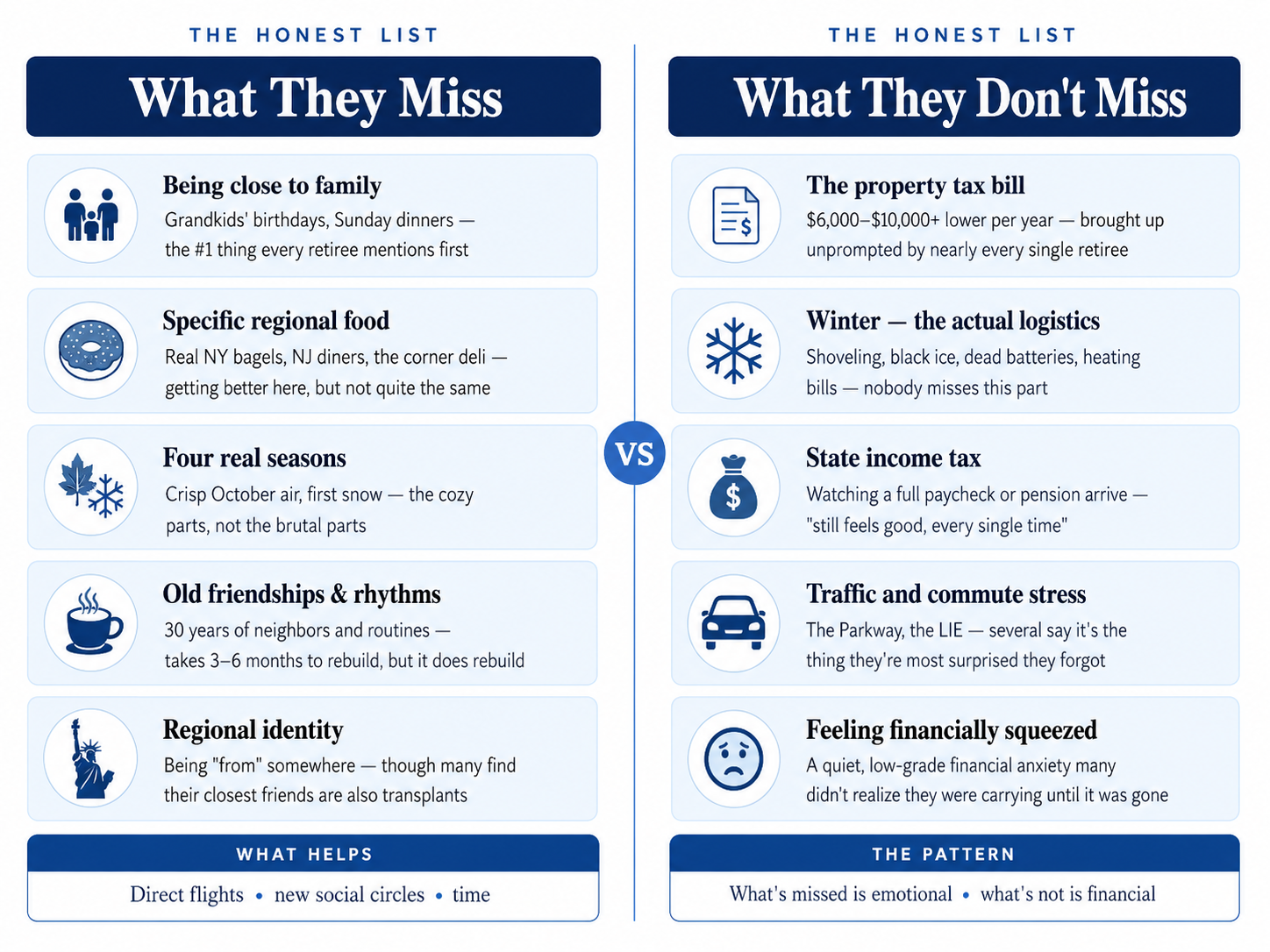
What They Miss
1. Being close to family
This is the one thing every single person says first, without hesitation. Grandchildren's birthdays. Sunday dinners. Being able to drop by unannounced. Distance from adult children and grandchildren is the genuine emotional cost of this move — and no property tax savings offsets it completely.
What helps: Jacksonville International Airport offers direct flights to New York, Boston, Newark, and Philadelphia, making visits manageable. Many families settle into a rhythm — grandkids visit for a week at Christmas and again in summer, and the retirees fly north two or three times a year. It's different. It's not the same as being fifteen minutes away. Most people say it gets easier, not because they miss it less, but because they build a rhythm around it.
2. The specific food they grew up with
This one surprises people with how much it matters. A real New York bagel. A proper NJ diner open at 2am. Real Italian delis with the right cold cuts. Certain regional pizza styles that just don't exist the same way in Florida.
What helps: St. Johns County's food scene has grown enormously, and transplant-run delis and bakeries have started appearing in Nocatee, Ponte Vedra, and St. Augustine specifically to serve this exact demographic. It's better than it used to be — but longtime residents will tell you honestly, it's still not quite the same as the corner deli you grew up two blocks from.
3. Four real seasons
Not the brutal parts — the crisp October air, the first snow, changing leaves, the coziness of a real winter evening. A few retirees genuinely miss this, particularly in November and December.
What helps: most say this fades by year two. The trade-off — swapping four months of genuine discomfort for eight months of exceptional outdoor living — tends to win out. But the nostalgia for a snowy Christmas morning is real, and no one pretends otherwise.
4. Old friendships and familiar rhythms
Thirty years of friendships built in one town don't transplant easily. The people who knew your kids growing up. The neighbor you've had coffee with every Tuesday for two decades. This is a real loss, and it takes time to rebuild.
What helps: 55+ communities and master-planned neighborhoods here are genuinely built for this. Most relocated retirees report a real social circle forming within three to six months — largely because the amenity structure (pools, clubs, pickleball leagues, HOA events) creates repeated, natural points of connection. It doesn't replace 30-year friendships. It does become something real, faster than most expect.
5. The specific identity of "being from" somewhere
Some retirees genuinely miss the cultural identity — the accent, the humor, the shared references of being a New Yorker or a Jersey native. That doesn't disappear when you move, but it can feel diluted in a place full of transplants from everywhere.
What helps: St. Johns County has such a high concentration of Northeast transplants that entire informal social circles have formed around shared origin. Many retirees find their closest new friends are, ironically, other people from NJ and NY who made the same move.
What They Don't Miss — At All
1. The property tax bill
Every single person brings this up unprompted. The relief of a property tax bill that's $6,000–$10,000+ lower per year doesn't fade — it becomes a permanent source of quiet satisfaction, especially every time the old state's number comes up in conversation with friends still living there.
2. Winter — the actual logistics of it
Not the aesthetic of snow. The reality of it: shoveling, black ice, dead car batteries, delayed flights, heating bills, and the sheer mental weight of checking the forecast every day from November through March. Nobody misses this part.
3. The state income tax
Watching a paycheck or a pension distribution arrive without a state tax bite is something retirees describe as "still feels good, every single time" — even years later.
4. Traffic and commute stress
The Garden State Parkway. The LIE. The daily grind of getting anywhere. Nobody describes missing this. Several describe it as the thing they're most surprised they don't think about anymore.
5. Feeling financially squeezed
This is the deepest one. Many retirees describe a persistent, low-grade financial anxiety they carried in New Jersey or New York — driven by property taxes, high daily costs, and state income tax — that simply isn't part of their life anymore. Several describe it as "not realizing how much weight I was carrying until it was gone."
6. Snow removal and home maintenance stress
Between the shoveling, the roof concerns from ice dams, and the aging systems of an older Northeast home, retirees consistently describe a level of home-related stress in their old house that simply doesn't exist in a newer St. Johns County home.
Notice the pattern: what they miss is almost entirely emotional and relational. What they don't miss is almost entirely financial and logistical. That's an honest, consistent finding — and it's worth sitting with if you're on the fence about this move.
What This Actually Means If You're Considering the Move
Nobody should move to Florida expecting to feel zero nostalgia for what they left behind. That's not realistic, and any article that tells you otherwise isn't being honest with you.
What the retirees I've worked with consistently say is this: the things you miss are real, but they're manageable — a flight home, a care package of deli meat, a phone call. The things you stop carrying — the tax bill, the winter stress, the financial pressure — are also real, and they don't come back for a visit. They're just gone.
Most people describe the trade as, on balance, one of the best decisions they've made — while still being completely honest that it's a trade, not a pure win. That honesty is exactly why I'm sharing it this way.
Thinking Through Your Own Decision?
If you're weighing this move, I'd rather have the honest conversation with you now than help you regret an incomplete picture later. I can connect you with several relocated NJ and NY clients who are happy to talk through their own experience directly, unfiltered.
Call or text Gail DeMarco: 904-640-8000
St. Johns County Relocation Specialist
Serving Nocatee, Ponte Vedra, Del Webb Saint Johns, RiverTown, Palencia, St. Augustine, and all of St. Johns County, FL
This article reflects patterns and themes shared by relocated clients over time. Individual experiences vary. This content is for informational and illustrative purposes only.
July 24, 2026
Buying a home in a 55+ community is a major life decision, but there's one question many buyers quietly wonder about:
"What happens to my home, HOA fees, and CDD payments if my spouse or I pass away?"
It's not an easy conversation, but it's an important one.
The good news is that Florida law provides strong protections for surviving spouses, and understanding how HOA fees, CDD assessments, and age restrictions work ahead of time can prevent unnecessary stress for your family later.
Here's what every 55+ buyer should know before purchasing in Del Webb Saint Johns, Sweetwater at Nocatee, WaterSong at RiverTown, Regency at Evermore, or any other active adult community in St. Johns County.
The Quick Answer
Question
|
What Happens?
|
| Do HOA fees stop after death? |
No. HOA dues continue with the property. |
| Do CDD fees stop? |
No. CDD assessments remain attached to the home. |
| Can the surviving spouse stay? |
Yes. Federal law protects occupancy rights. |
| Does the home automatically transfer? |
Usually, if jointly owned. |
| Can children automatically inherit and live there? |
Not always. Community age restrictions may apply. |
The key thing to remember:
HOA dues, CDD assessments, and property taxes are attached to the property—not the individual homeowner.
HOA and CDD Fees Continue After Death
Many people assume monthly fees stop when a homeowner passes away.
Unfortunately, that's not how it works.
Whether it's an HOA payment, CDD assessment, or property taxes, the financial obligations remain with the property until ownership changes.
Depending on your situation, responsibility typically falls to:
- The surviving spouse
- The living trust
- The estate during probate
- The new owner after the home is sold
If payments aren't made, the HOA may charge late fees and, eventually, place a lien on the property.
That's why keeping these accounts current is important—even during estate settlement.
What Happens if the Home is Jointly Owned?
For most married couples in Florida, this is the simplest situation.
If the home is owned as:
- Tenancy by the Entirety (Florida's default for married couples), or
- Joint Tenancy with Right of Survivorship
ownership generally transfers automatically to the surviving spouse without probate.
That means:
- The surviving spouse keeps living in the home.
- HOA and CDD payment responsibility continues normally.
- No interruption in ownership occurs.
For many retirees, this provides valuable peace of mind.
Can the Surviving Spouse Stay in a 55+ Community?
Yes.
This is one of the biggest concerns buyers have, especially if one spouse is younger than 55.
Under the Federal Housing for Older Persons Act (HOPA), a surviving spouse generally has the right to remain in the home—even if they don't meet the community's minimum age requirement.
That protection applies across properly operated 55+ communities throughout Florida.
For example, if one spouse is 58 and the surviving spouse is only 52, the younger spouse is generally not forced to move simply because their partner passed away.
This federal protection gives many couples tremendous reassurance.
What About Selling the Home to Your Children?
This is where age restrictions become more important.
While a surviving spouse can usually remain in the home, selling or transferring ownership to someone under 55 may be subject to community rules.
Many Florida active adult communities operate under the 80/20 HOPA rule, meaning:
- At least 80% of occupied homes must have one resident age 55 or older.
- Up to 20% of homes may have younger occupants, depending on the community's occupancy level.
Because every HOA manages compliance differently, it's smart to ask before buying.
Questions to ask include:
- What percentage of the community currently qualifies as 55+ occupied?
- Can an adult child inherit and occupy the home?
- Are there waiting lists or approval requirements?
- Are exceptions allowed?
Getting these answers in writing can help avoid future surprises.
What If You're Buying Alone?
If you're purchasing as a single homeowner, estate planning becomes even more important.
Without proper planning, your home may pass through probate before ownership transfers.
During that time:
- HOA dues still must be paid.
- CDD assessments continue.
- Property taxes remain due.
Many Florida estate planning attorneys recommend a Revocable Living Trust because it can simplify the transfer process and often helps avoid probate.
While every situation is different, it's worth discussing with an experienced Florida estate attorney before purchasing.
What This Means for Your Home Search
These issues shouldn't discourage anyone from buying in a 55+ community.
In fact, Florida's laws provide strong protections for homeowners and surviving spouses.
The goal isn't to worry about the future—it's simply to understand how ownership, fees, and community rules work so you can make informed decisions.
When comparing communities like Del Webb Saint Johns, Sweetwater at Nocatee, WaterSong at RiverTown, or Regency at Evermore, don't hesitate to ask questions about:
- HOA policies
- HOPA compliance
- Transfer procedures
- Estate-related ownership changes
A knowledgeable real estate professional can help you understand these details before you buy.
The Bottom Line
If a homeowner passes away, HOA dues and CDD assessments do not disappear—they stay with the property.
For most married couples, ownership transfers smoothly to the surviving spouse, who generally has the legal right to remain in the home under federal HOPA protections.
The biggest challenges usually aren't the fees themselves—they're making sure ownership, estate planning, and community policies are understood before they're ever needed.
With the right preparation, your family can avoid unnecessary confusion during an already emotional time.
Have Questions Before You Buy?
I always encourage 55+ buyers to ask these questions during the home search — not after closing. I can walk you through each community's specific HOA and HOPA policies, and connect you with a Florida estate attorney who specializes in this exact planning for relocating retirees.
Call or text Gail DeMarco: 904-640-8000
St. Johns County 55+ Community Specialist
Serving Del Webb Saint Johns, Sweetwater at Nocatee, WaterSong at RiverTown, Regency at Evermore, and all of St. Johns County, FL
This article is for general informational purposes only and does not constitute legal or estate planning advice. HOA and CDD policies vary by community and are subject to change. Always consult a licensed Florida estate attorney regarding your specific situation and review your HOA's governing documents directly.
July 22, 2026
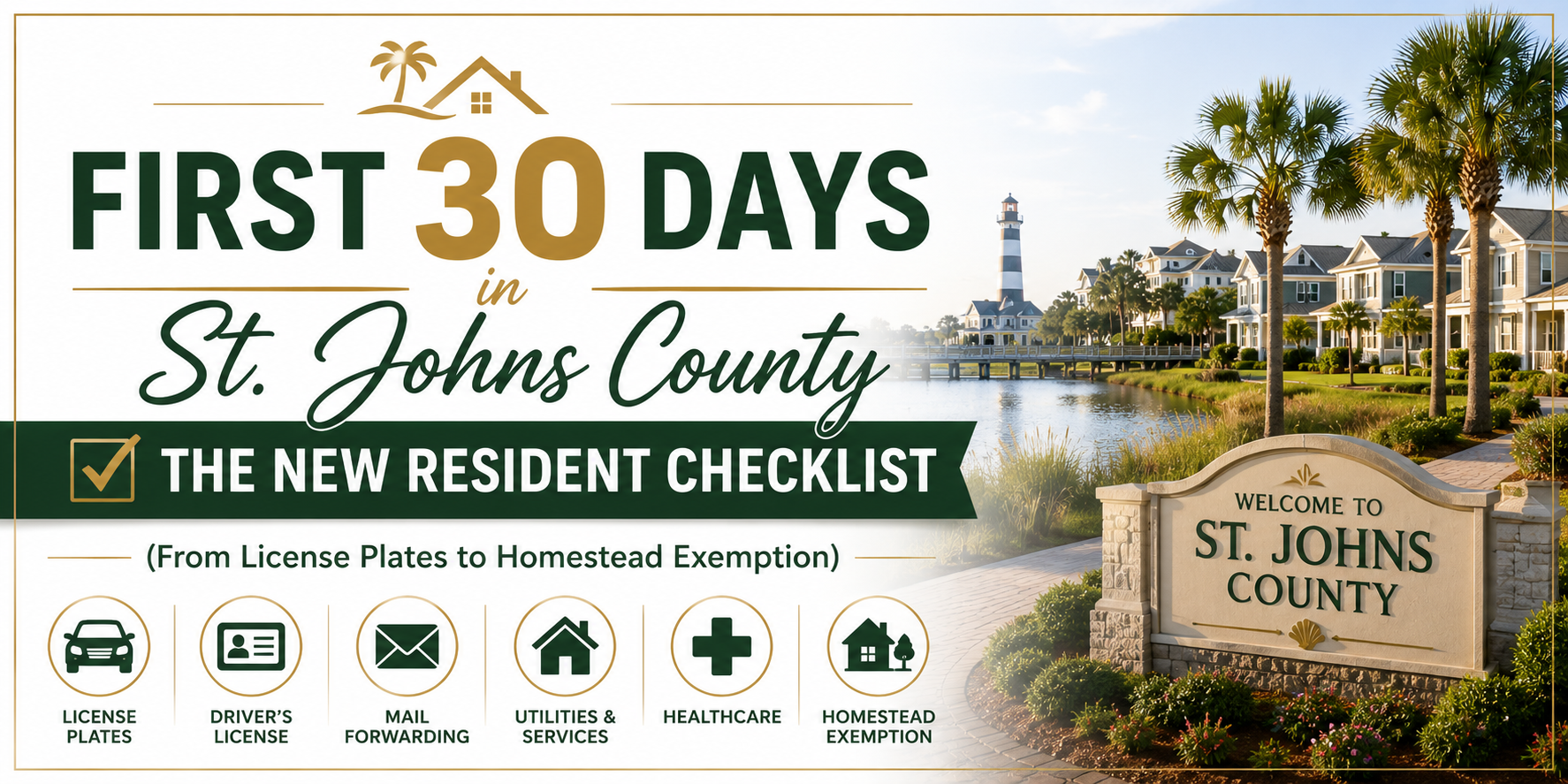
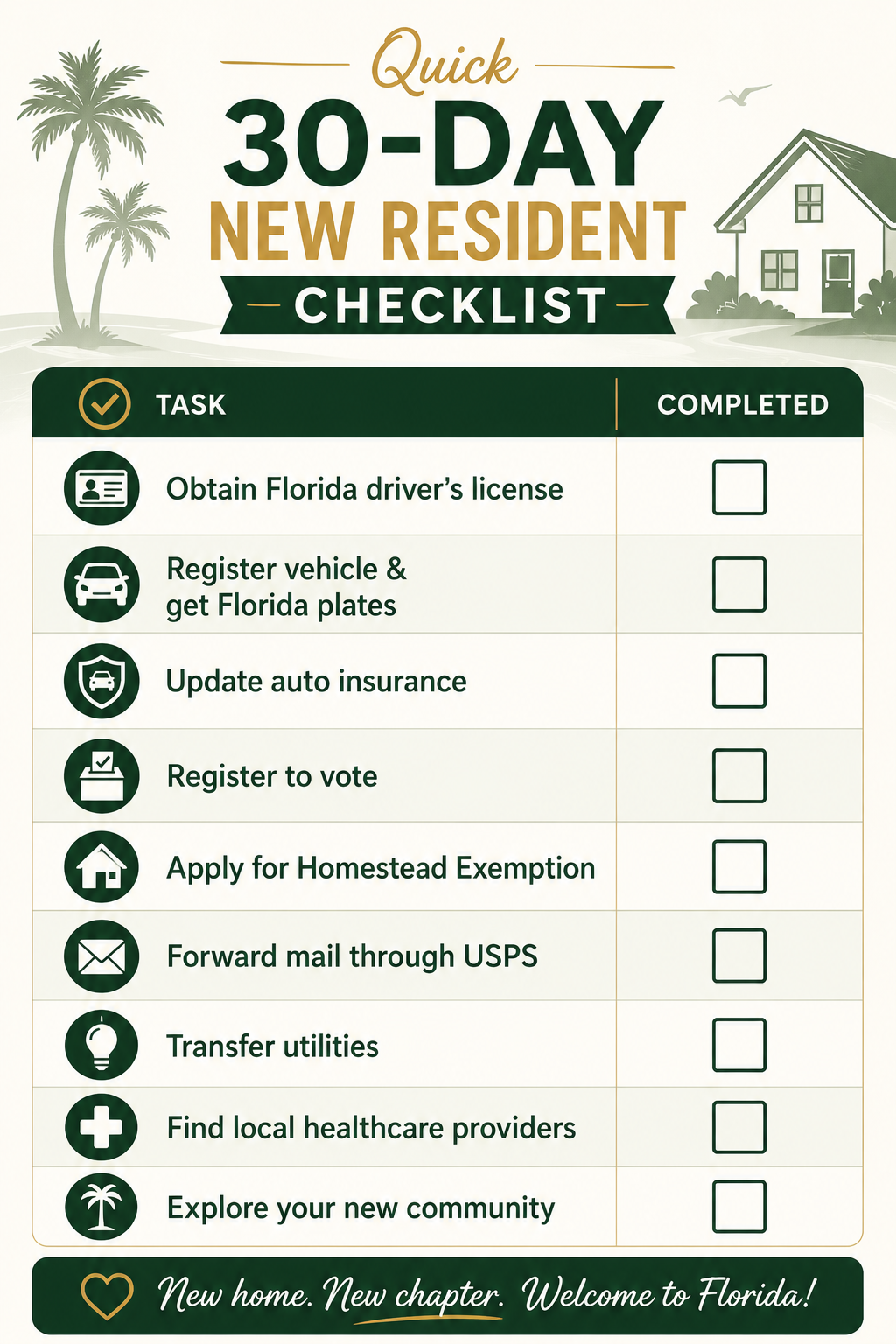
Moving to St. Johns County, Florida is exciting, but your first month is also when you should complete several important tasks that can save you money, avoid penalties, and make your transition much smoother. From updating your driver's license to filing for Homestead Exemption, here's a practical checklist to help you settle in.
Week 1: Update Your Driver's License & Vehicle Registration
If you've recently become a Florida resident, state law generally requires you to obtain a Florida driver's license and register your vehicle within 30 days of establishing residency.
You'll need to:
- Update your Florida driver's license
- Register your vehicle
- Obtain Florida license plates
- Update your auto insurance if necessary
Bring:
- Proof of identity
- Social Security number
- Two proofs of Florida residency
- Vehicle title and insurance (for registration)
Week 2: Register to Vote
Once you've updated your driver's license, registering to vote is simple.
You can:
- Register online
- Register while obtaining your Florida driver's license
- Register through the Supervisor of Elections
Being registered ensures you're ready to vote in local, state, and federal elections.
Week 3: File for Homestead Exemption
One of the biggest financial benefits for Florida homeowners is the Homestead Exemption.
If the home is your permanent residence as of January 1, you may qualify for:
- Up to $50,000 in property tax exemptions
- Protection through Florida's Save Our Homes assessment cap, which limits annual increases in assessed value for eligible homesteaded properties
For many homeowners, this can reduce property taxes while helping keep future tax increases more predictable.
Week 4: Set Up Local Services
Make life easier by transferring or setting up your local accounts:
- Electricity
- Water & sewer
- Internet service
- Trash and recycling
- USPS mail forwarding
- Banking (if changing local branches)
- Medical providers
- Schools (if applicable)
Completing these tasks early helps avoid missed bills and service interruptions.
Local Tip for New Residents
One of the best ways to feel at home is to get involved in the community. Visit local parks, explore nearby beaches, support small businesses, and attend community events throughout St. Johns County, including St. Augustine, Ponte Vedra Beach, Nocatee, Fruit Cove, Julington Creek, Hastings, and World Golf Village. Getting familiar with your area makes the transition much easier.
The Bottom Line
The first 30 days in St. Johns County are administrative — not exciting — but they are what makes your move financially and legally complete. Skip the Homestead Exemption deadline and you lose a full year of tax savings. Skip proper domicile documentation and you leave yourself exposed to a former state's tax authority.
Handle these steps in the first month, and by month two you're not managing a transition anymore — you're just living your new life in Florida.
Call or text Gail DeMarco: 904-640-8000
St. Johns County Relocation Specialist
Serving Nocatee, Ponte Vedra, Del Webb Saint Johns, RiverTown, Palencia, St. Augustine, and all of St. Johns County, FL
Deadlines, fees, and procedures are subject to change. Always verify current requirements with the St. Johns County Tax Collector, Property Appraiser, and Clerk of Court offices. Consult a licensed CPA and estate attorney regarding domicile and tax matters specific to your situation.
July 20, 2026

Moving from New Jersey or New York? A Florida home inspection is very different—and missing a few key inspections could cost you thousands after closing.
If you're relocating to St. Johns County, Florida, don't assume the inspection process is the same as it is up north.
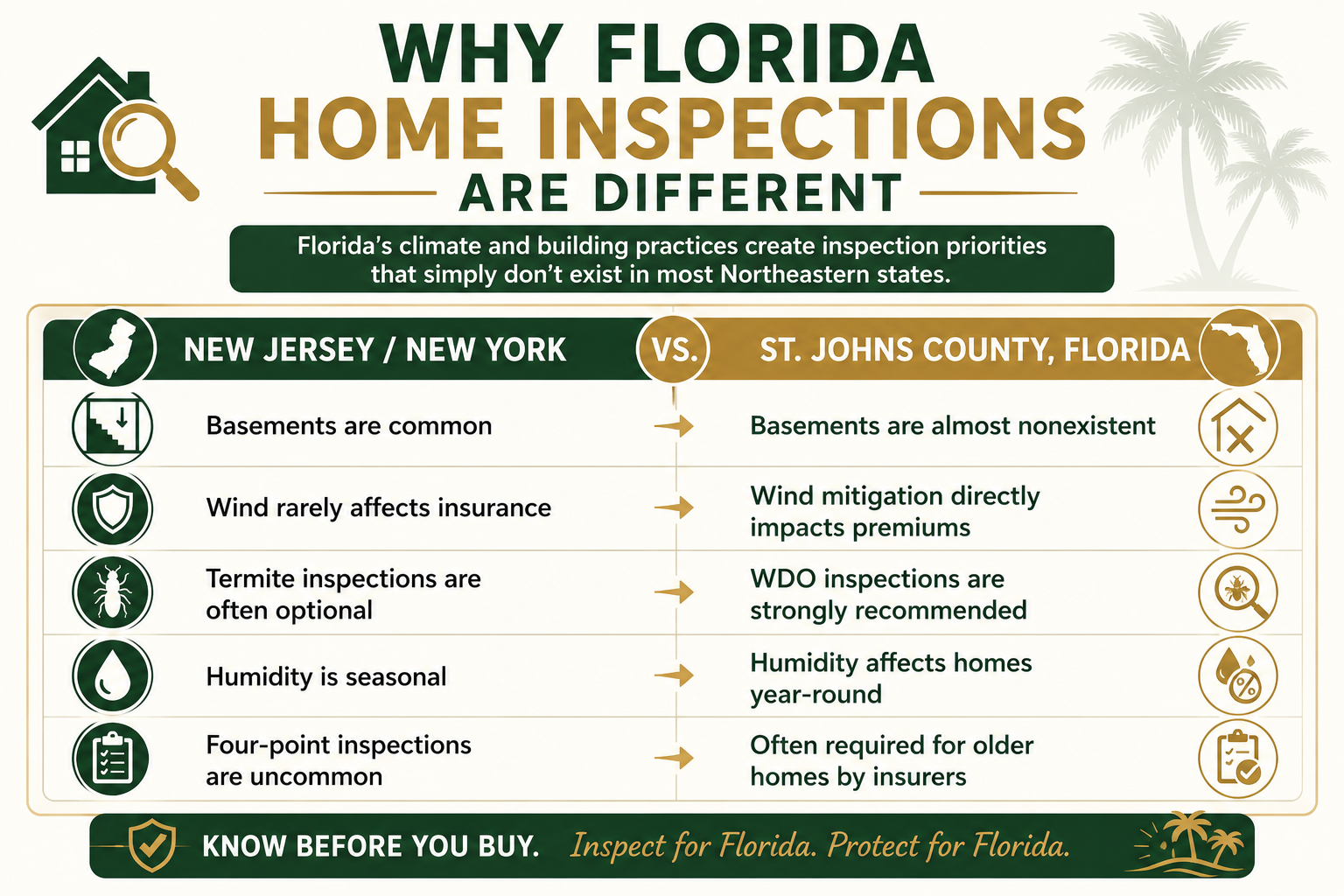
While every inspection checks the basics—roof, electrical, plumbing, HVAC, and structure—Florida homes face unique challenges from hurricanes, humidity, termites, and insurance requirements that many Northern buyers have never encountered.
Knowing what to inspect before you buy can help you:
- Avoid expensive surprises after closing
- Lower your homeowners insurance premium
- Strengthen your negotiating position
- Make a more confident buying decision
Why Florida Home Inspections Are Different
Understanding these differences before scheduling inspections helps prevent unexpected costs later.
1. Roof Condition Is More Than a Maintenance Issue
In Florida, your roof affects much more than curb appeal.
Insurance companies closely evaluate:
- Roof age
- Roofing material
- Previous storm damage
- Roof-to-deck attachment
- Roof shape (hip roofs often qualify for discounts)
Many Florida insurers become more restrictive once a roof reaches 15–20 years old.
Ask your inspector:
- How old is the roof?
- Is there evidence of storm damage?
- Are repairs visible?
- Will the roof affect insurance eligibility?
A newer roof often means lower insurance costs and stronger resale value.
2. Don't Skip the Wind Mitigation Inspection
This is one inspection many Northern buyers have never heard of—but it may provide one of the biggest returns.
A wind mitigation inspection evaluates:
- Roof shape
- Hurricane straps
- Roof deck attachment
- Impact-resistant windows
- Storm shutters
Typical cost:
$75–$150
Potential insurance savings:
15–40% annually
For many homeowners, that's hundreds—or even thousands—of dollars saved every year.
3. Four-Point Inspections Matter for Insurance
If you're buying an older home, many Florida insurance companies require a Four-Point Inspection before issuing a policy.
It evaluates:
- Roof
- Electrical
- Plumbing
- HVAC
Common issues that can increase insurance costs include:
- Federal Pacific electrical panels
- Polybutylene plumbing
- Older roofs
- Aging HVAC systems using discontinued refrigerants
These issues may become valuable negotiation points before closing.
4. Always Order a Separate Termite (WDO) Inspection
Florida's warm climate makes termites far more common than in many Northern states.
A licensed pest professional checks for:
- Active termites
- Wood-boring insects
- Wood decay fungi
Typical cost:
$75–150
Remember:
A general home inspector does not perform an official WDO inspection.
5. HVAC Systems Work Much Harder in Florida
Unlike Northern states where heating often gets more attention, Florida air conditioners operate nearly year-round.
Inspectors should evaluate:
- Unit age
- Refrigerant type
- Coil condition
- Air handler
- Ductwork
- Efficiency rating
Replacing an HVAC system can cost several thousand dollars, making older systems an important negotiation item.
6. Check the Stucco Carefully
Many St. Johns County homes feature stucco exteriors.
Watch for:
- Large cracks
- Soft spots
- Moisture intrusion
- Efflorescence
- Failed caulking around windows and doors
Moisture problems can spread quickly in Florida's humid climate, making early detection important.
7. Pools Need Their Own Inspection
If the home includes a pool or spa, schedule a dedicated inspection.
A pool inspection evaluates:
- Surface condition
- Pump and filter
- Heater
- Screen enclosure
- Deck
- Possible leaks
Inspection cost:
$150–300
Considering that pool repairs can reach thousands of dollars, this inspection is well worth the investment.
8. Evaluate Drainage and Lot Grading
Florida's flat terrain makes drainage especially important.
Inspectors should look for:
- Proper grading
- Standing water
- Downspout placement
- Drainage easements
- Retention ponds nearby
Poor drainage today can become water intrusion tomorrow.
9. Know Whether the Home Uses Sewer or Septic
Many homes in St. Johns County—especially those on larger lots—use septic systems.
A septic inspection should include:
- Tank condition
- Drain field
- System age
- Maintenance records
Spending a few hundred dollars on an inspection can help avoid a major repair bill later.
Recommended Inspection Checklist
Before closing on a Florida home, consider scheduling:
✔ General Home Inspection
✔ Wind Mitigation Inspection
✔ Four-Point Inspection (older homes)
✔ WDO (Termite) Inspection
✔ Pool Inspection (if applicable)
✔ Septic Inspection (if applicable)
✔ Sewer Scope (older homes)
✔ Mold Inspection (if moisture concerns exist)
Together, these inspections represent a small percentage of your purchase price but can help protect one of your largest investments.
Use Your Inspection Results to Negotiate
Inspection reports aren't just informational—they're powerful negotiating tools.
Common buyer requests include:
- Roof replacement credits
- HVAC replacement credits
- Electrical repairs
- Plumbing updates
- Termite treatment
- Pool equipment repairs
- Drainage improvements
In today's balanced St. Johns County market, many sellers are open to negotiating these items before closing.
The Bottom Line
A Northern buyer who runs a standard home inspection without the Florida-specific additions is leaving real money on the table — and real risk on the table.
The wind mitigation inspection alone can save $1,000+ per year on insurance. The four-point can reveal an uninsurable electrical panel before it becomes your problem. The WDO can uncover a termite infestation before it consumes your equity.
Order the full suite. Review everything with your agent. Negotiate from the results. This is not excessive caution — it is exactly what experienced Florida buyers do on every transaction.
Call or text Gail DeMarco: 904-640-8000
St. Johns County Relocation Specialist
Serving Nocatee, Ponte Vedra, Del Webb Saint Johns, RiverTown, Palencia, Shearwater, St. Augustine, and all of St. Johns County, FL
Inspection costs are estimates based on 2025–2026 St. Johns County market data. Always hire licensed Florida inspectors for each inspection type. This article is for informational purposes only.
July 17, 2026
If you're buying a new construction home in St. Johns County, you've probably seen ads offering "$30,000+ in incentives," "free upgrades," or special financing. Some offers can save you thousands—but others are simply marketing.
Here's what buyers should know before signing a builder contract.
Why Builders Are Offering Bigger Incentives
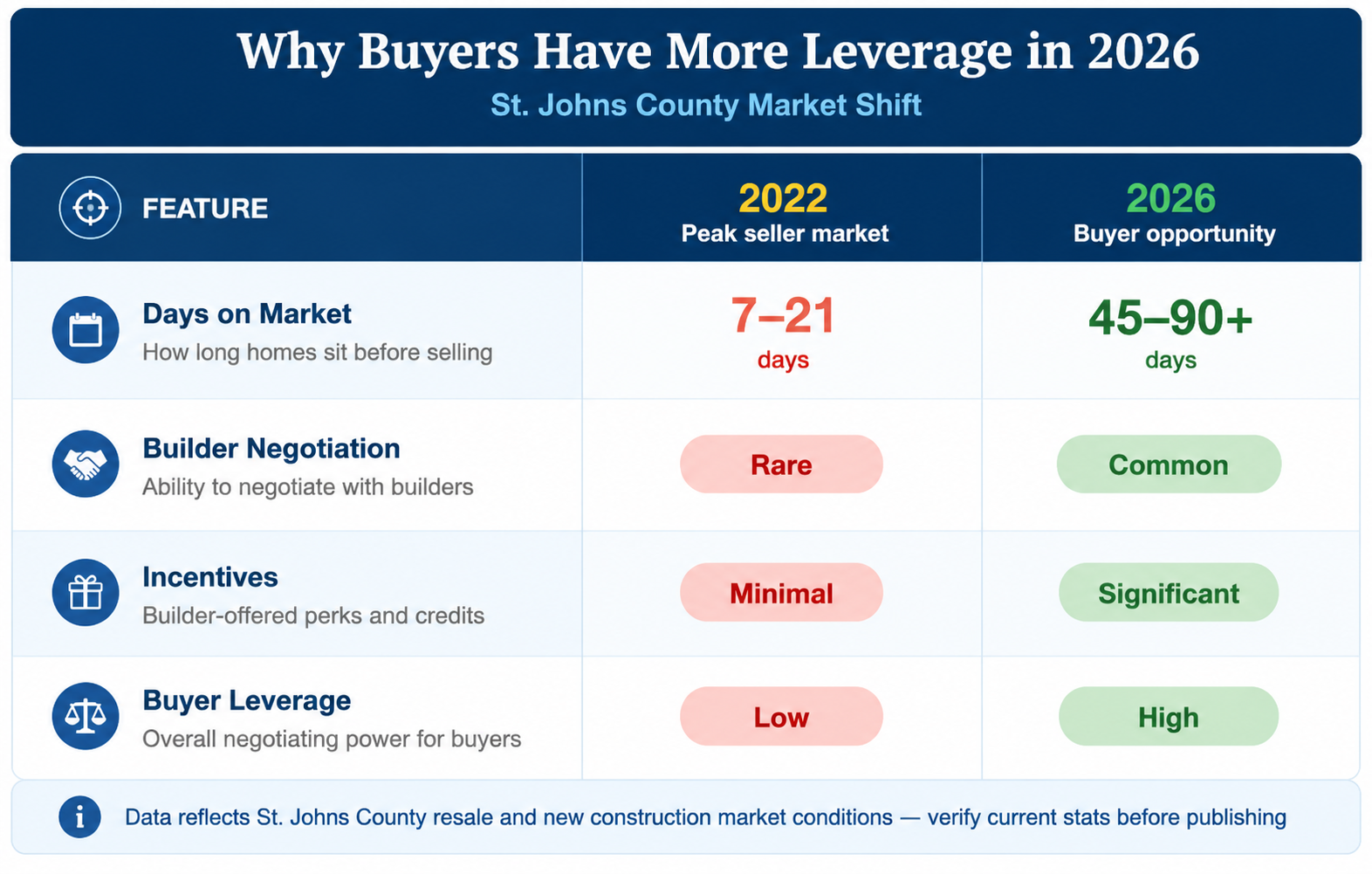
Today's market is very different from 2022. Inventory has grown, homes are staying on the market longer, and builders are competing harder for buyers.
This shift gives buyers more leverage than they've had in years.
The Incentives That Actually Save Money
1. Mortgage Rate Buydowns ⭐ Best Value
Builders may pay to reduce your mortgage rate, lowering your monthly payment for several years—or even for the life of your loan.
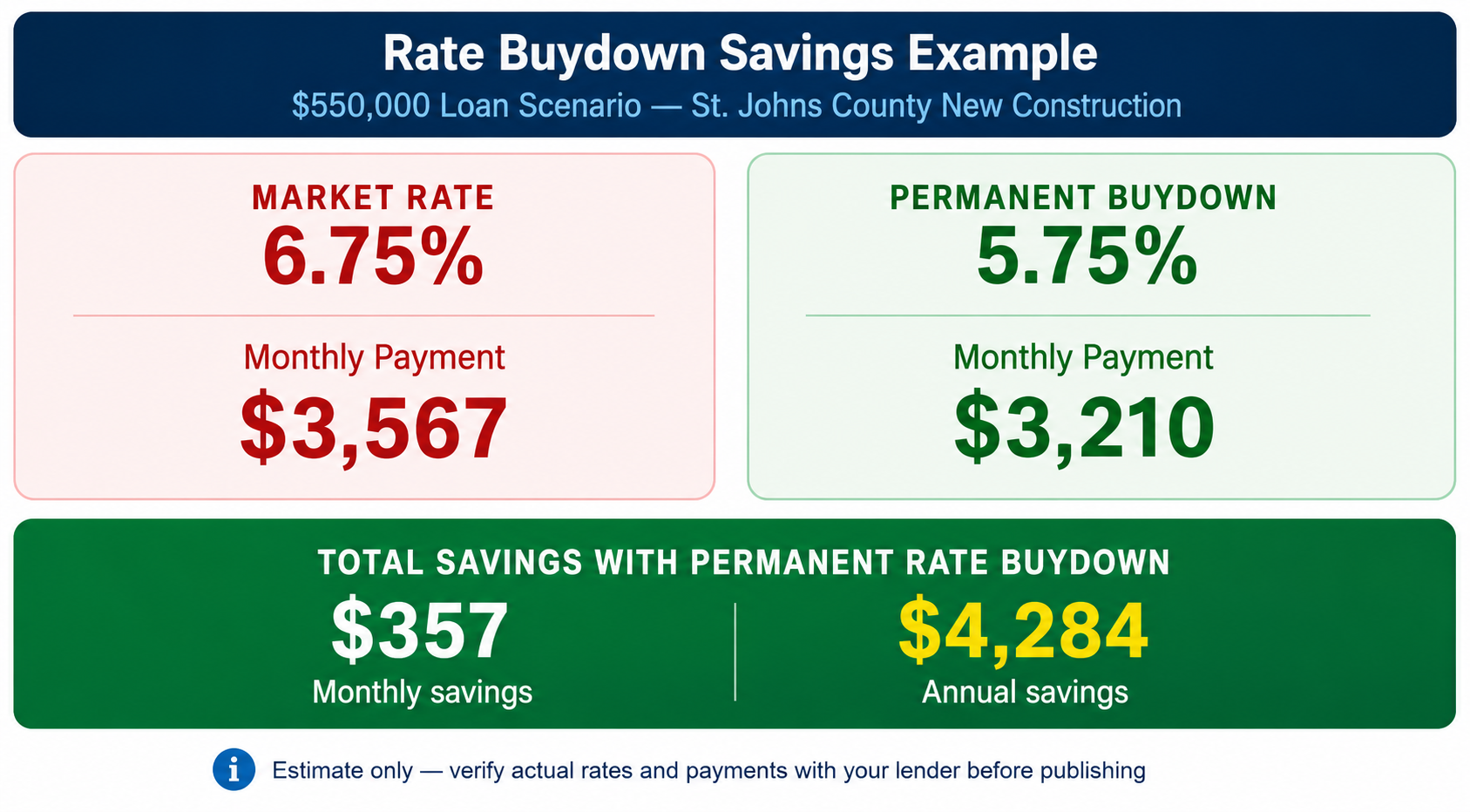
Example (Approx. $550,000 loan):
- Market rate (6.75%): $3,567/month
- Permanent buydown (5.75%): $3,210/month
- Savings: About $4,300 per year
A large closing-cost credit applied toward a permanent rate buydown can save well over $100,000 over a 30-year loan.
2. Closing Cost Credits
Builders commonly offer $15,000–$40,000 toward:
- Closing costs
- Prepaid taxes & insurance
- Mortgage points
- HOA fees
Many offers require using the builder's preferred lender, so always compare loan estimates before deciding.
3. Design Center Upgrades
Credits of $10,000–$30,000 are common.
Prioritize:
- Structural upgrades
- Extended lanais
- Better kitchens
- Quartz countertops
Skip cosmetic items like paint or light fixtures that are much cheaper after closing.
Marketing vs. Reality
Before accepting any "limited-time" promotion, ask:
- What does the incentive actually include?
- Is it tied to the preferred lender?
- Is every incentive listed in writing?
- Can I compare outside financing?
If it isn't written into the contract, don't assume it's guaranteed.
How to Negotiate Like a Pro
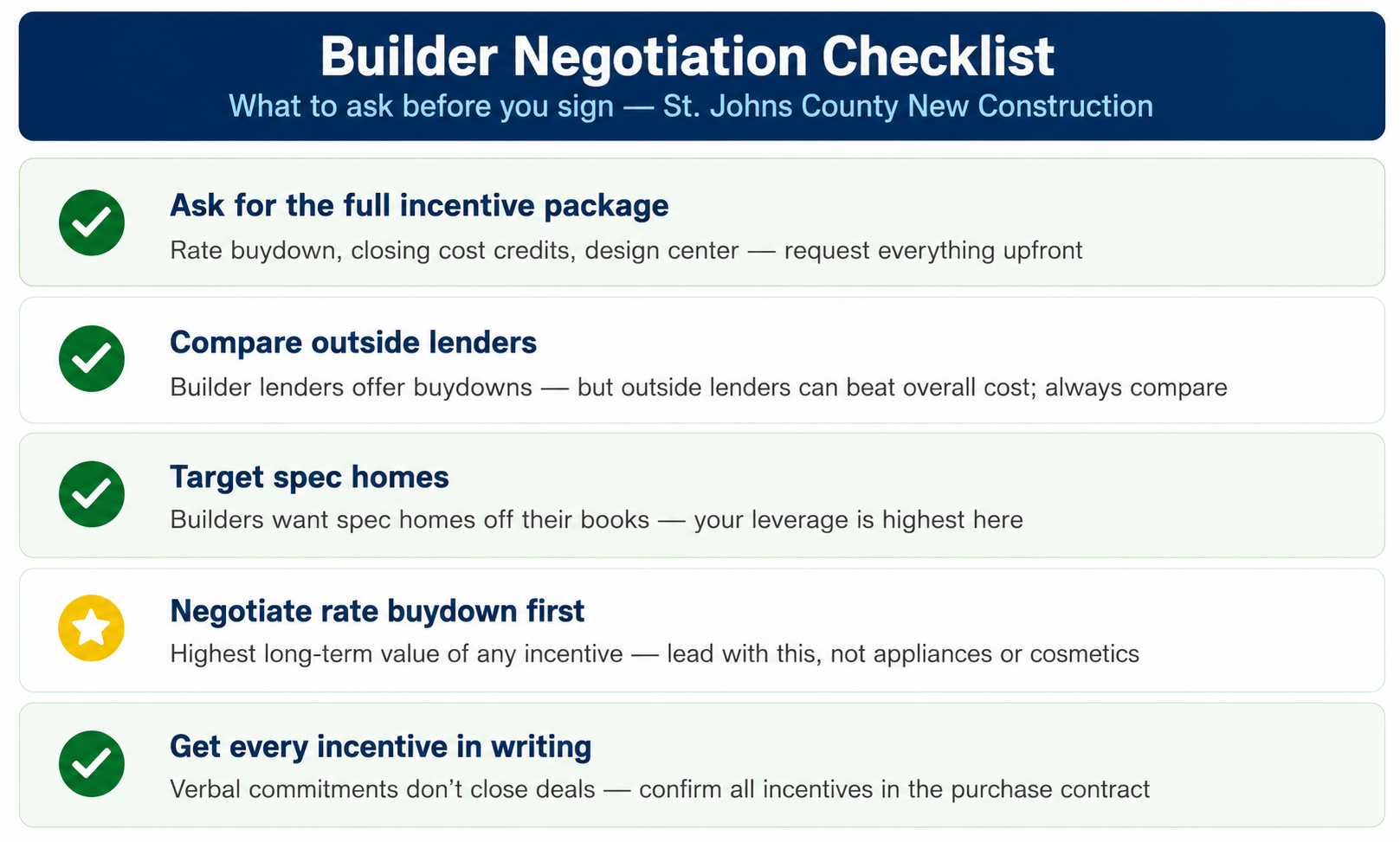
The strongest deals usually come from:
- Shopping completed spec homes
- Negotiating near quarter-end (March, June, September, December)
- Comparing mortgage quotes
- Prioritizing permanent rate buydowns over cosmetic upgrades
- Working with your own buyer's agent
Builders negotiate differently than traditional sellers, and timing can make a big difference.
Best Communities for Builder Incentives
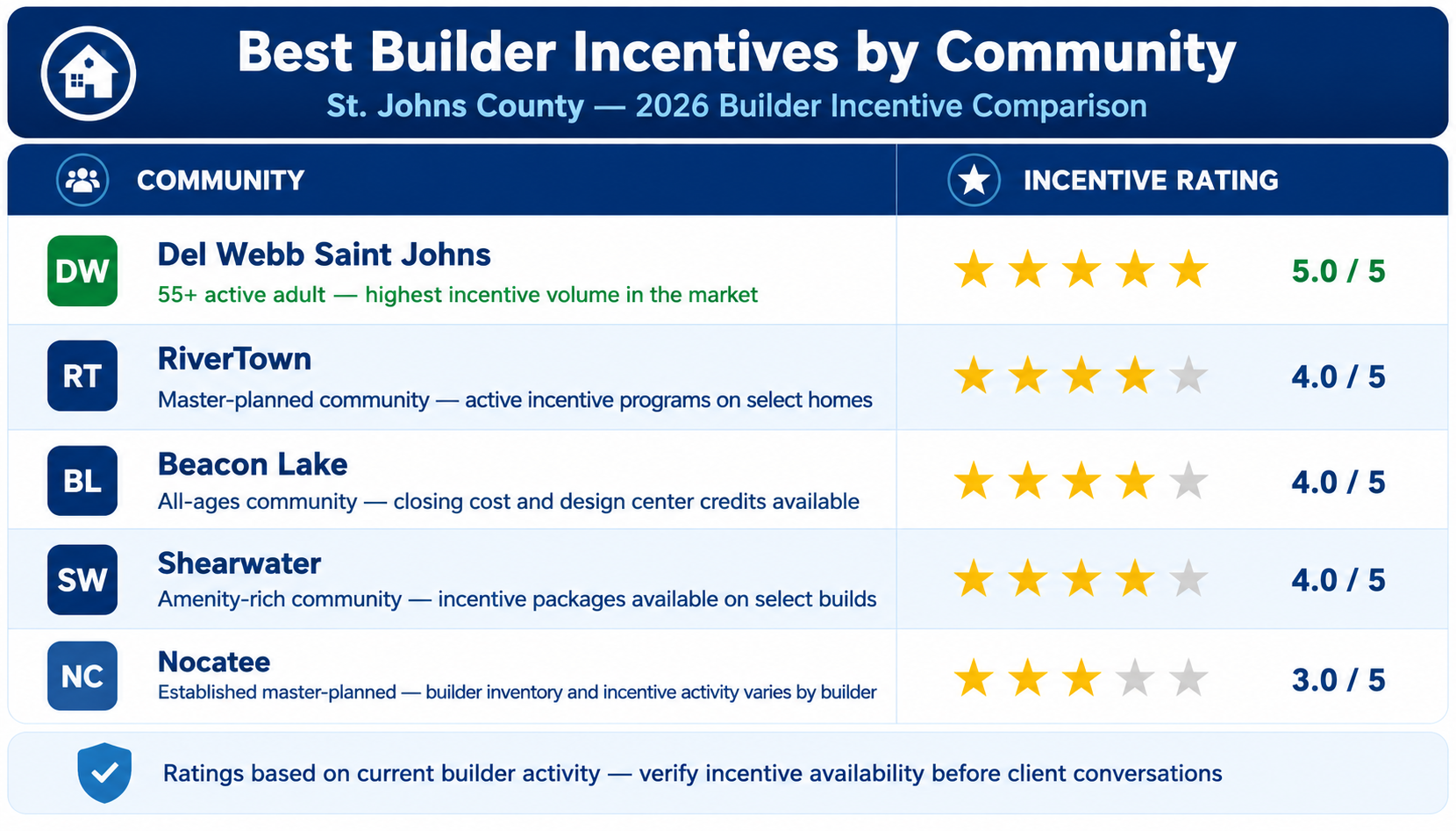
Several St. Johns County communities continue offering attractive incentives in 2026, including:
- Del Webb Saint Johns
- RiverTown
- Beacon Lake
- Shearwater
- Nocatee
- Regency at Evermore
- Palencia
- St. Augustine area communities
Offers change frequently depending on inventory and builder goals.
Bottom Line
Builder incentives are real—but knowing which incentives actually save money is the key.
A permanent rate buydown will almost always provide more long-term value than cosmetic upgrades or promotional extras. Compare financing, negotiate strategically, and don't be afraid to ask for more before signing.
Call or text Gail DeMarco: 904-640-8000
St. Johns County New Construction Specialist
Serving Nocatee, Ponte Vedra, Del Webb Saint Johns, RiverTown, Shearwater, Palencia, St. Augustine, and all of St. Johns County, FL
Builder incentive packages, pricing, and availability change frequently. All figures are estimates based on 2025–2026 market data. Always verify current incentive packages directly with builder sales offices. This article is for informational purposes only.
July 15, 2026

It's the question that keeps most relocating buyers up at night.
You've found the community you want. The numbers make sense. The lifestyle is calling. But you still own your New Jersey home — and you're not sure whether to sell it first or buy first.
Get the sequence wrong and you're either homeless between closings or carrying two mortgages. Get it right and the move feels seamless.
Here's the honest framework for making this decision in 2026.
The Two Paths: What Each Actually Means
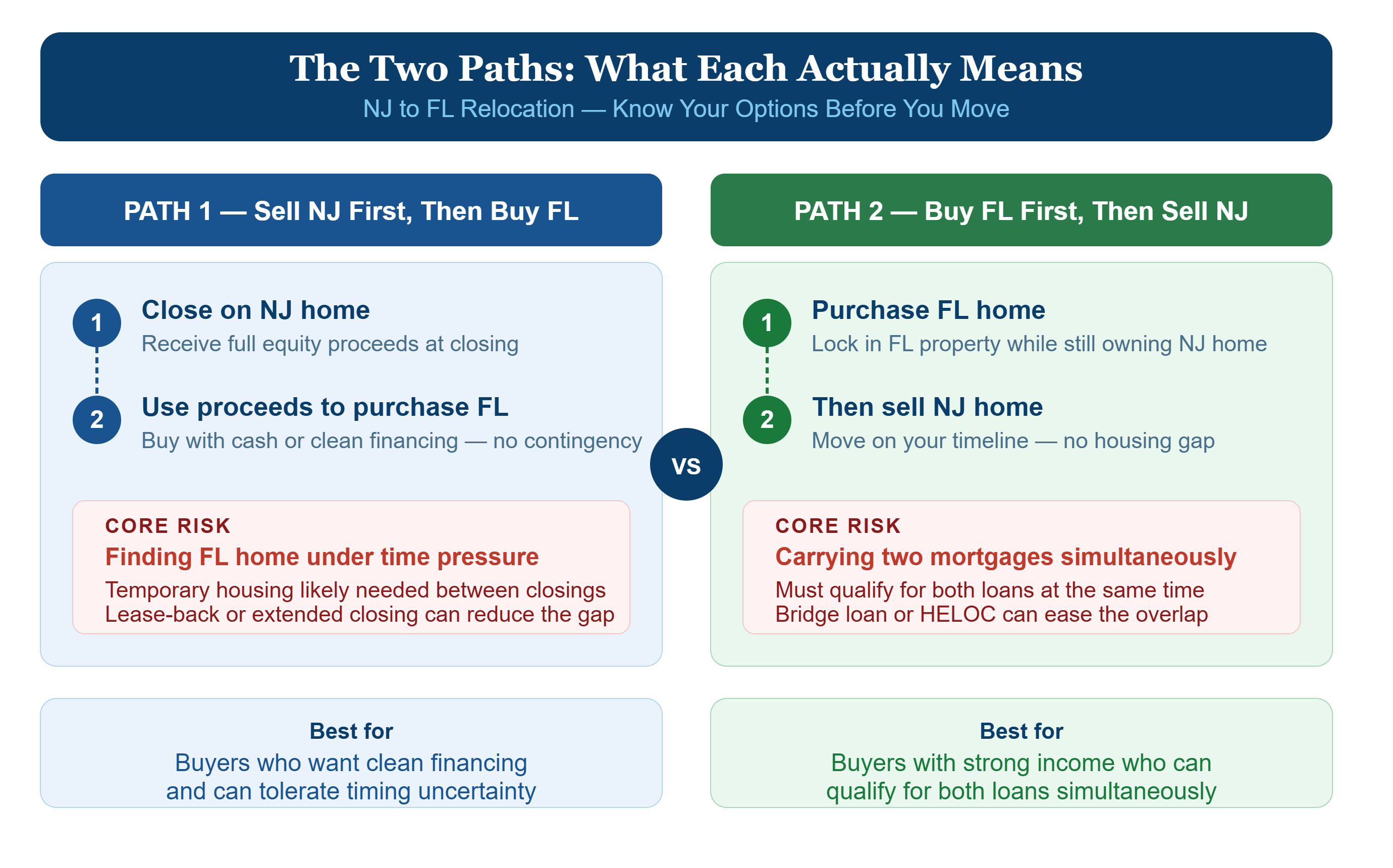
Neither is universally right. The right answer depends on your financial position, your timeline, and the current conditions in both markets.
The 2026 Market Conditions You Need to Know
Understanding both markets right now changes the calculation significantly.
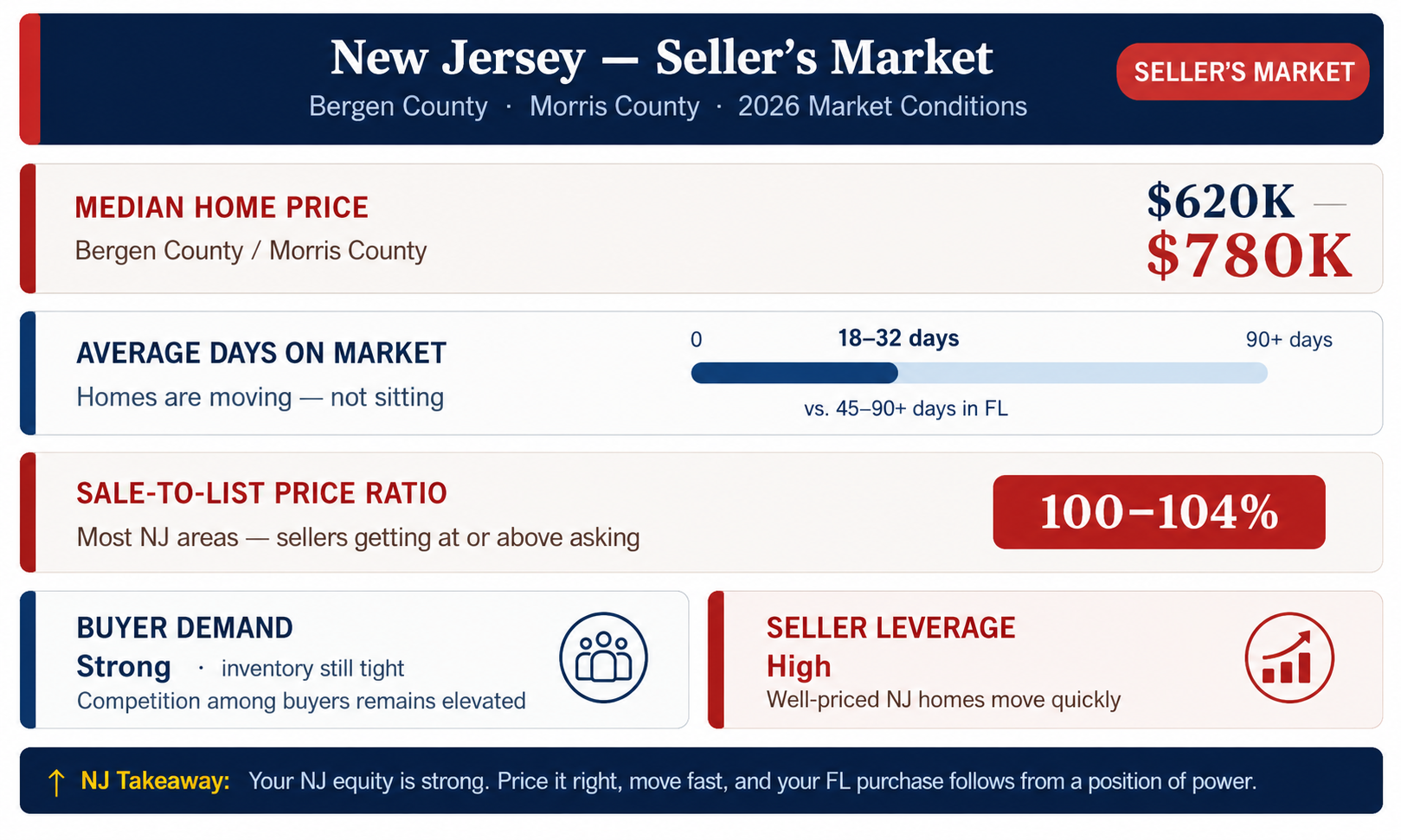
New Jersey (Seller's market in most counties):
St. Johns County (Balanced / buyer-friendly market):
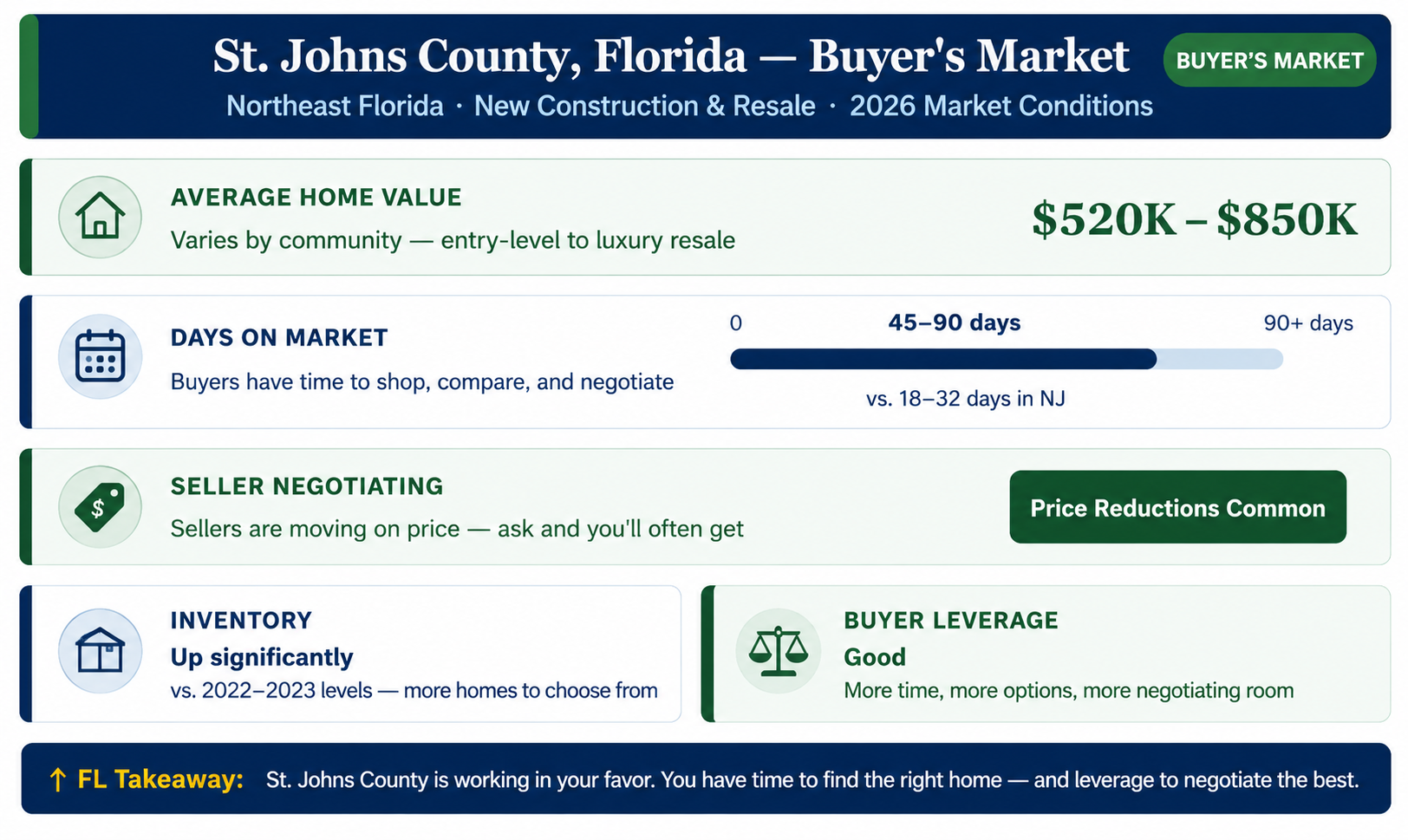
The 2026 implication: NJ homes are selling fast. St. Johns County homes are sitting longer. That combination actually makes sequencing easier — you can sell your NJ home relatively quickly and have time to find the right Florida property without being rushed.
Option A: Sell In New Jersey First
Lower-risk financial path — the right choice for most buyers in 2026
How it works:
- List and sell your NJ home
- Close and receive your full equity proceeds
- Use equity to purchase in St. Johns County — cash or strong down payment, no contingency complications
Advantages:
- No double mortgage — eliminates the biggest financial stress of the move
- Maximum buying power — cash or large down payment gives you negotiating leverage in FL
- Cleaner offers — non-contingent offers are stronger in any market
- Debt-to-income clarity — lenders qualify you on one mortgage only
- Lower financial risk — no exposure if either market shifts unexpectedly
Challenges and solutions:
- Where do you live between closings? Negotiate a rent-back from your NJ buyer, use a short-term rental, or stay with family
- What if FL prices rise before you buy? St. Johns County is stable-to-soft in 2026 — the risk is low currently
- Time pressure to find in FL? Work with an agent who can move fast when the right property appears
The rent-back strategy:
In a strong NJ seller's market, many buyers will agree to let you remain in your home 30–90 days after closing in exchange for a slightly below-market price or a modest daily rent. This eliminates the gap between closings entirely.
Option B: Buy In Florida First
Higher-leverage path — works well for buyers who can carry both properties
How it works:
- Purchase in St. Johns County while still owning your NJ home
- List and sell NJ after you're settled in Florida
- Move entirely on your own timeline
Advantages:
- No time pressure on the FL purchase — find the right home, not just the available one
- Move at your own pace — no temporary housing needed
- Comfortable transition — set up your FL home fully before vacating NJ
- NJ home can generate income — rent it while listed if the sale takes time
Challenges and solutions:
- Qualifying for two mortgages — requires strong DTI and reserves; your lender must approve both simultaneously
- Carrying costs during overlap — budget for two mortgage payments, HOA, CDD, and utilities
- Emotional difficulty selling NJ — easier once you're already living in Florida
- NJ capital gains exposure — consult your CPA; residency requirements apply
Key financial test:
Can you comfortably carry both properties for 3–6 months if NJ takes longer to sell than expected? If yes, Option B is viable. If no, Option A is the safer path.
Option C: Bridge Loan
Borrow against NJ equity to fund the FL purchase — repays when NJ sells
How it works:
- Short-term loan secured by your NJ home equity
- Typically a 6–12 month term
- Repaid in full at NJ closing — no long-term obligation
Key details:
- Interest rate — typically prime plus 1–2%; higher than a standard mortgage
- Ideal candidate — high NJ equity, strong income, credit score 700 or above
- Risk — NJ must sell within the loan term; two sets of carrying costs run simultaneously
- Best for — buyers who need to move quickly and cannot qualify for two mortgages at the same time
Bridge loans are not the right tool for everyone. But for equity-rich NJ homeowners who need flexibility without double mortgage qualification, they solve a real problem.
Option D: Contingent Offer
Your FL purchase is conditional on your NJ home selling first
How it works:
- FL contract includes a clause allowing you to exit if your NJ home doesn't sell
- Protects your deposit if the NJ sale falls through or delays beyond the agreed timeline
Key details:
- Seller acceptance — difficult in competitive markets; more accepted in today's balanced FL market
- Kick-out clause risk — FL seller can continue marketing and accept another offer if a stronger one comes along
- Best market for it — a slow FL market where sellers are motivated, which describes St. Johns County in 2026
- Risk to buyer — you could lose the FL home if your NJ sale falls through or takes longer than expected
Important: In St. Johns County's current balanced market, contingent offers are more accepted than they were in 2021–2022. Sellers with homes sitting 60–90 days will often accept a contingency from a qualified buyer rather than wait for a clean offer.
The rule before you submit a contingent offer:
Always have your NJ home actively listed before submitting a contingent offer in Florida. A seller is far more likely to accept from someone already in active contract than from someone who hasn't listed yet.
The Decision Framework: Which Path Is Right for You?
Answer these four questions honestly:
1. Can you qualify for two mortgages simultaneously?
Yes → Option B or bridge loan is viable
No → Option A (sell first) is your path
2. Do you have 3–6 months of financial runway to carry both properties?
Yes → Option B is manageable
No → Option A strongly recommended
3. Is your NJ home ready to list right now?
Yes → List it · use proceeds · buy clean in FL
No → Get it ready first before committing to a FL purchase timeline
4. How motivated is the FL seller?
Highly motivated / days on market 60+ → Contingent offer worth trying
Normal market seller → Clean offer preferred
The 2026 Recommended Path for Most New J Buyers
Given current market conditions — NJ selling fast, St. Johns County giving buyers more time — the optimal sequence for most buyers in 2026 is:
Step 1: Get your NJ home market-ready and consult a listing agent on pricing and timing.
Step 2: Get pre-approved in Florida simultaneously.
Step 3: Research St. Johns County communities — visit or do video tours.
Step 4: List your NJ home.
Step 5: Negotiate a 60–90 day rent-back with your NJ buyer.
Step 6: Use the rent-back window to find and close on your Florida home.
Step 7: Move directly from NJ to FL — no temporary housing required.
This sequence eliminates double mortgages, eliminates temporary housing, and gives you maximum buying power in Florida with your equity proceeds in hand.
The Numbers: What Your New Jersey Equity Buys in St. Johns County
This is what makes the sequence feel concrete.
| New Jersey Home Sale Scenario |
Net Proceeds (est.) |
St. Johns County Purchasing Power |
| $650K NJ home · paid off |
~$610,000 net |
Cash purchase in most St. Johns communities |
| $750K NJ home · $150K mortgage remaining |
~$555,000 net |
Strong down payment · small FL mortgage |
| $850K NJ home · $200K mortgage remaining |
~$600,000 net |
Cash or near-cash purchase |
| $1,000,000 NJ home · paid off |
~$940,000 net |
Full luxury range in Ponte Vedra or Nocatee |
Most NJ homeowners selling in 2026 arrive in St. Johns County with enough equity to purchase with cash or a minimal mortgage — dramatically reducing their monthly carrying cost and completely eliminating state income tax on their Florida income.
One More Number Worth Knowing
The NJ exit tax applies at closing. New Jersey withholds 2% of the gross sale price at closing for non-resident sellers — or 8.97% of estimated gain, whichever is higher.
On a $750,000 NJ home sale, that withholding is $15,000 minimum, held by the state and refunded through your final NJ tax return. Budget for this in your proceeds calculation — it is not a surprise you want at the closing table.
Ready to Think Through Your Specific Sequence?
Every buyer's situation is different. Your NJ equity, your mortgage balance, your income, and your timeline all affect which path makes the most sense. I work through this framework with relocating buyers every week — and I can connect you with a Florida mortgage lender and NJ listing agent contact to run the real numbers for your household.
Call or text Gail DeMarco: 904-640-8000
St. Johns County Relocation Specialist
Serving Nocatee, Ponte Vedra, Del Webb Saint Johns, RiverTown, Palencia, Shearwater, St. Augustine, and all of St. Johns County, FL
All figures are estimates based on 2025–2026 market data. Net proceeds depend on individual sale price, mortgage balance, closing costs, agent commissions, and NJ exit tax withholding. Consult a licensed CPA and real estate attorney before making sequencing decisions.
July 13, 2026

More buyers than ever are purchasing homes in St. Johns County without visiting first.
That's not recklessness. That's the reality of relocating from New Jersey, New York, or Connecticut when you're still working, still in school with your kids, or simply can't make three trips to Florida before deciding.
Remote purchasing is now completely normal in this market. With the right process and the right agent, it works. Here's exactly how.
Is Remote Buying Right for You?
| Situation |
Viability |
| New construction from a builder |
Excellent — floor plans and pricing are consistent and documented |
| Master-planned community you've researched |
Strong — community character is predictable |
| Made at least one prior visit to the area |
Very good — you understand the market |
| Resale home, unfamiliar neighborhood, zero visits |
Proceed carefully — extra due diligence required |
Step 1: Choose the Right Agent — Everything Else Follows
In a local purchase, a mediocre agent is an inconvenience. In a remote purchase, a mediocre agent is a real risk.
Your agent is your eyes, ears, and advocate on the ground. Look for someone who:
- Knows the specific communities deeply — not just general St. Johns County familiarity
- Is comfortable with video tours, FaceTime, and digital documents
- Will tell you what's wrong with a property, not just what's right
Ask every agent before hiring:
| Question |
Strong Answer |
| How many remote buyers have you worked with? |
Multiple — with references |
| Will you do a live video walkthrough? |
Yes, always — including drawbacks |
| Do you know this specific community well? |
Should know streets, phases, lot types |
| Will you negotiate hard on my behalf? |
Clearly yes — with examples |
Step 2: Get Pre-Approved Before You Search
| Step |
Detail |
| Choose a lender early |
Florida-familiar lender preferred |
| Gather documents in advance |
W-2s, tax returns, bank statements, pay stubs |
| Account for CDD fees |
Lenders include CDD in debt-to-income calculations |
| Know your all-in monthly cost |
Purchase + HOA + CDD + insurance + property taxes |
Many Northeast buyers are equity-rich from a home sale. If you're bringing a large down payment or cash, clarify source-of-funds documentation with your lender early — it speeds underwriting significantly.
Step 3: Research Communities Before the First Video Tour
By the time you ask your agent to walk a property on video, you should already know:
| Question |
Where to Find It |
| HOA fee and what it covers |
HOA documents · your agent |
| CDD fee for this specific lot |
Builder office · county tax records |
| Flood zone of this address |
msc.fema.gov — look up the specific address |
| School zone assignment |
St. Johns County School District website |
| Builder reputation and warranty |
Builder reviews · your agent's firsthand knowledge |
| Resale history and price trajectory |
Your agent · Zillow historical data |
Step 4: The Video Walkthrough — Make It Count
A well-done video walkthrough gives you 80–90% of the information you'd get in person. Ask your agent to cover:
| Area |
What to Watch For |
| Street approach and lot |
Neighbors, traffic, grading, drainage |
| Exterior — all four sides |
Roof condition, stucco, gutters |
| Every room — slow pan |
Proportions, light, ceiling height |
| Kitchen and bathrooms |
Counter space, fixtures, storage |
| HVAC and water heater |
Age and condition — ask to see units |
| Outdoor space |
Lanai size, yard grade, pool if applicable |
| Community amenities |
Pool, trails, fitness center on video |
Ask your agent to record the walkthrough and send you the video. Watch it twice — once for gut reaction, once analytically. The second viewing catches things the first missed.
Tools that work:
| Tool |
Use |
| FaceTime or Zoom |
Live walkthrough with two-way audio |
| Pre-recorded 4K video |
Review multiple times at your own pace |
| Google Maps Street View |
Verify street, neighborhood, surroundings |
| Satellite aerial view |
Lot orientation, proximity to roads or water |
| Builder's virtual tour |
Floor plan and design center options |
Step 5: Never Skip the Inspection
In a remote purchase, the home inspection is your most important line of defense.
| Inspection Type |
Cost |
Recommended |
| General home inspection |
$350–$600 |
Always — no exceptions |
| Wind mitigation |
$75–$150 |
Yes — saves 15–40% on insurance |
| Four-point inspection |
$100–$200 |
Required for older homes |
| WDO (termite) |
$75–$150 |
Always in Florida |
| Pool inspection |
$150–$300 |
Yes if home has a pool |
Review inspection results with your agent on a video call — not just email. Know the difference between a safety concern, a negotiating point, and normal maintenance. Your agent should guide you through every item.
Step 6: The Digital Closing Process
Florida real estate transactions are fully compatible with remote buyers.
| Step |
How It Works Remotely |
| Making an offer |
Agent prepares contract · you sign via DocuSign |
| Earnest money |
Wire transfer to escrow / title company |
| Inspection |
Agent coordinates · you attend by video if desired |
| Closing documents |
Reviewed and signed digitally or mail-away |
| Final walkthrough |
Agent walks property live with you on video |
| Closing |
Remote online notary available — no travel required |
| Key delivery |
Agent accepts keys on your behalf |
Florida allows fully remote closings through Remote Online Notarization (RON). You can close on a St. Johns County home from your kitchen table in New Jersey.
Step 7: Plan Your First In-Person Trip Strategically
| Visit Timing |
Best Purpose |
| Before offer (ideal) |
Tour top 2–3 communities · validate research |
| During inspection period |
Walk the home · renegotiate if needed |
| After closing, before move |
Measure rooms · meet neighbors · plan layout |
If you can only make one trip, make it during the inspection period — when you still have the ability to exit or renegotiate if something doesn't feel right.
Mistakes Remote Buyers Make — And How to Avoid Them
| Mistake |
Why It Matters |
| Skipping the inspection to speed closing |
Never worth it — especially remotely |
| Not checking the specific lot's flood zone |
Community zone ≠ lot zone · always verify |
| Choosing an agent on price alone |
Your agent is your only protection — choose expertise |
| Forgetting to budget for CDD |
It's annual, on your tax bill, not your mortgage |
| Relying on listing photos only |
Photos are marketing · video shows reality |
The Bottom Line
Buying remotely is not a compromise. When done right, it is a disciplined process that thousands of buyers complete successfully in St. Johns County every year.
The keys: the right agent, thorough research, a full inspection, and asking every question before you sign. With those in place, distance is a logistics challenge — not a risk.
Most remote buyers say the same thing after closing: "It was easier than I expected — and I couldn't be happier."
Call or text Gail DeMarco: 904-640-8000
St. Johns County Remote Purchase Specialist
Serving Nocatee, Ponte Vedra, Del Webb Saint Johns, RiverTown, Palencia, Shearwater, St. Augustine, and all of St. Johns County, FL
For informational purposes only. Always work with a licensed Florida real estate agent and attorney on any real estate transaction.
July 10, 2026

If you're considering a move to Nocatee, you've probably seen the photos: resort-style pools, golf carts, beautiful homes, and endless community events.
But what's it actually like once the moving truck leaves?
Here's the honest answer from what many new residents say after making the move.
First Impressions: It Feels Like a Small Town
One of the biggest surprises for newcomers is how connected the community feels.
Nocatee isn't just a neighborhood—it's a master-planned community with over 25,000 residents, yet many people describe it as having a small-town atmosphere. Community events, farmers markets, holiday celebrations, and neighborhood gatherings make it easy to meet people and build friendships.
The Golf Cart Lifestyle Is Real
What sounds like a novelty quickly becomes part of daily life.
Many residents use golf carts to:
- Go to restaurants
- Visit the grocery store
- Attend community events
- Access parks and amenities
- Visit friends nearby
More than 15 miles of interconnected trails and paths help make golf-cart transportation a genuine lifestyle feature rather than just a fun perk.
The Amenities Are a Major Draw
Nocatee is known for its resort-style amenities, including:
- Splash Water Park
- Spray Water Park
- Fitness centers
- Dog parks
- Sports fields
- Nature trails
- Community event spaces
Many residents say the amenities help them feel like they're on vacation without leaving home.
Families Love the Schools
One reason Nocatee continues to attract buyers is its location within the highly rated St. Johns County School District, consistently ranked among Florida's top-performing school districts.
For families relocating from out of state, school quality is often one of the biggest deciding factors.
The Location Is Hard to Beat
Nocatee offers convenient access to many of Northeast Florida's most popular destinations:
- Ponte Vedra Beach: 10–15 minutes
- Jacksonville: 25–30 minutes
- St. Augustine: 30–40 minutes
- Jacksonville International Airport: 35–40 minutes
Residents enjoy being close to the beach while still having easy access to shopping, dining, healthcare, and employment centers.
The Downsides
No community is perfect.
The most common concerns residents mention include:
- Home prices are generally higher than many nearby communities
- HOA and CDD fees add to monthly ownership costs
- Traffic can increase during peak commuting hours
- The area's popularity means ongoing growth and new construction
For many buyers, however, the lifestyle benefits outweigh these drawbacks.
Quick Snapshot
| Category |
Nocatee |
| Lifestyle |
Resort-style, active |
| Schools |
Excellent |
| Beach Access |
10–15 minutes |
| Golf Cart Living |
Yes |
| Amenities |
Extensive |
| New Construction |
Available in select areas |
| Best For |
Families, retirees, remote workers |
The Bottom Line
Most people who move to Nocatee say they came for the amenities but stayed for the lifestyle.
The combination of strong schools, resort-style recreation, golf-cart convenience, and a true sense of community makes Nocatee one of the most desirable places to live in Northeast Florida.
Is it the cheapest place to live? No.
But for many buyers, the quality of life makes it worth the investment.
Thinking About Moving to Nocatee?
Call or text Gail DeMarco at 904-640-8000 for local insights, neighborhood tours, and personalized relocation guidance.
Serving Nocatee, Ponte Vedra, St. Johns County, and surrounding Northeast Florida communities.
July 8, 2026
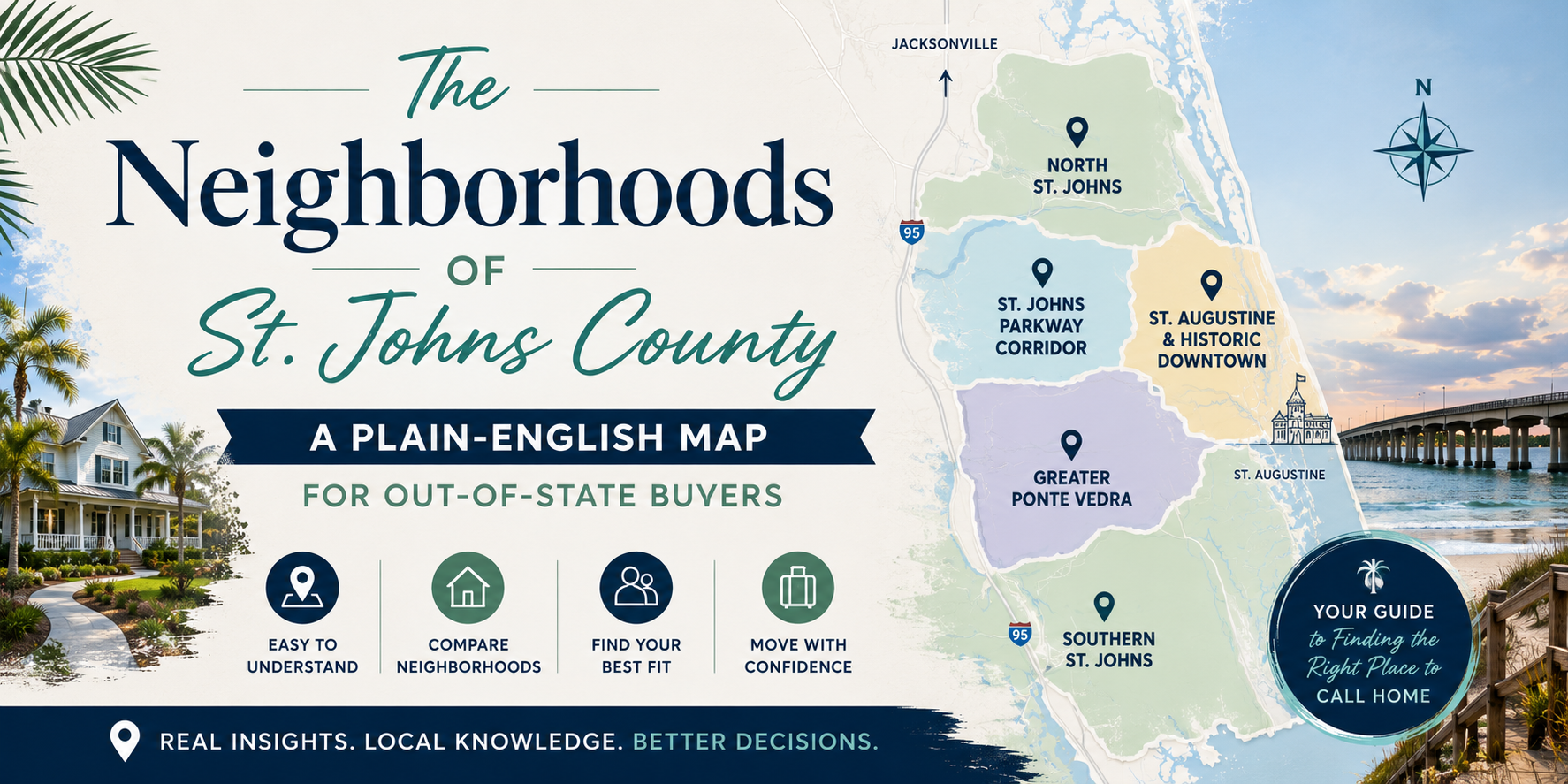
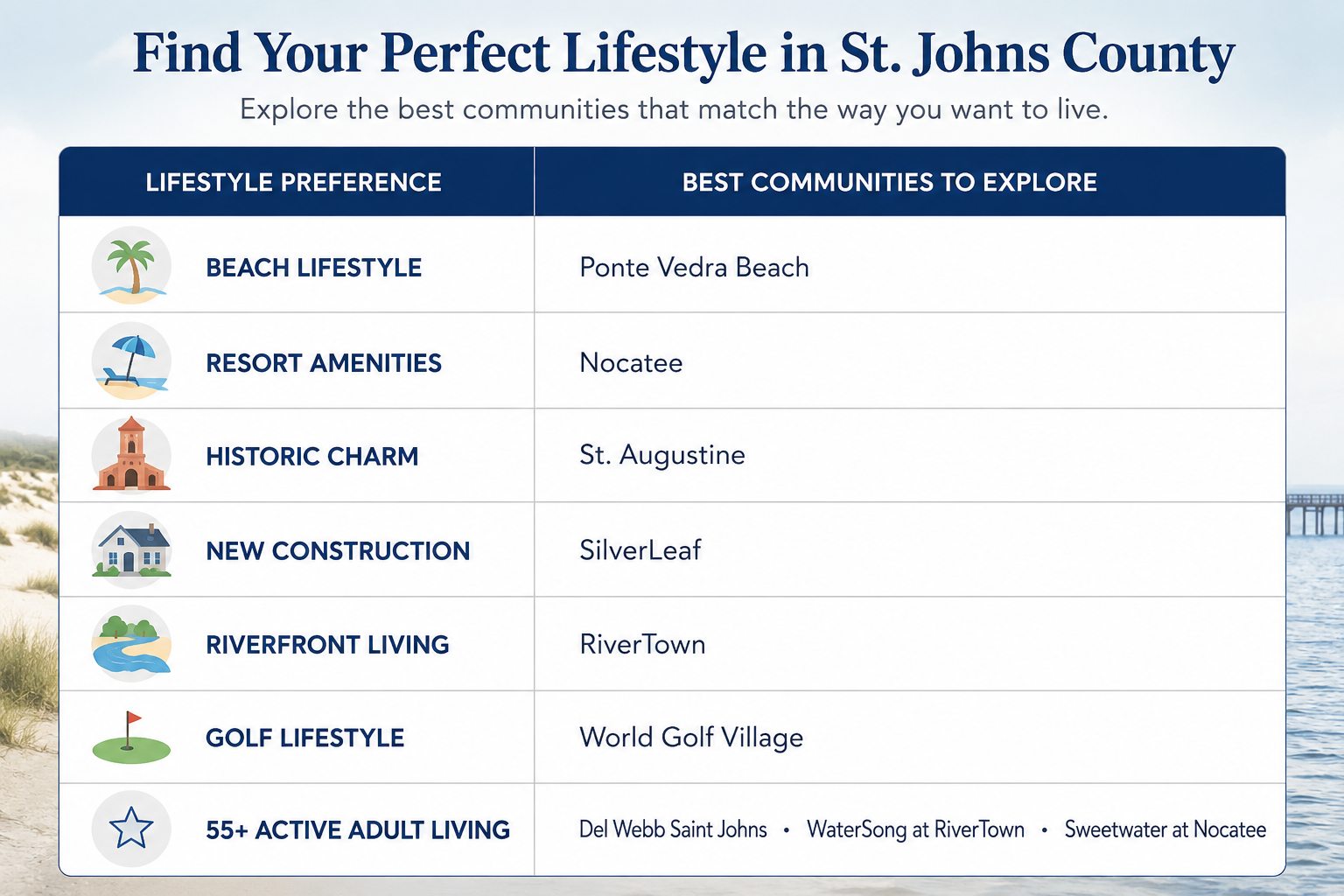
If you're moving to St. Johns County from New York, New Jersey, Pennsylvania, Connecticut, or another high-cost state, one of the first things you'll discover is that St. Johns County isn't just one market—it's several very different lifestyles.
The county is one of Florida's fastest-growing areas, known for highly rated schools, master-planned communities, beaches, golf, and a high quality of life. Population growth has nearly doubled since 2010 as families, retirees, and remote workers continue relocating here.
So where should you focus your search?
Here's a simple guide.
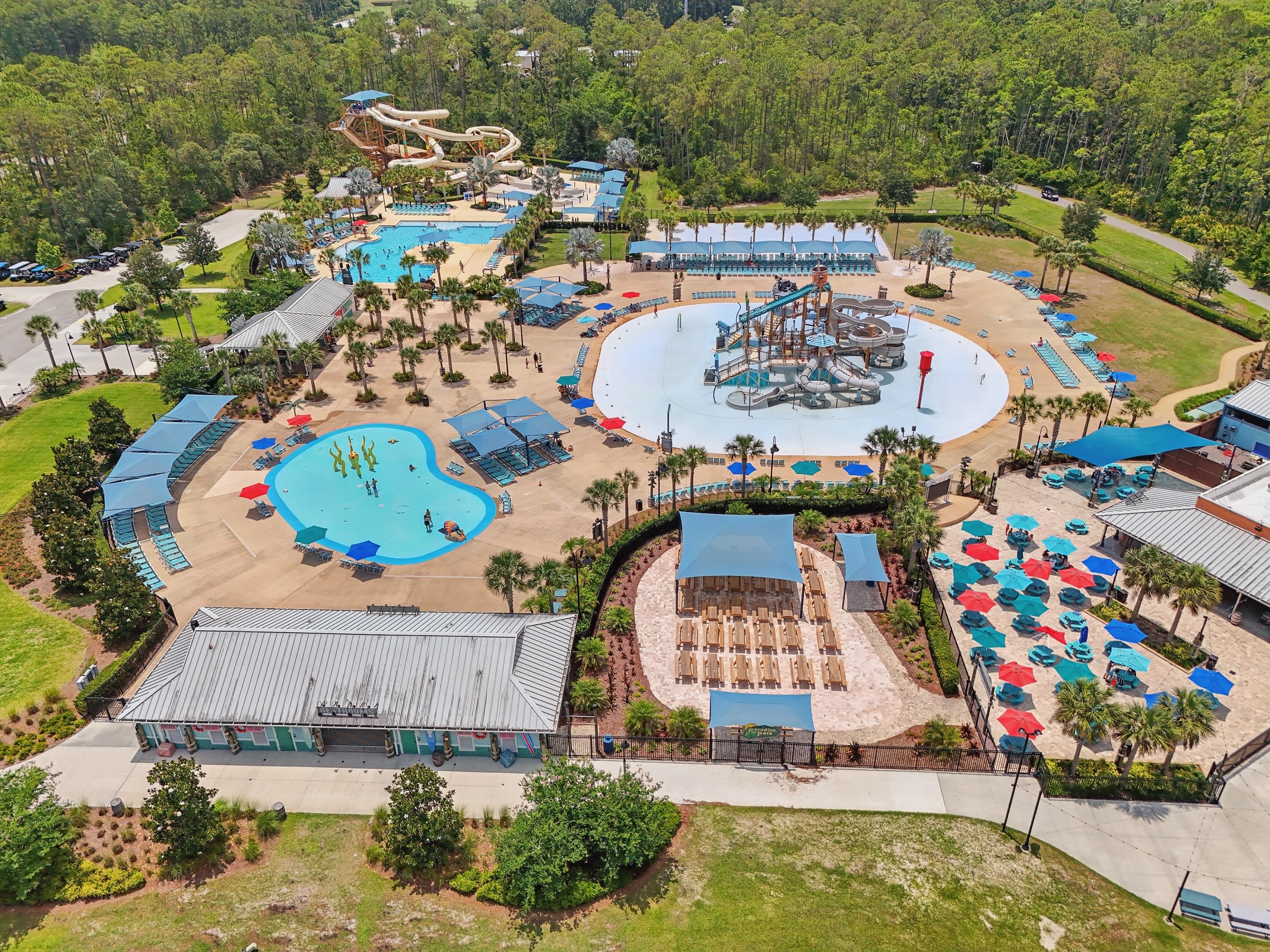
Nocatee: Resort-Style Living
Best for: Families, remote workers, active lifestyles
Nocatee is one of the nation's top-selling master-planned communities and is known for its water parks, golf-cart trails, community events, and highly rated schools. Residents enjoy access to shopping, dining, fitness centers, and miles of walking and biking paths.
Typical Home Prices
- $500,000 to $1M+
- Luxury homes can exceed $2M
You'll Love It If:
✔ You want a true community feel
✔ Amenities are important to you
✔ You want to be close to Ponte Vedra Beach
Ponte Vedra Beach: Coastal Luxury
Best for: Beach lovers, golfers, luxury buyers
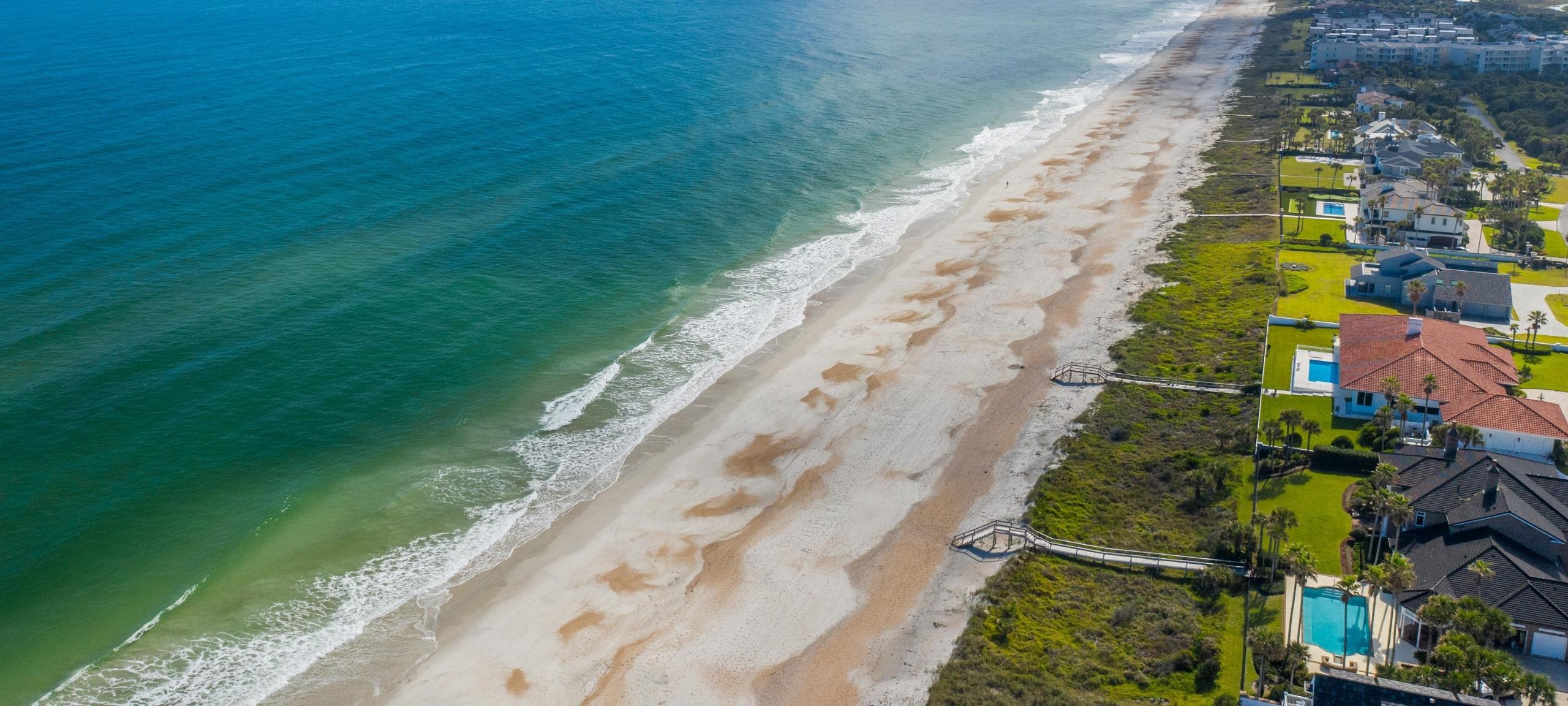
Ponte Vedra Beach is known for oceanfront living, golf communities, and a prestigious coastal lifestyle. It's home to championship golf, private clubs, and some of Northeast Florida's most desirable neighborhoods.
Typical Home Prices
- $700,000 to several million dollars
You'll Love It If:
✔ Beach access is a priority
✔ You want a prestigious address
✔ Golf and country club living appeal to you
St. Augustine: History Meets Coastal Living
Best for: Buyers seeking charm, culture, and coastal living
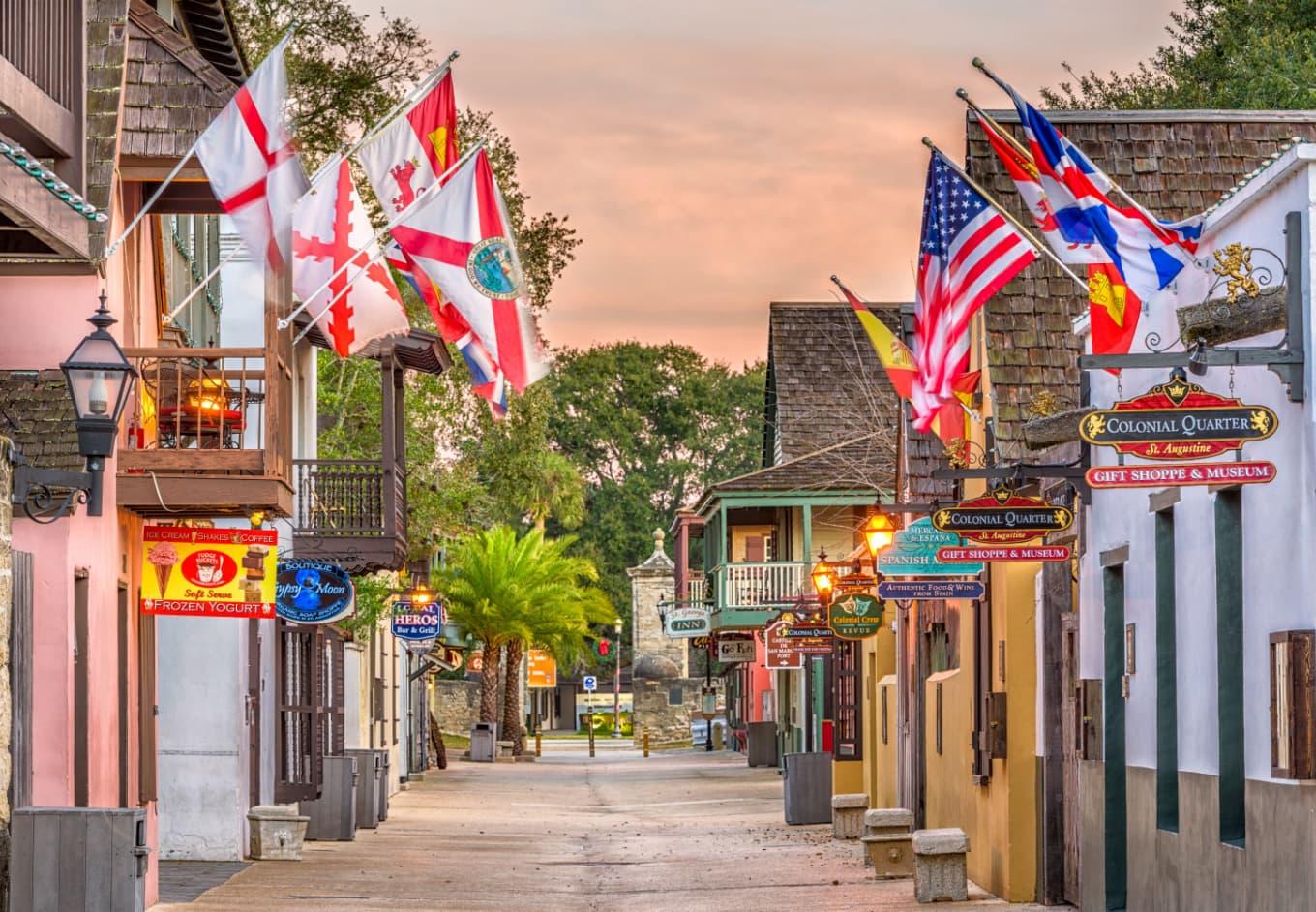
As America's oldest city, St. Augustine offers historic architecture, waterfront dining, beaches, and a unique small-town atmosphere. It continues attracting buyers looking for a balance of lifestyle and long-term growth.
Typical Home Prices
- $400,000 to $800,000+
- Historic and waterfront homes can be much higher
You'll Love It If:
✔ You enjoy walkable downtown areas
✔ You appreciate history and character
✔ You want easy beach access
SilverLeaf: The Fast-Growing Newcomer
Best for: New construction buyers and growing families
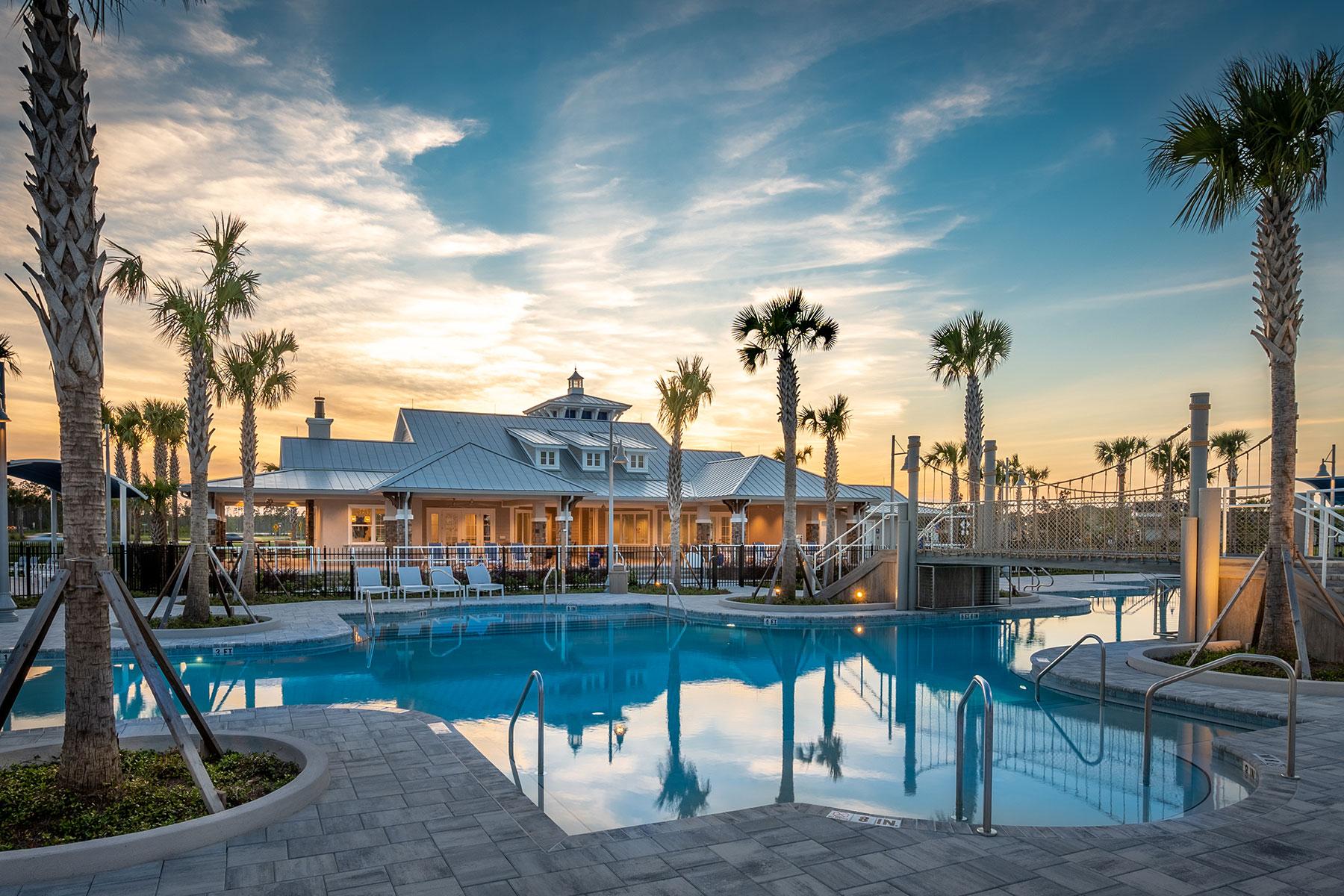
Located between Jacksonville and St. Augustine, SilverLeaf has quickly become one of the most popular new-home communities in Northeast Florida and has ranked among the nation's top-selling master-planned developments.
Typical Home Prices
You'll Love It If:
✔ You want a newer home
✔ Builder incentives are important
✔ You need convenient I-95 access
RiverTown: Nature and Riverfront Living
Best for: Families, outdoor enthusiasts, boaters
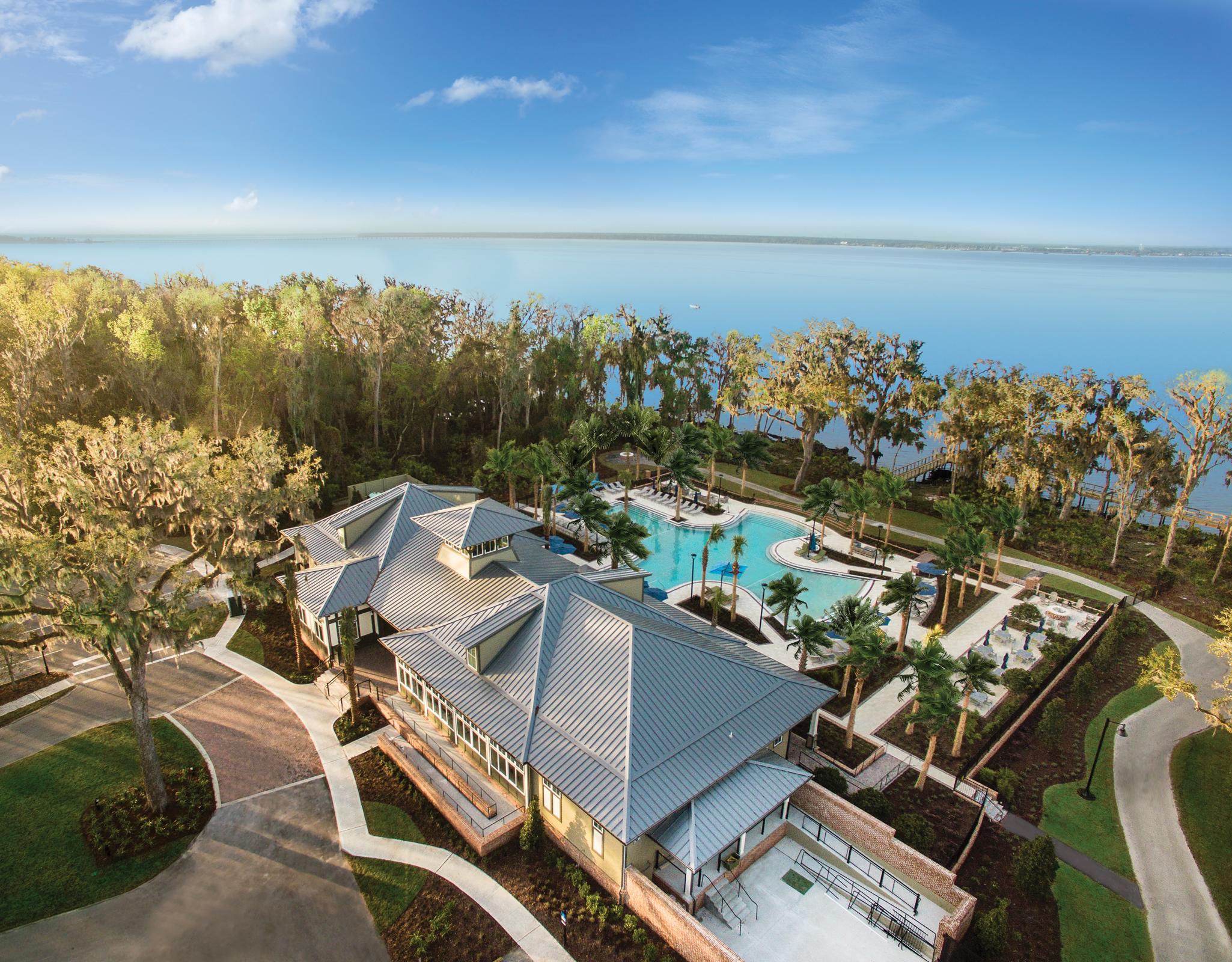
RiverTown sits along the St. Johns River and offers a blend of nature, trails, kayaking, resort-style amenities, and newer homes.
Typical Home Prices
You'll Love It If:
✔ You enjoy outdoor recreation
✔ River views appeal to you
✔ You want strong amenities without Nocatee pricing

World Golf Village
Best for: Golf enthusiasts and commuters
Located near I-95, World Golf Village offers established neighborhoods, golf access, and convenient commuting to Jacksonville and St. Augustine.
Typical Home Prices
You'll Love It If:
✔ You want central access to the county
✔ Golf is part of your lifestyle
✔ You prefer established communities
Quick Neighborhood Guide
The Bottom Line
The biggest mistake out-of-state buyers make is assuming all of St. Johns County feels the same.
It doesn't.
A home in Nocatee offers a very different lifestyle than a home in Ponte Vedra Beach, SilverLeaf, or historic St. Augustine.
The good news? There's truly something for almost every budget and lifestyle.
The key is matching the neighborhood to how you actually want to live.
Thinking about relocating to St. Johns County?
Call or text Gail DeMarco at 904-640-8000 for a personalized neighborhood tour and relocation consultation.
Serving Nocatee, Ponte Vedra Beach, SilverLeaf, RiverTown, World Golf Village, St. Augustine, and communities throughout St. Johns County, Florida.
July 6, 2026
If you're exploring 55+ communities in St. Johns County, you've probably narrowed your search to two of the area's most popular options: Del Webb Saint Johns and Sweetwater at Nocatee.
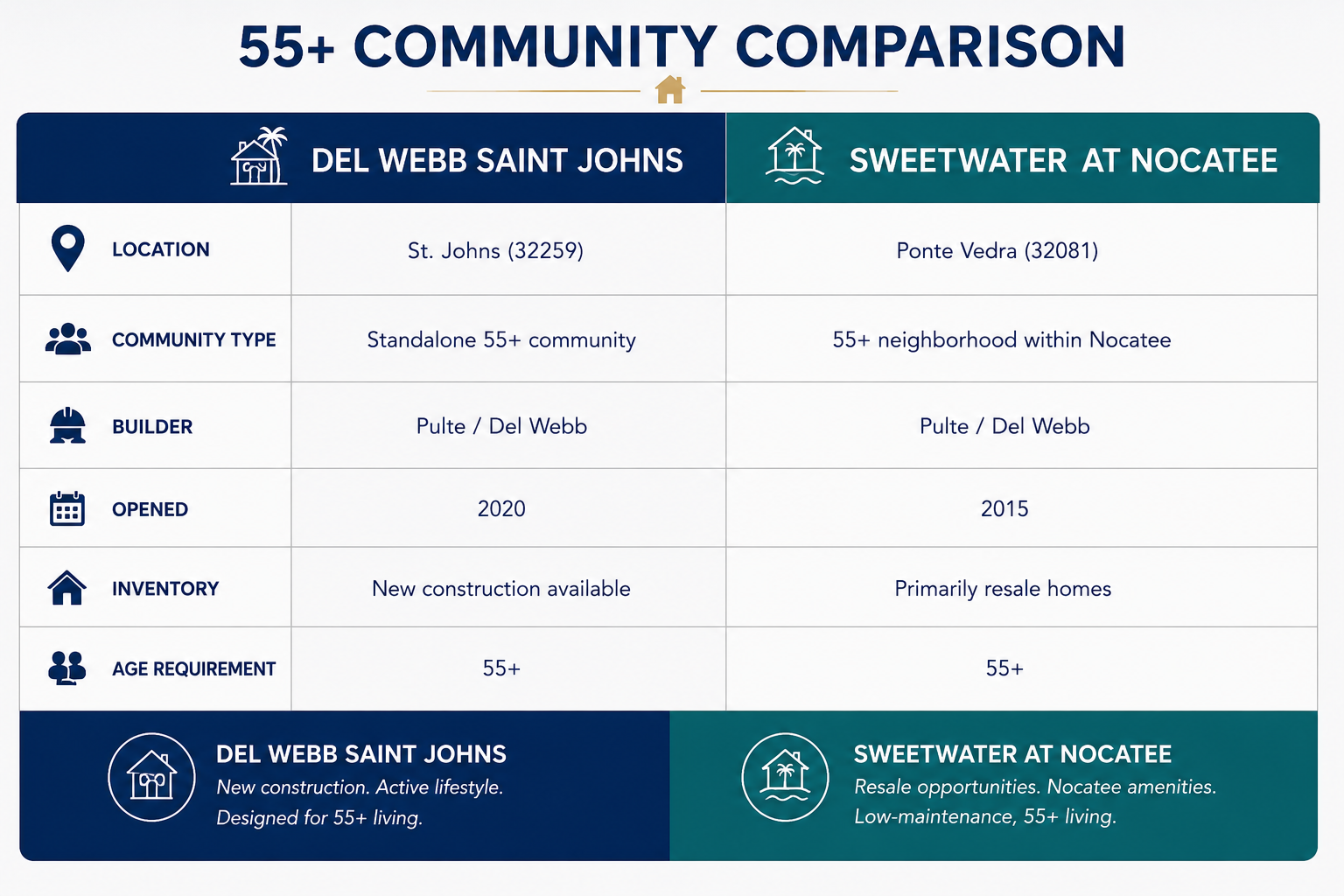
Both communities were built by Pulte, both offer active adult living, and both are located within highly desirable master-planned areas. But the lifestyles they offer are surprisingly different.
The biggest question is:
Do you want a dedicated 55+ community designed exclusively for active adults, or do you want to be part of a larger, multigenerational community with golf-cart access to shops, restaurants, and daily conveniences?
Let's break it down.
Location & Convenience
Del Webb Saint Johns
Located along the growing CR-210 corridor, Del Webb Saint Johns offers easy access to shopping, dining, and major roadways.
- St. Augustine: 20–25 minutes
- Ponte Vedra Beach: 20–25 minutes
- Jacksonville: 35–40 minutes
- Jacksonville Airport: 40–45 minutes
Most errands require a car.
Sweetwater at Nocatee
Sweetwater sits inside Nocatee, one of the nation's most successful master-planned communities.
- Ponte Vedra Beach: 10–15 minutes
- Jacksonville: 25–30 minutes
- Jacksonville Airport: 35–40 minutes
- Nocatee Town Center: Golf-cart accessible
- Atlantic Ocean: Approximately 20 minutes
Winner: Sweetwater
If proximity to the beach, shopping, dining, and golf-cart convenience matter most, Sweetwater has the edge.
Amenities
Del Webb Saint Johns
The centerpiece of the community is the Anastasia Club, a 13,500-square-foot amenity center exclusively for residents.
Features include:
- Resort-style outdoor pool
- Indoor heated lap pool
- Fitness center and movement studio
- Pickleball, tennis, and bocce courts
- Community garden
- Social clubs and events
- Full-time lifestyle director
Everything is designed specifically for active adults.
Sweetwater at Nocatee
Residents enjoy a private amenity center plus access to Nocatee's larger amenity network.
Features include:
- Private clubhouse and pool
- Fitness center
- Access to Nocatee Splash Water Park
- Nocatee Fitness & Wellness Center
- Over 15 miles of trails
- Golf-cart access to shops, restaurants, and services
Winner?
- Del Webb Saint Johns for dedicated 55+ amenities and programming.
- Sweetwater for overall variety and convenience.
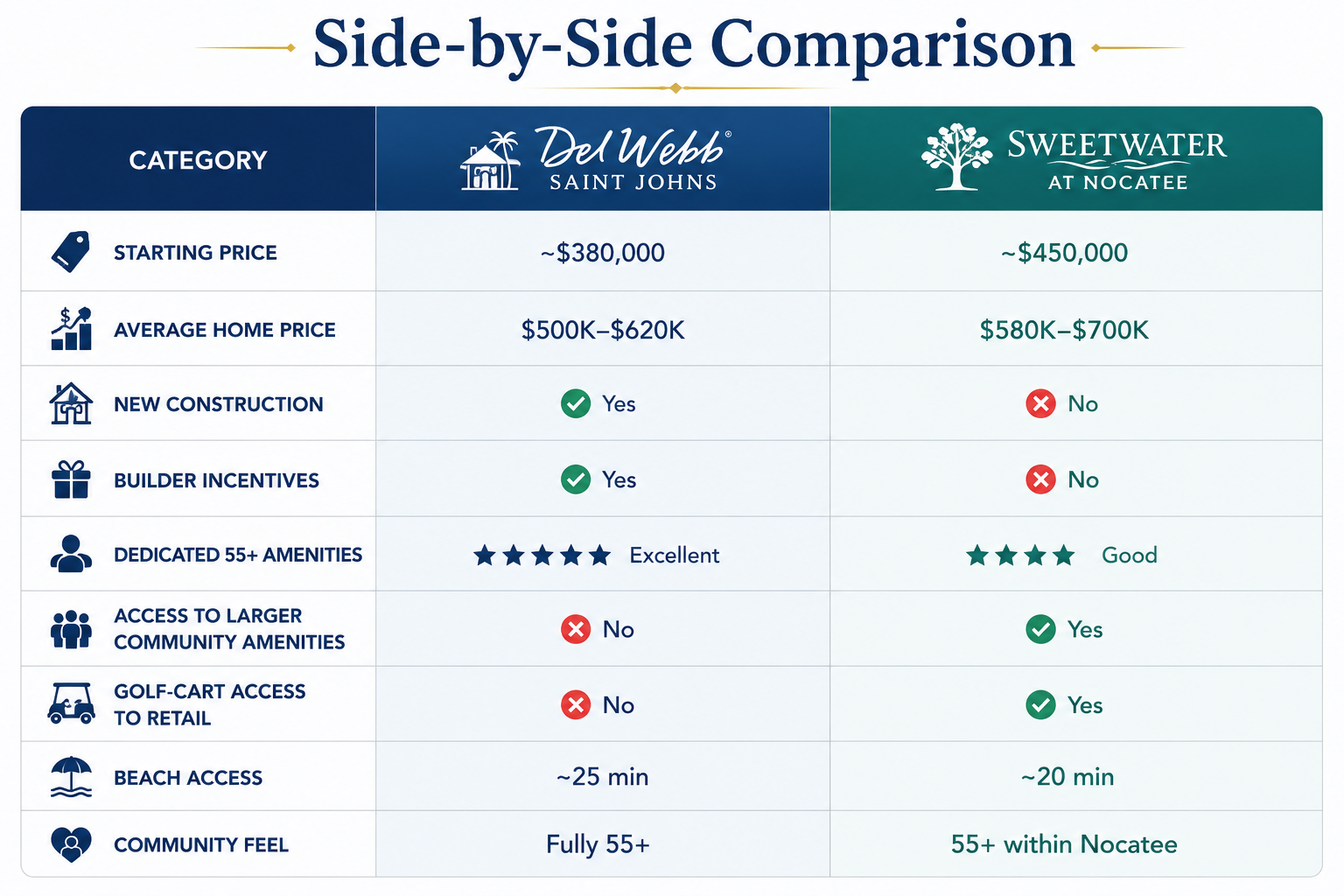
Home Prices & Fees (2026)
_Del_Webb_VS_Sweetwater.jpg)
Bottom Line
Del Webb Saint Johns generally costs $50,000–$100,000 less for a comparable home and offers builder incentives that are not available in Sweetwater's resale market.
Community Lifestyle
Del Webb Saint Johns
This is a true active-adult environment.
Everyone is 55+, activities are geared toward retirees, and the atmosphere is peaceful and community-focused. Residents often appreciate the quieter setting and strong social connections.
Sweetwater at Nocatee
While Sweetwater itself is 55+, it's surrounded by the larger Nocatee community.
That means you'll regularly interact with families, young professionals, and children while enjoying all the conveniences Nocatee offers. Many residents love the added energy and connection.
The Difference
- Del Webb Saint Johns: More private and age-focused.
- Sweetwater: More connected to a larger community lifestyle.
Which Community Is Right for You?
Choose Del Webb Saint Johns If:
✔ You want a fully dedicated 55+ environment
✔ New construction and builder incentives appeal to you
✔ You prefer a quieter, more age-focused lifestyle
✔ Getting the most value for your money is important
Choose Sweetwater at Nocatee If:
✔ Golf-cart living is a priority
✔ You want easy access to shops, restaurants, and events
✔ Living near Ponte Vedra Beach appeals to you
✔ You enjoy being part of a larger, vibrant community
Final Thoughts
Both Del Webb Saint Johns and Sweetwater at Nocatee are among the best 55+ communities in Northeast Florida.
The decision isn't about which community is better—it's about which lifestyle fits you best.
Del Webb Saint Johns offers a more private, purpose-built active-adult experience with lower entry prices and new homes.
Sweetwater at Nocatee offers unmatched convenience, golf-cart living, and access to one of Florida's premier master-planned communities.
The best advice? Visit both communities, explore the amenity centers, and spend a little time imagining your daily routine. In most cases, the right choice becomes clear very quickly.
Call or text Gail DeMarco: 904-640-8000
St. Johns County 55+ Community Specialist
Serving Del Webb Saint Johns, Sweetwater at Nocatee, WaterSong RiverTown, Regency at Evermore, and all of St. Johns County, FL
All prices, fees, and figures are approximate 2026 estimates subject to change. Verify current pricing with the builder or listing agent and CDD/HOA management before making any purchase decision.